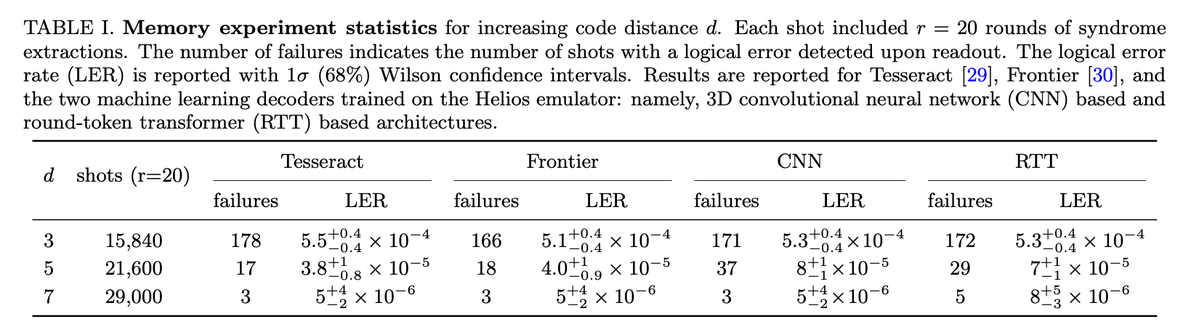
Certainly the most surprising result in my career so far: a new qLDPC decoder that I thought had no chance to work!
We call it the Frontier decoder, joint work with Rüdiger Urbanke (1/4)
AI is an apocalypse in the sense that it reveals all. Or it reveals much.
We have mathematicians arguing that solving the problems that they themselves identified as the goals (in their funding applications and talks) never mattered.
We have the finest literary people in France who were collectively fooled by a novel written by AI. None of them would ever accept AI authorship.
We have been told for decades that without copyright, there could be no progress... and all of a sudden, we have these machines producing copyright-free content, often breaking new ground.
We have entire institutions that were supposed to be focused on innovation... that cannot adapt meaningfully to a world with AI.
We are left wondering. What is actual progress and what is mere signalling. How people react to AI tells us much.
Effective Immediately, all organizations using PHP for their systems are advised to be prepared for an update addressing two critical vulnerabilities. PHP is widely used for web applications. These vulnerabilities often provide a direct path to the server's file system or database. If an immediate update is not feasible, it is recommend that organizations take the system offline until it can be fully mitigated. NSA will follow up shortly with more specific guidance.
Interesting development for quantum supremacy:
this paper gives a polynomial classical algorithm for the original boson sampling proposal of Aaronson-Arkhipov for any constant-fraction loss, ie any implementation without fault tolerance (1/2)
https://t.co/R69XStg5KX
1) This is remarkable.
2) If mathematicians can find such simplified proofs (with the help of AI) so soon after the first proof was published, I don't see why future AI couldn't do that on its own in the near future.
Congrats to quantinuum on seeing color code lifetime improve 12x going from d=3 to d=5 and ~12x again from d=5 to d=7: https://t.co/KMvWHjdI50
Notes:
- This suggests practical error rates reached at d≈21; need more qubits
- The 20ms cycle time is brutally slow; need more speed
Mathematician Terence Tao:
"one thing this whole era of AI is teaching us is that our idea of intelligence is not really accurate"
The history of AI has been: 'here’s a task only humans can do', and then one by one, an algorithm does it too
Maybe we're not quite as smart as we think
It may surprise those outside number theory to learn that, for decades, people had written several papers that assumed a Siegel zero exists:
Famously, in 1982 Heath-Brown proved the twin prime conjecture in this hypothetical world.
Now in light of the Siegel zero disproof, a collection of the literature has now become something of a historical curiosity.
https://t.co/HSSpR3pSOs
TERENCE TAO:
“OpenAI did make a major breakthrough [on quasi-Riemann Hypothesis] the biggest advance on the subject in 50 years. A massive new zero-free region, very clever new technique.
Well, it’s sort of a combination of three or four existing ideas, arranged in a very unusual way. It’s not something I think any single mathematician alive would have come up with.
I think if you got the right people to work together and locked them in a room, they might have come up with this after lots of trial and error.”
On 6 October, James Maynard was nervously checking his phone under the table throughout dinner. He’d heard rumors of a tsunami heading for the shores of math. When he checked in one last time from bed, the swell struck: OpenAI had released more than 700 math papers, generated with an advanced version of its AI model. They appeared to topple hundreds of long-standing problems, forcing researchers to face the reality that no problem in math is off-limits for machines.
At first, Maynard, a mathematician at the University of Oxford and recipient of the Fields Medal, math’s most prestigious prize, feared for colleagues whose work would be upended. But then he spotted a paper that offered progress on one of his favorite pastimes: the Riemann hypothesis, a puzzle about prime numbers and one of seven famed Millennium Prize Problems, often considered the most formidable in all of math. “I was like a kid at Christmas,” Maynard says. “Even if it was some scary monster giving me a gift, I was just so excited.”
The release comes less than 1 month after OpenAI announced a solution to the Navier-Stokes equations, another Millennium Prize Problem. OpenAI’s latest proof solves only a weaker version of the Riemann hypothesis. But Maynard, who made the most recent notable Riemann advance in 2024, says it is “groundbreaking” and likely to have payoffs for other problems across math. “Within analytic number theory, it’s obviously the best headline result for the past 100 years in the field.”
Learn more: https://t.co/zq4l1m4of5