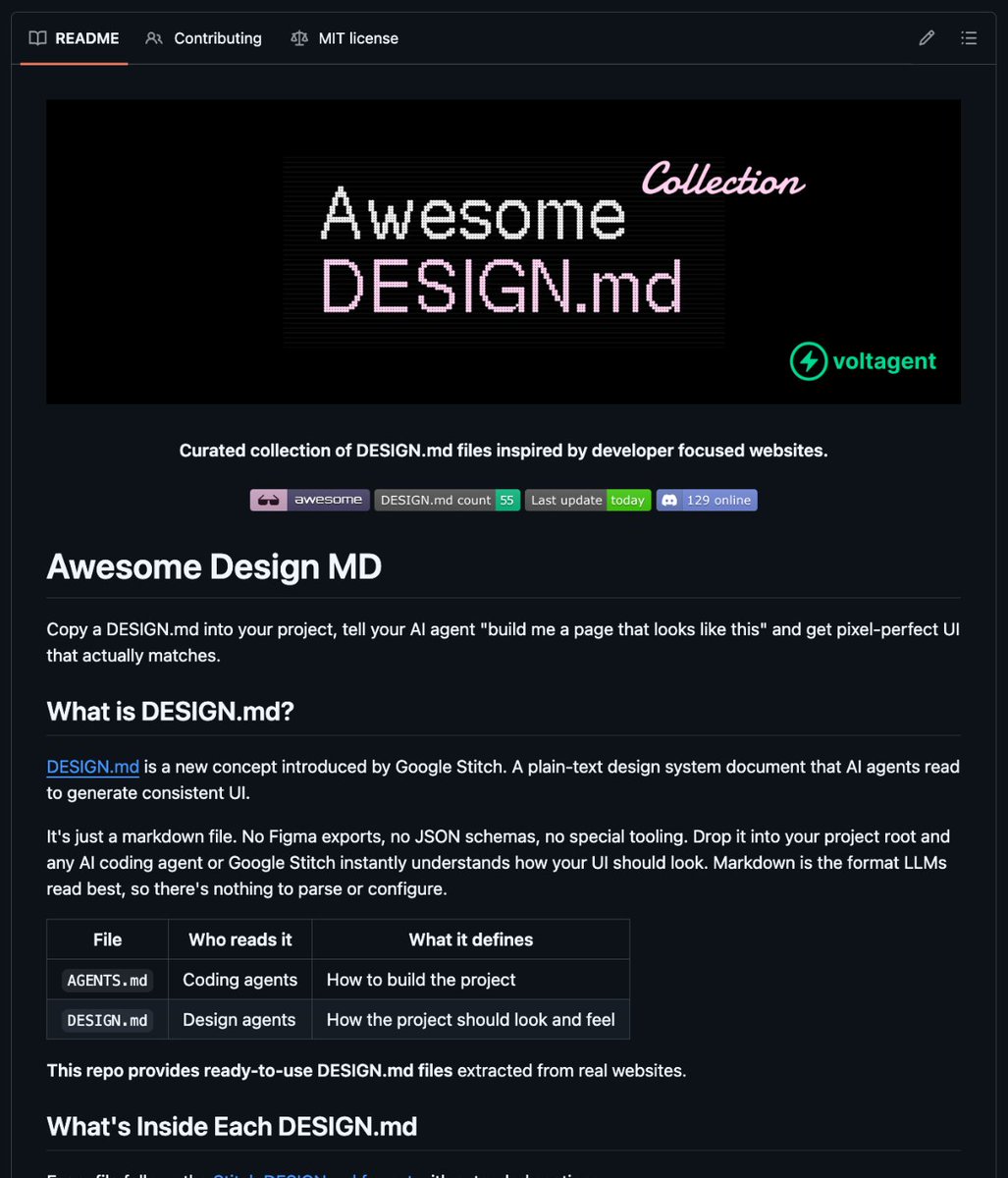
Google Stitch introduced a new concept: DESIGN . md
Like README . md but for design systems. A plain markdown file that LLMs read to generate consistent UI.
An awesome collection of DESIGN . md files inspired by developer-focused websites like Stripe, Vercel, Linear, Notion, Figma and more.
Drop one into your project. Your AI coding agent builds the rest.
🚨 The "Figma for AI agents" just dropped.
It's called awesome-design-md and it's a curated collection of DESIGN .md files extracted from 31 real websites that coding agents can actually read.
No Figma exports. No JSON schemas. No special tooling.
Just drop a single markdown file into your project root and tell your agent "build me a page that looks like this."
Covers 31 design systems across every major category:
→ Claude, Vercel, Supabase, Linear, Stripe, Notion, Figma, Apple, NVIDIA, and more
→ Each file captures color palette, typography rules, component styling, layout principles, shadow system, responsive behavior, and anti-patterns
→ Includes preview.html and preview-dark.html so you can see the design before using it
→ Follows the Google Stitch DESIGN .md format the same spec LLMs read best
The wildest part? It even ships with an Agent Prompt Guide inside every file copy-paste prompts ready to feed directly to your coding agent.
Think of it like AGENTS .md for how your project should build, and DESIGN .md for how it should look. Two files, zero ambiguity, pixel-perfect output.
100% Opensource. MIT License.
Link in the first comment 👇
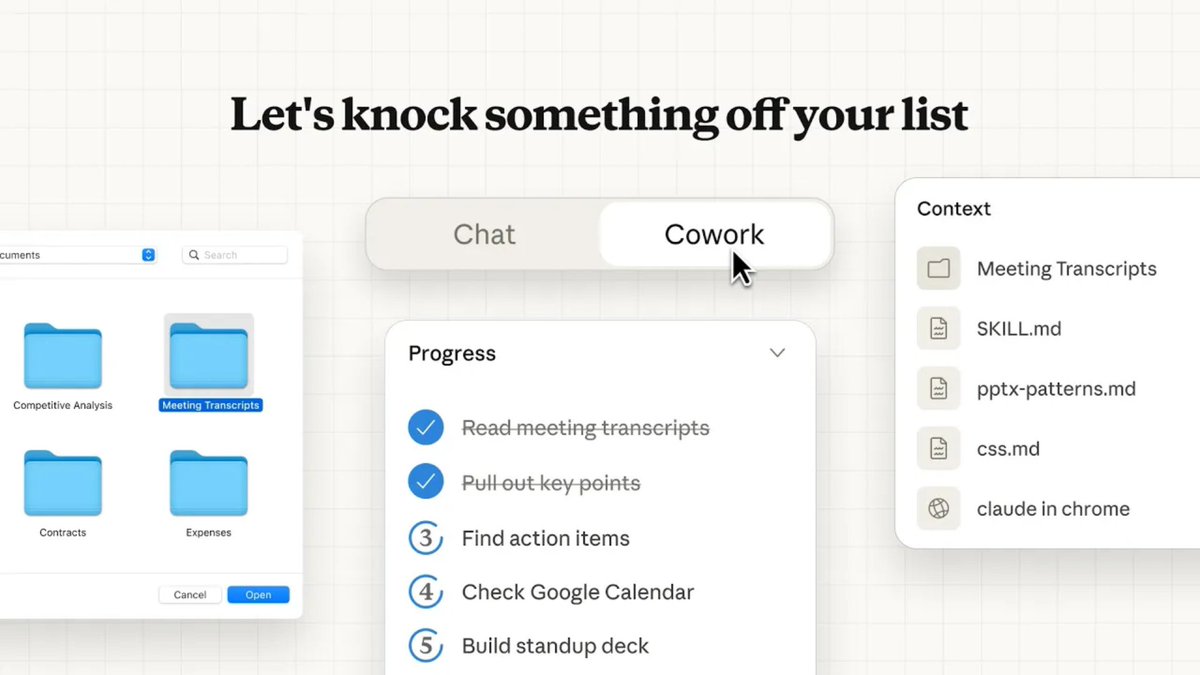
🚨 BREAKING: Someone just leaked their full Claude Cowork setup and it compresses an entire workday into 90 seconds.
I scraped every power user workflow across X, Reddit, and private Slack groups to find out how.
99% of people are using it completely wrong.
Here's what the top 1% actually do 👇
Sleep debt: 8h 20m and rising. Hours whispering 'just one more prompt' to Claude Code at 2am: uncountable. Can't write code. Or couldn't, until a week ago. Send help.
This 𝗖𝗟𝗔𝗨𝗗𝗘.𝗺𝗱 file will make you 10x engineer 👇
It combines all the best practices shared by Claude Code creator:
Boris Cherny (creator of Claude Code at Anthropic) shared on X internal best practices and workflows he and his team actually use with Claude Code daily. Someone turned those threads into a structured 𝗖𝗟𝗔𝗨𝗗𝗘.𝗺𝗱 you can drop into any project.
It includes:
• Workflow orchestration
• Subagent strategy
• Self-improvement loop
• Verification before done
• Autonomous bug fixing
• Core principles
This is a compounding system. Every correction you make gets captured as a rule. Over time, Claude's mistake rate drops because it learns from your feedback.
If you build with AI daily, this will save you a lot of time.
Marc Andreessen: AI coding doesn’t eliminate programmers — it redefines them. The job is no longer typing code line by line, it’s orchestrating 10 coding bots in parallel, arguing with them, debugging their output, changing the spec, and pushing them toward the right result. But here’s the catch: if you don’t understand how to write code yourself, you can’t evaluate what the AI gives you.
The next layer of programming isn’t writing scripts — it’s supervising AI that writes them. Today’s best programmers spend their day jumping between terminals, managing multiple coding bots, fixing mistakes, and refining instructions. The irony? You still need deep fundamentals, because without them, you won’t know when the AI is wrong.
The job of the programmer has changed. Now it’s about arguing with coding bots, debugging AI-generated code, and understanding why something doesn’t work or isn’t fast enough. AI abstracts the work — but only people who truly understand code can tell if the abstraction is doing the right thing.
Programmers aren’t going away — they’re becoming 10x, 100x, even 1,000x more productive. Tasks are changing, the job is changing, but humans are still overseeing the process, evaluating results, fixing errors, and making judgment calls. AI changes how we code, not who is responsible.
The future programmer isn’t replaced by AI — they’re upgraded by it. You still need to learn how to write and understand code, because when the AI gets it wrong, humans are the ones who have to know why. That up-leveling of capability is the real revolution.