Saw this on FB: 🔥 🔥
On day 1 of my high school history class, our teacher got up and said:
“You are 15 or 16 years old. 200 years ago, people your age were married, planted crops, had children and built a cabin before winter.
You can do your homework. The bar is set embarrassingly low. You are not dealing with regional famine or plague. You do not have to save your family from marauders or go into battle to destroy your enemies.
You just have to sit down and learn from someone who cares about you in a safe air-conditioned room.
You have no excuses.”
This is the kind of teachers we need.
Good people have high levels of empathy, but once that empathy is exhausted, they switch to a state of objective observation. They see you for exactly who you are, without the filter of their love. This is why their anger feels so cold, it is the absence of the warmth you took for granted
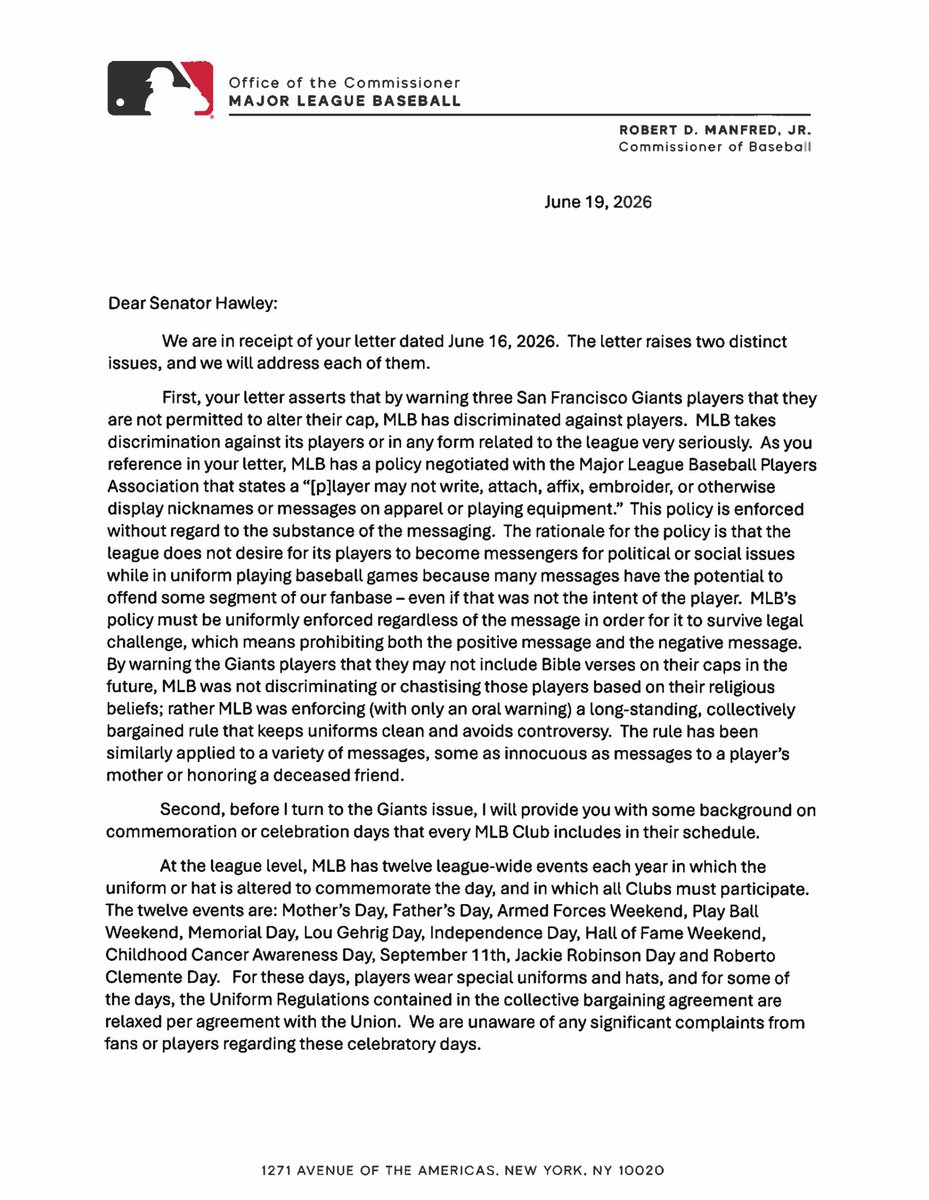
.@MLB Commissioner writes to me and admits they were wrong to threaten the Giants players over Bible verses and promises never to fine or discipline these players - or any players for their religious beliefs
Big Balls reflects on lessons from working with Elon Musk.
"You've gotta do what you think is right. That's the biggest thing about Elon."
"I think if I was to distill the Elon mindset into one thing, it would be truthmaxxing."
The great lie is that society is divided between rich and poor.
The great truth, as David Friedberg puts it, is makers vs takers.
Makers build, create, and deliver real value: houses, software, art, businesses, and everything that moves civilization forward.
Takers watch, criticize, analyze, and politic. They push the lie that the rich hoard unfairly so the poor must seize it… all while positioning themselves to rule the chaos.
As @friedberg tells his kids: “At the end of the day, if you made something and someone else valued it, you were a maker. That was an amazing achievement. That is a great day.”
Takers thrive on division. Makers drive progress.
Time to choose your side.
To me, Independence Hall in Philadelphia, Pennsylvania, is something of a sacred place.
Historically and spiritually, the adoption of the Declaration of Independence and the establishment of the Constitution of the United States led the way for religious liberty as the first freedom granted by the First Amendment.
How grateful we are to celebrate what the Lord has done through wise men and women to bring about the privileges many now enjoy throughout the world.
Bret Weinstein cuts straight to the chase:
"We are going to have an endless battle in which those of us who see what we believe is clear evidence of some kind of election rigging or fraud are faced with indignation from a vast array of people portraying themselves as more rigorous and careful who say, 'Where is your evidence? Where exactly is your evidence that there was something wrong with this election?' And we are gonna be caught in the following predicament.
No piece of evidence is sufficient to establish that case. And the sum total of all of the evidence contains true things and false things. So it is also no good.
So the question is, can you logically deduce that something has gone wrong? I believe you can easily.
Can you prove it? No.
And not being able to prove it means that the election will proceed. It will be validated by all of the structures, including the courts. And that means that those who take on the power that derives from these elections will be the result of whatever process we just went through, whether it was an election that happened to be anomalous through organic means, or it was the result of some kind of fraud or election rigging. That is not an accident.
That is not an accident.
And the point that I wanna make primarily is the primary evidence against elections that look like this being organic is not actually in the trickle of evidence that we are actually able to see, the moment by moment vote count that does something strange during the night when some large tranche of ballots is suddenly counted or something like that.
The evidence is in the structure of how the elections are actually carried out. These elections are designed to allow fraud that cannot be detected and will not be prosecuted. And that's really the thing that we must focus on."
@BretWeinstein
🚨 BOOM! Dr. King DROPS THE MIC on abortionists 🫳🏻🎤
REP. BRANDON GILL: Dr. King, are pro-lifers white supremacists?
DR. ALVEDA KING: Pro-lifers cannot be white supremacists...white supremacists are PLANNED PARENTHOOD who ADMITTED they do have racist underpinnings with an agenda to reduce the black population by abortion. We have been aborted as blacks in America disproportionately.
"Pro-lifers believe in life from the womb to the tomb and beyond. Pro-lifers fight for every baby in the womb, regardless of skin color."
👏🏻👏🏻👏🏻
"You aren't a Christian if you don't accept the Trinity."
The history of that statement is quite shocking, and almost nobody who says it knows that acceptance of the doctrine of the Trinity was once enforced by exile, fire, and death.
Here is what happened.
For the first 300 years after Jesus, Christians did not agree on how He related to God the Father. They argued about it constantly. There was no official rule. That was just normal.
Then a priest named Arius said the Son came from the Father and was beneath Him. Not equal. Not eternal. A lot of Christians agreed with him. A lot. This was not some fringe group. For stretches of the next century, his side was winning.
Other Christians said the opposite. The Son was fully God, equal to the Father, no beginning. Two camps, same Bible, opposite conclusions.
The fighting got bad. Riots. Mobs in the streets. Christians brawling over the nature of God.
So the Roman emperor stepped in. Constantine. He had just won a civil war and he wanted his empire to stop fighting. He was not even baptized. He did not care about the theology. He cared about order.
In the year 325 he called the bishops to a town called Nicaea. He paid for it. He ran the meeting himself. And they voted. They ruled that the Son was equal to the Father, fully God, one substance with Him. That ruling is the core of the Trinity. It got settled in that room, by that vote, on one word that is not even in the Bible.
They wrote the ruling into an official statement of belief. A creed. Every bishop was expected to sign it.
That is the part people think is the story. It isn't. The shocking part is how they made everyone accept it.
Constantine made the bishops sign the creed. The few who refused, he banished.
Then he ordered every book Arius ever wrote to be burned.
Then he made a law. If you were caught hiding one of those books, you were put to death.
Even after all of that, the Trinity did not win for good.
A few years later Constantine changed his mind. He brought Arius back. And he exiled Athanasius, the bishop who had won the argument at Nicaea. That man got banished five separate times in his life for believing the thing the church now says you have to believe.
For the next fifty years it flipped back and forth. One emperor said Trinity. The next said no. Whoever sat on the throne decided what was true. The official belief about God changed every time power changed hands.
It finally got locked in by another emperor named Theodosius. He made the Trinity the law of the empire. Disagree, and you were a heretic. Not in some spiritual sense. By law. Backed by soldiers.
A few years after that, the empire executed a bishop for his beliefs. The first time the state put a Christian to death over doctrine. It would not be the last.
Then came the document that says it out loud. A creed written around the year 500. Almost five centuries after Jesus. They named it after Athanasius, that same bishop. He did not even write it. They put his name on it for the authority.
It opens by declaring that anyone who does not hold the Trinity, whole and complete, will perish forever. Believe it or be damned. Put in writing, and made the test of who gets saved.
So that is where the line comes from. Not from Jesus. Not from the apostles. From emperors and councils who needed a divided empire to fall in line.
The Trinity did not become the rule because the argument was settled. It became the rule because the side that held it had the throne, the law, and the sword.
The next time someone says you aren't a Christian unless you accept the Trinity, remember what it took to make that rule stick. Exile. Fire. And death.
I agree with this statement, and am grateful to @SecWar Hegseth for correcting the error:
“The Pentagon’s job is not to adjudicate theological debates, but instead to ensure sincerely-held faith is respected and encouraged in our ranks.”
The problem with your argument is that you simply assume the very thing you're trying to prove.
You define "Christian" as "someone who accepts the Nicene Creed, post-apostolic tradition, and your particular understanding of the Trinity." Then you point out that Latter-day Saints don't accept those things and conclude they aren't Christian.
That's not an argument. That's circular reasoning.
The apostles never recited the Nicene Creed. Peter never taught *homoousios*. Paul never told converts they had to affirm fourth-century metaphysical definitions before they could be called Christians.
What did they preach? Faith in Jesus Christ as the divine Son of God, His atoning death, His resurrection, repentance, baptism, and discipleship.
Latter-day Saints affirm every one of those things.
You say Christianity is the faith of the "One Holy, Catholic, and Apostolic Church." Fine. Now demonstrate from Scripture that this institution could never fall into apostasy, corruption, doctrinal confusion, or loss of authority. Because the New Testament repeatedly warns about exactly those dangers.
You appeal to tradition. Latter-day Saints appeal to prophets and revelation. The real question is whether God still speaks. If He does, your argument collapses.
You say LDS theology teaches a "different God." Yet the New Testament consistently depicts the Father and Son as distinct persons. Jesus prays to the Father. The Father speaks to the Son. Stephen sees Jesus standing at the right hand of God. The text says what it says.
What's actually happening here is that you've elevated later creedal interpretations above the plain biblical text and then declared anyone who disagrees "not Christian."
And let's be honest: if acceptance of fourth-century councils is what makes someone Christian, then Christianity isn't being defined by Christ and His apostles. It's being defined by bishops centuries later.
Latter-day Saints worship Jesus Christ as Lord and Savior. We pray in His name. We trust in His atonement. We follow His teachings. We covenant to take His name upon us.
You are free to argue that our theology is wrong.
What you are not free to do is redefine Christianity so narrowly that devotion to Jesus Christ suddenly becomes irrelevant while allegiance to post-biblical creeds becomes the determining factor.