In September 1990, my village in Valencia hit 46°C.
It was the exact kind of natural climate volatility this ancient planet has unleashed for billions of years.
Today, Valencia, Rome, and Athens are actually sitting well below their seasonal averages. Yet, the media is in a coordinated meltdown over a standard two-week warm patch in the UK, France, and Belgium.
As a geospatial engineer who wrote a thesis on climatology, I’m positioned better than many to talk about the topic, the entire narrative relies on a broken view of data systems.
The formula is simple: zoom in on a tiny slice of geography, filter out the cool regions that ruin the story, and label a hot afternoon a global catastrophe.
The funniest part is the sheer hubris of the solution.
We are told the Earth's massive climate system operates like a living room thermostat, that if humans just stop CO2 emissions, we can magically freeze the weather at our preferred temperature.
Pretending we can micromanage global macro-cycles with carbon taxes.
But as long as panic funds the machine, and people don’t think by themselves, they’ll keep selling the front-row tickets.
Are the Met Office using their modern automated sensors at this site?
These updated systems respond faster than the older thermometers, in order to register short term temperature spikes. Their older and slower counterparts missed these short term values in the past, and supplied lower readings because of it.
What the MO should have done, in order to make accurate comparisons in the past, is to have run both systems together.
It’s become apparent from independent investigations the automated readings are capturing data that wasn’t available in the past.
As of now it’s like comparing apples to pears.
Why is it hot in Europe this week?
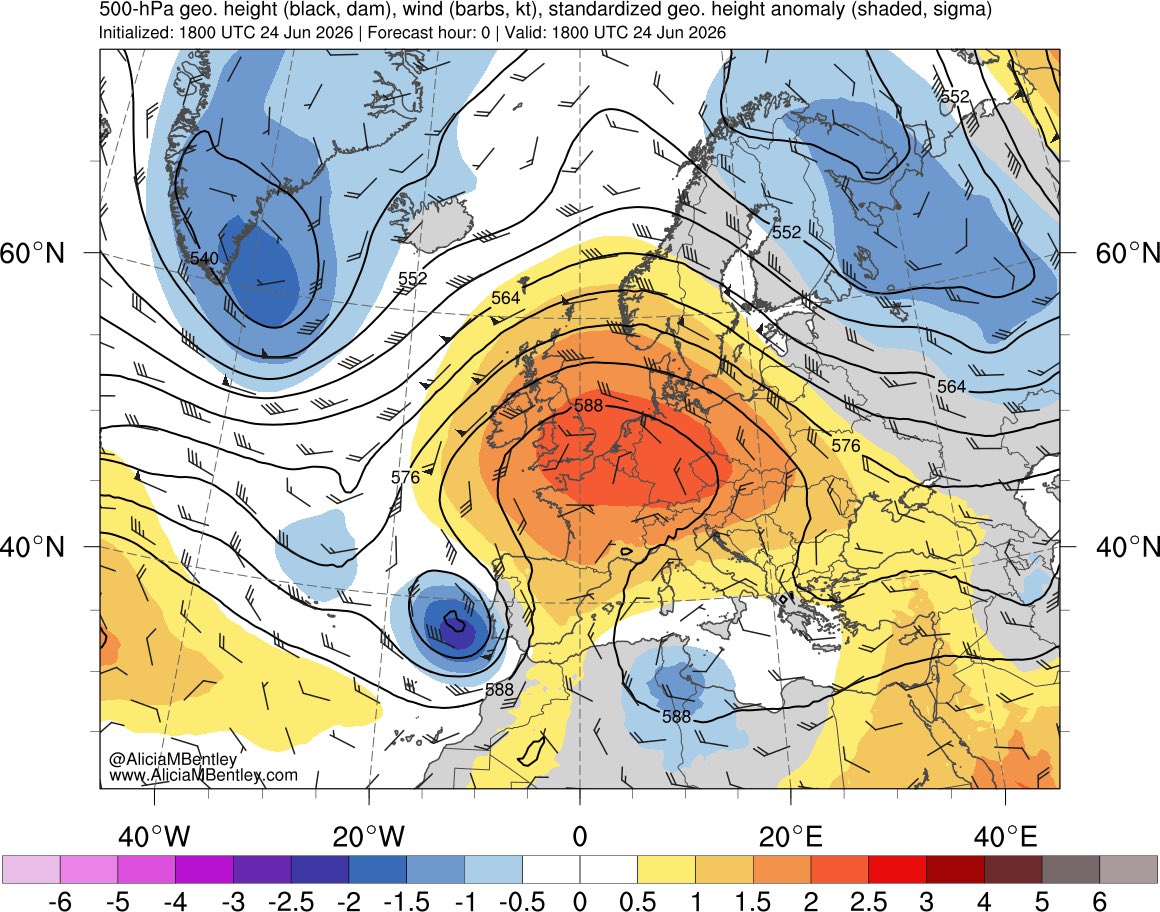
Well, it has to do with the “omega block” in the jet stream. Omega blocks get their name because they resemble the Greek uppercase letter omega, Ω.
You can see that in the synoptic setup. The map below on the left shows the 500 mb geopotential height anomaly at 18z. The contour lines resemble the Ω shape due to an enormous high-pressure ridge in the mid-troposphere that is sandwiched between two low-pressure systems to its east and west.
Hot Saharan air has been advected—that is, horizontally transported—northward into western Europe due to anticyclonic (clockwise) airflow, and as that air mass moves north, it is compressed adiabatically beneath the ridge where air is sinking.
This process is natural and has nothing whatsoever to do with climate change or greenhouse gas emissions. In fact, there are quite a few studies suggesting that reduced latitudinal baroclinicity (north-to-south temperature gradient) caused by Arctic amplification could reduce the frequency of mid- and high-latitude blocking events (e.g., Hassanzadeh et al., 2014; Woollings et al., 2018).
🔗 https://t.co/NGsFsRKpEt
🔗 https://t.co/M7h3vg232H
There is, however, debate about this.
Europe has seen an unusual amount of these extreme heat events since 2019, but most other areas of the globe have not. The notable exception was the June–July 2021 Pacific Northwest heatwave in North America, but even that wasn’t as rare as previously thought.
🔗 https://t.co/rNRFfJohs4
The most likely explanation for this boils down to a combination of two things:
1️⃣ Undiagnosed changes in atmospheric circulation patterns.
2️⃣ Increased absorbed solar radiation at the surface due to reduced stratiform low- and mid-level cloud cover (increased sunniness), some of which is likely due to reduced atmospheric aerosol concentrations from the EU’s strict pollution regulations.
The overall increase in the “global mean temperature” (which mostly affects overnight lows) has very little to do with this event. Even in a “pre-industrialized” climate, a record-breaking heatwave would still be happening. Heck, the “global mean temperature” fell today despite the heat cranking up in Europe.
This is mostly weather systems moving around. When you have a chaotic system with two turbulent fluids interacting with each other (the atmosphere and ocean), wild things can happen.
Get your weather information from real meteorologists, not sensationalistic clickbait news outlets like BBC News or the Daily Mail.
@anygirlfriday It was hotter in the 1976 heatwave I lived through it tarmac was melting on the roads no summer has ever come close in my sixty years on this earth you spud buy the way they measured temp using mercury not platinum nowadays