One of our best case studies is a partner our CEO tried to turn away when he first approached us.
@joshlinkner is one of the most inspiring people you'll hear speak. But when he came to us and asked about what we could do for him in AI search, we were a bit hesitant.
We usually work with larger enterprises where our price-point makes more sense and their TAM is big enough to benefit massively from our work.
But Josh insisted, and he was right...
Within just 2 months, we delivered so much inbound demand that the annual contract had paid for itself multiple times over. Some other wins:
1/ 90% of inbound leads now come from LLM referrals
2/ 5x AI site traffic
3/ AI referrals close at 2x the average win rate of other channels
Full case study here: https://t.co/Ovc2lnoIEs
What is the right set of prompts you should be tracking in your AI visibility tool?
Today, we're incredibly excited to be publishing all of our research, findings, and methodology, so that anyone who's tracking their AI visibility today can benefit from everything we've learned over the last 14 months. It's a really important problem that we've spent countless hours thinking about.
But first, what are the qualities of a great prompt map? In our opinion:
1/ Efficient: You cover the largest set of relevant citations with the smallest set of prompts
2/ Responsive: Visibility improvements in your tracking software correlate with site traffic and business outcomes in the real world
3/ Evolving: You have a framework to constantly re-evaluate your prompt map against 1 & 2 above.
In our latest research, we cover a ton of ground on (1) how to achieve an efficient prompt map. My personal 2 most interesting takeaways:
1/ If you're selling into any sort of regulated persona (healthcare, government, even products with regulated ingredients), almost everything goes out the window. Citation space varies immensely, almost as much as if the user was just asking for a different product entirely
2/ The challenge of making a great prompt map is highly dependent on your industry. The personas and prompt variations that elicit citation changes behave very differently for different products.
Check out the full white paper here: https://t.co/gTPrk6PuPs
This is a special case study for us. @Novig was one of our first customers back when betting on us was a riskier move.
It's hard to take credit when you work with winners, and nobody has been winning more than Novig. They've raised over $100M to take on Vegas by being the most bettor-friendly sports betting platform in the world.
Since we started working together last year:
→ 20x AI-referred site traffic
→ Millions of impressions to the site
→ 85% reduction in model hallucinations about Novig's brand
Proud to showcase this partnership!
Congratulations to Sami and the Petra Labs team on their $5.2m seed round to solve attribution for AI search
Based on what they're already doing for some industry-leading clients, it's clear they have strong product-market fit
When I met Sami at Tech Breakfast Club earlier this year I had a million questions about Chatgpt and Claude attribution. Some months, 30 to 40% of my law firm's new clients come from AI recommendations. Yet, compared to traditional SEO there's almost zero visibility.
Every company is scrambling to get insight into this new growth channel
We raised $5.2M because one-size-fits-all software doesn’t work in zero-sum games.
The greatest AI companies of the future will sell results, not software.
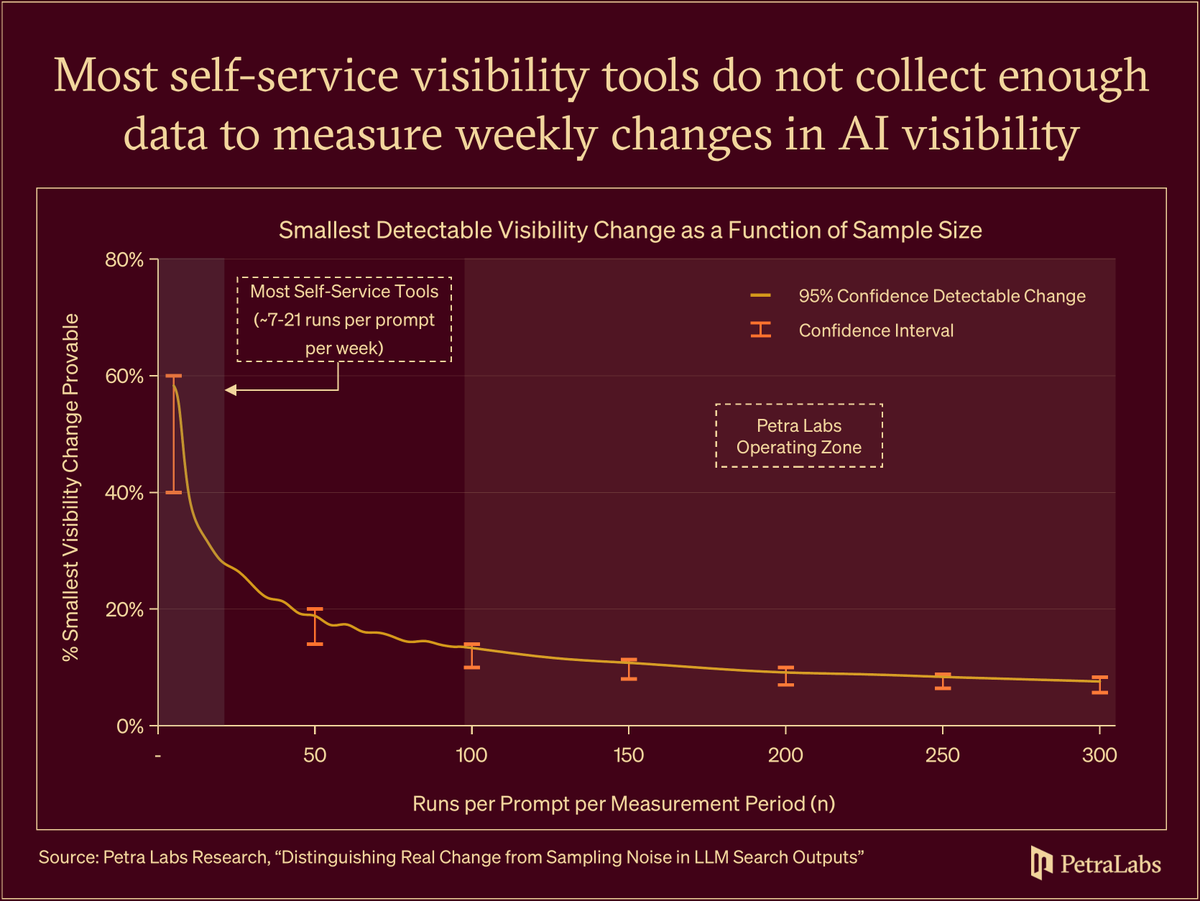
When your visibility moves on an AEO tracker, how do you know it's a real change? We're excited to share new research on the question that sits underneath every AI visibility report.
These models don't answer the same way every time. Ask one the same question twice and you'll often get different brands, different sources, and a different order. So when a tracker shows your mention rate moving 10–15% between 2 weeks, how do you know whether that's a real change in the market, or just the natural variation in how the model answers?
Behind every visibility number, each prompt you track is run many times, and your score is how often you show up across those runs. Our white paper measures how many runs it takes to tell a real change apart from natural LLM variation.
Gather enough data points over time and real changes become measurable, but for the week-to-week moves teams tend to watch, you need more data than most self-service tools provide. And the number isn't fixed, we found differences between ChatGPT and Gemini, and even across industries.
At Petra Labs, we customize every deployment by client, industry, model, and prompt, rather than using the same setup for everyone.
When we report a change in visibility or recommend that you act on, we want to be confident it reflects what's happening in the real world.
25% of all consumers have made spending decisions using AI search in the last 3 months according to McKinsey
1. Heavily validated by the data we see from our B2C customers. Unsurprisingly, LLM conversions are weighted towards younger demographics
2: McKinsey separated "shopping" from "managing health and wellness" and "planning travel" when they designed their survey. To the models (and to the people asking questions) they're one and the same.
"I have trouble sleeping at night" --> MoonBrew
"Plan my trip" --> Qatar Airways
LLMs have taken industries that never really relied on SEO and turned search into a primary growth lever for them (some industries, not all)
3: We see 1-3% of traffic come with an AI assistant UTM for the best performing brands with the highest visibility, but 10x that number of customers self-report AI tool discovery
AI search is a zero-sum game. If you're not seeing the results, it's because your competitors are.
We used that same prompt to figure out if the data you see in your AI visibility tracker actually reflects what a logged-in user sees.
Most visibility trackers show you logged-out or API data. But, most users ask questions from logged-in accounts.
☘️ Some brands are lucky: they get the same visibility from Logged-In and Logged-Out surfaces, driven by the same citations. This happens because despite the fact that there's a lot of differences between access surfaces, there is also a lot of overlap.
🫠 Some brands are unlucky: their real-world presence may be completely misrepresented by the visibility trackers, both in terms of presence and relevant citations, which leads to a super common pain point we hear about all the time: "My visibility went up in [software] but not a single business KPI changed."


![petra_labs's tweet photo. We used that same prompt to figure out if the data you see in your AI visibility tracker actually reflects what a logged-in user sees.
Most visibility trackers show you logged-out or API data. But, most users ask questions from logged-in accounts.
☘️ Some brands are lucky: they get the same visibility from Logged-In and Logged-Out surfaces, driven by the same citations. This happens because despite the fact that there's a lot of differences between access surfaces, there is also a lot of overlap.
🫠 Some brands are unlucky: their real-world presence may be completely misrepresented by the visibility trackers, both in terms of presence and relevant citations, which leads to a super common pain point we hear about all the time: "My visibility went up in [software] but not a single business KPI changed."](https://pbs.twimg.com/media/HMt3OQiXkAEZbGu.jpg)





