Bitcoin looks discounted and the $64,000 support is gaining strength — Ray Salmond, analyst.
"Negative news is having a diminished impact."
"Dips to $62,000 are quickly being bought."
$70k is inevitable 🚀
A hedge fund returned 50% a year for ten years straight. In 2005 the man who ran it sat on a desk at Columbia and taught the entire method to 30 students for free. No bank, no fund, no business school has ever promoted the recording.
His name is Joel Greenblatt. He ran Gotham Capital from 1985 to 1994. Almost nobody sustains 50% annually for a single year. He did it for ten. Then in 1995 he returned all outside capital, kept running his own money, and walked into a classroom.
The first lecture is about corners of the market where the usual buyers are structurally forced to sell regardless of price. Spinoffs, restructurings, situations where an index fund must dump a stock the day it leaves the index. He does not teach a screener or a formula. He teaches why these corners exist at all, and why they keep existing after everybody knows about them.
The uncomfortable part is what he says about diversification. He held very few positions. It runs directly against everything the business school teaches two floors down. Columbia charges $80K a year in tuition. The man upstairs gave away the method for free.
Every screener is free now. Every filing is searchable. The constraint was never information. It was knowing which information to ignore.
Filmed from the back row, audio uneven, students blocking the frame. He gave away 50% a year to a room of 30 people. Almost nobody traded on it.
One classroom. One camera. The full lecture is free. It is in the video.
COLDCARD BUG MAY HAVE BEEN CAUSED BY A COMPILER WORKAROUND
A new technical analysis by Core-Lightning dev ddustin suggests the 2021 COLDCARD vulnerability may have started while a developer was trying to connect three layers of the firmware: the wallet’s Python code, MicroPython’s C code, and the STM32 hardware random number generator.
The custom code appears to have conflicted with MicroPython’s existing implementation, likely triggering a compiler error.
The evidence suggests the developer then disabled the hardware RNG by setting MICROPY_HW_ENABLE_RNG to 0, allowing the firmware to compile.
That change had an unintended consequence. When users created new wallets, the firmware no longer used the hardware random number generator. Instead, it fell back to MicroPython’s much weaker Yasmarang software random number generator.
The commit message left by the dev was just the word “runs.”
The analysis argues this is a reminder that developers should never ship security-critical code they don’t fully understand, especially when it protects billions of dollars in Bitcoin.
JUST IN: A second Coldcard hack has been reported.
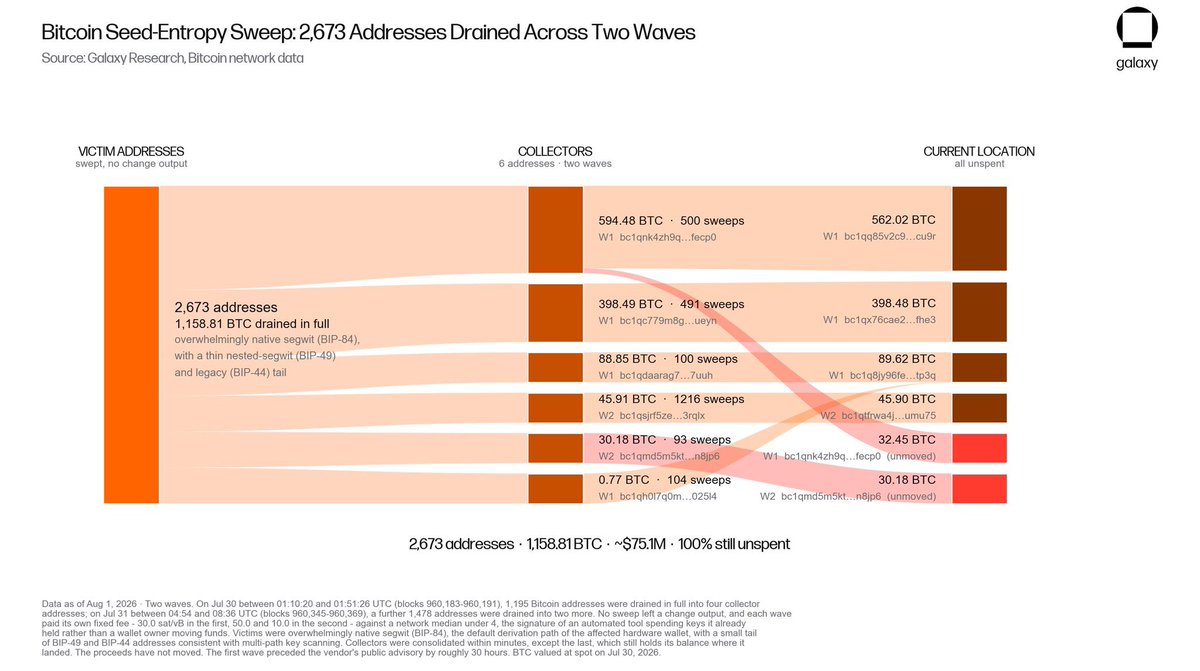
A total of 1,158.81 BTC has been stolen from 2,673 addresses so far, according to Galaxy Research.
Users are urged to review the company's official security guidance as soon as possible‼