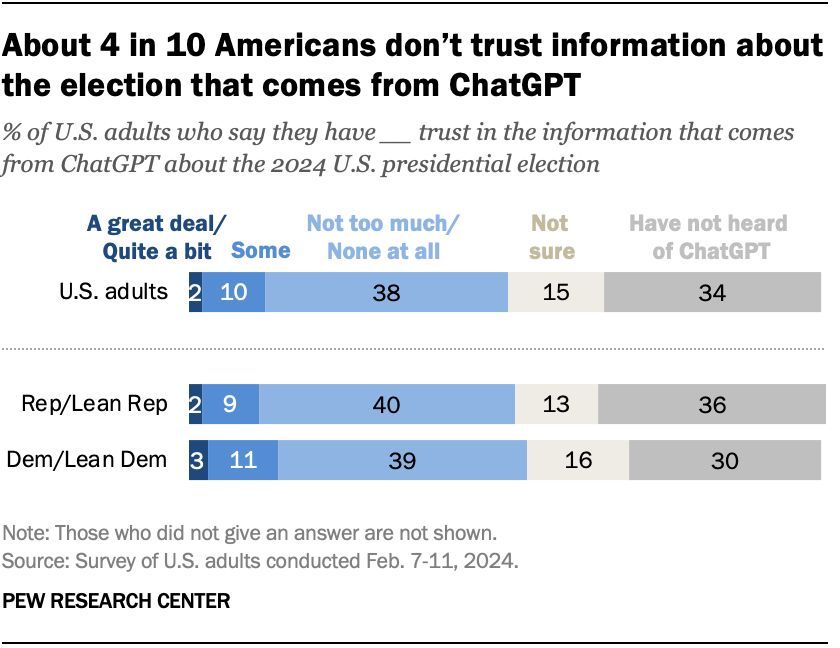
Notably, however, very few Americans have actually used the chatbot to find information about the presidential election: Just 2% of adults say they have done so. Dive into our analysis to learn more: https://t.co/hqRRMeWUdh
About four-in-ten Americans (38%) don’t trust the information that comes from ChatGPT about the 2024 U.S. presidential election – that is, they say they have not too much trust (18%) or no trust at all (20%).
A third of employed Americans with a postgraduate degree have used ChatGPT for work, compared with smaller shares of workers who have a bachelor’s degree only (25%), some college (19%) or a high school diploma or less (8%). https://t.co/tpNm6wP3oI
Similarly, about six-in-ten say generative AI programs should have to credit the sources they rely on if they draft a movie script in the style of a popular movie.
Dive into our full analysis: https://t.co/XG6YO5rUbr
When asked about seven examples of content that AI programs could generate, the public consistently says these programs should credit sources. Explore more from our analysis: https://t.co/uXIDUEx1XV
Whether an author is living or dead has little impact on public attitudes: 65% say credit is needed if AI programs imitate the writing style of a famous author who died many years ago.
Overall, 54% of Americans say artificial intelligence programs that generate text and images, like ChatGPT and DALL-E, need to credit the sources they rely on to produce their responses. https://t.co/ziAzySQf4Q
22% of Americans say they interact with artificial intelligence almost constantly or several times a day. Another 27% say they interact with AI about once a day or several times a week. Half of Americans think they interact with AI less often. https://t.co/XH9NeLX5s2
Nearly four-in-ten Republicans now say they have not too much or no confidence at all in scientists to act in the public’s best interests. This share is up dramatically from the 14% of Republicans who held this view in April 2020.
Dig in: https://t.co/4YjRqBMNxA
ChatGPT, a generative AI tool, garnered wide media attention this year. In March 2023, we found that 58% of U.S. adults had heard of ChatGPT, while 42% had heard nothing at all about it.
Dive into our findings: https://t.co/BUHsvGR6JY
57% of Americans say science has had a mostly positive effect on society. This share is down 8 percentage points since November 2021 and down 16 points since before the start of the coronavirus outbreak.
Dive deeper: https://t.co/3rU9d4AFnH
From detecting cancer on a medical scan to drafting an essay for a school assignment, artificial intelligence is increasingly shaping the way Americans live. Here's what the data says about Americans’ views of artificial intelligence: https://t.co/beCQ860kqN
Americans are increasingly cautious about the growing role of AI in their lives. Today, 52% of Americans are more concerned than excited about AI in daily life, and 10% say they are more excited than concerned.
Check out our full analysis here: https://t.co/UywcsHuCVm
AI is increasingly being used to do things like help diagnose disease and recommend treatment, yet six-in-ten Americans say they would feel uncomfortable with their health care provider relying on AI to help care for them.
Explore more: https://t.co/pQJrxp3pyY
57% of Americans say science has had a mostly positive effect on society. This share is down 8 percentage points since November 2021 and down 16 points since before the start of the coronavirus outbreak.
Dive deeper: https://t.co/UJicpc0USV
As AI becomes a larger part of everyday life, Americans see some specific uses of AI positively, attitudes depending a great deal on the context of how and why the technology is being used.
Read more: https://t.co/MytbEpu3kh
Fewer than half of Republicans (47%) now say that science has had a mostly positive effect on society. In 2019, 70% of Republicans said this.
Read the full report here: https://t.co/Nhe4c0YNOK
AI is increasingly being used to do things like help diagnose disease and recommend treatment, yet six-in-ten Americans say they would feel uncomfortable with their health care provider relying on AI to help care for them.
Explore more: https://t.co/en7a6hMIWs