The Golf Club at Creekmoor Head Professional, 2018 MWPGA Youth Player Development Award, 2x State Champion Coach, 2014 Missouri Golf COTY, husband and father.
This seems all too familiar with our golfers out there… let’s actually test to see if that club should actually be in your bag! @creekmoorgolf@pgaprojt@PingTour
@joshlukenichols@WrightBalance_@LarryRinker Good stuff. Been swinging upper core since about 2007 and changed my golf life. Larry Rinker is a good follow. I’m not certified with Wright Balance, but my buddy @natewsargent is and I’ve learned a lot more about it over the years from him.
I think we need to start paying less attention to the things we don’t like about golf courses and more attention to the things we do like.
Don’t let the site of a golf cart ruin your day. Bad bunkering? Ok.
Was the sun shining? Were the greens in great shape? Was the routing good? Were your playing partners enjoyable?
It’s the half full vs half empty thing. Some courses have things that aren’t great, but most have redeeming qualities.
Let me introduce you to a powerful concept called the 2/3 rule.
It will change your outlook on golf and free you up while you play.
____
Golfers are way too hard on themselves.
Often, they have no idea what it takes to play their best.
And because of that, they are in the wrong frame of mind before every shot.
Here is where the 2/3 rule can help...
The good news is you do *not* need to be firing on all cylinders to shoot your best scores.
I believe you can still do it while one part of your game is not performing all that well.
And this is all relative to your current skill levels and handicap.
This applies to everyone.
_____
There are three areas of your game:
• Tee Shots
• Approach Shots
• Finesse Shots (anything inside 100 yards)
I've been around some great players and I don't believe I have seen anyone conquer all 3 parts in a round.
I have shot some pretty nice scores when one part of my game was just "OK"
I once shot a 64, and my driver wasn't all that locked in #humblebrag
Know this - at least one part of your game will be a bit of a struggle.
If you hit 2/3, you can play some great golf!
But you have to *let it happen* rather than expect perfection.
___
Now let's talk about a more important concept.
I believe most golfers don't reach their potential because they lose focus and discipline on days when they are struggling more.
I didn't become a better golfer until I started reducing the 0/3 days.
Let's say you are someone who typically shoots in the mid-80s.
In your best rounds, you might be able to break 80.
But when things are going badly, the upper end goes much higher.
You could end up in the high 90s or even crack 100 if you don't throw the scorecard away.
This is where the 1/3 rule is powerful.
When you turn a round that would have usually been in the high 90s into the low 90s, *that* is how your handicap drops.
For me, I can now turn a day that would've been an 82 into a 75-76.
There are a lot of tools that are required to do this (ahem, I know a book that can help you)
But the first step is accepting that two parts of your game might feel very uncomfortable.
You have to find a way to fight through it.
Scoring is A LOT more than how your swing feels.
You don't need to be perfect to have a great round of golf; you need to be patient.
At least one part of your game is going to abandon you.
If you remind yourself that mistakes are OK and have the mental resolve to dig in, your scores will improve.
Wonder why you can’t bring your range game to the course?
Because the range is different than the course
Your brain knows that they’re different
Here’s a rule of thumb that’s worth committing to memory:
🔵 Anytime there’s an increase in consequences, there’s an increase in pressure
🔵 When there’s an increase in pressure, there’s a subconscious fear of getting those negative consequences on a brain level
🔵 When there’s a subconscious fear, there’s a equivalent level of tension and protection
🔵 When there’s tension and protection, your swing, chipping, putting motion will be hindered
🔵 And when those are hindered, you hit worse shots
So then what can you do?
You can accept this. Not resign yourself to it. But accept it as reality. That’s always a good place to start.
Then you can do the things that get you as close to freed up as possible.
Things like being more mindful in the moment. Things like bringing yourself back to the present so you can focus on what the shot requires.
The purpose of the mental game is to give your physical game the best opportunity to show.
Want to take a FREE assessment of your mental game to start working on what can free you up?
Link to the FREE Mental Game Assessment in the tweet below 👇
QUESTION:
How long would a par 72 course need to be for the typical 12 index player to have a scoring avg of 72?
ANSWER:
3,820 yards
All par 3s = 35 yards
All par 4s = 216 yards
All par 5s = 380 yards
Data from @ArccosGolf
When I’m asked the yardage of a target. My response is I don’t know because you’re hitting a range ball to a downhill target. This supports my first point. I’ve never tried to figure out how far my clubs go on the range.
It's really easy to get discouraged at the range...
We've all been there.
I'll be honest though, these balls aren’t helping your case.
In testing alone we found that not only is the sound and feel what we call, “sub-optimal” but…
From 75-100 yards in the fairway...
For an entire season...
No player on the PGA Tour has EVER had an average proximity of less than 10-feet.
"Yeah, but Lou, as a 12 index that has a desk job and plays once a week and practices *maybe* twice a month I SHOULD be hitting these shots really tight every time because they are easy." 😉
The tour data goes back to 2004 (first year we have data on this).
#ManageYourExpectations
You have a 25 foot putt.
Should you EVER leave it short of the hole?
THE DATA
The plot below is for the top 20 putters on the PGA Tour. These are putts from 24'0" to 25'11".
They are short of the hole 32% of the time from 25 feet.
From ~46 feet, they leave 50% short.
WHAT DOES THIS MEAN FOR YOU
Us amateurs don't have the same speed control as a tour pro, so the distance where we should leave 50% short is going to be shorter.
The numbers below are for the typical putter at that handicap index.
You should leave about 50% of your putts short from the following distance:
0 index: ~42 feet
5 index: ~35 feet
10 index: ~28 feet
15 index: ~23 feet
20 index: ~20 feet
From that distance and longer, to optimize overall number of putts, you should be leaving 50% short.
WHAT ABOUT SHORT PUTTS?
For short putts that are makeable, you want to get most of those past the hole.
From 10 feet, tour pros get 95% of their putts to the hole.
What should the 95% distance be for amateurs?
0 index: ~9.5 feet
5 index: ~9.0 feet
10 index: ~8.5 feet
15 index: ~8.0 feet
20 index: ~7.5 feet
SUMMARY
For your skill level, you want to get 95% of your putts past the hole from the distance listed above.
Then as you get farther from the hole, you will want more and more putts to finish short of the hole, until you get to your 50/50 distance.
From that distance and longer, you will want 50% of your putts to finish short of the hole.
5 Minute Golf Warm Up 🏌️♂️
Do you hate being stiff for the first few holes?
Not really sure how to get loosened out before you play?
Bookmark this thread, and use it before your next round 🏌️♂️!
Looking at the skill gap between pros and amateurs is always fun.
This is something I always get a lot of questions about.
The Gap is HUGE
A lot of people are surprised the first time they see these numbers. I want to note that the gaps below are actually bigger than they appear to be.
This is because tour pros are playing setups that are more challenging than the typical am plays (e.g., pins are tucked, rough around green is tougher, etc...).
The Numbers
These are based on the average number of shots it takes to hole out from the fairway.
In the first set of numbers below, a tour pro from 200 yards in the fairway is going to average the same number of shots to hole out as a scratch player from 156 yards in the fairway and a 10 index from 57 yards in the fairway. Tour pros are very very good. 🤯
Tour pro from 200 yards
Scratch = 156 yards
10 index = 57 yards
Tour pro from 160 yards
Scratch = 99 yards
10 index = 33 yards
Tour pro from 120 yards
Scratch = 60 yards
10 index = 26 yards
Tour pro from 80 yards
Scratch = 40 yards
10 index = 21 yards
Tour pro from 40 yards
Scratch = 28 yards
10 index = 16 yards
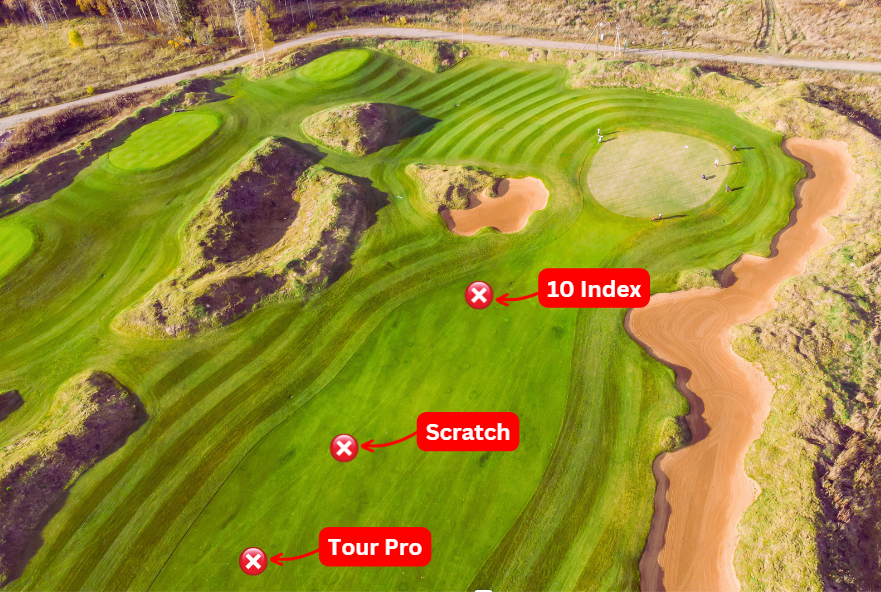
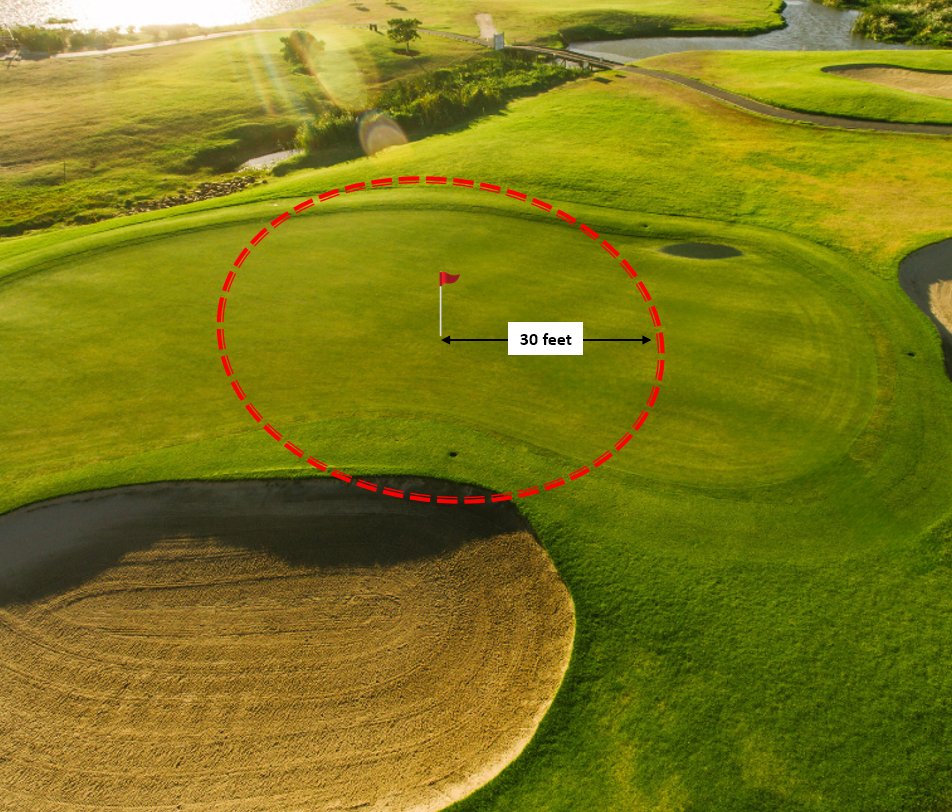
From what yardage in the fairway are players more likely to hit it outside 30 feet than inside 30 feet?
It doesn't matter if the ball finished on the green or not, just that it finished more than 30 feet from the hole.
The numbers:
Tour pro: 180 yards
Scratch: 122 yards
5 index: 111 yards
10 index: 86 yards
15 index: 55 yards
Let this sink in:
The typical 10 index is more likely to hit it outside of 30 feet from 86 yards in the fairway!!! 86 yards!!!
Manage your expectations:
If you are a 10 index, should you try to hit every 86 yard shot inside of 30 feet? Yes. Absolutely.
Will you? No.
Don't beat yourself up when every shot does not go exactly where you intended.
What can you do?
Keep working on tightening up your dispersion.
Becoming a better ball striker does not mean you start hitting everything stone dead. It means your bad (and mediocre) shots start to get a little better.
You can use the numbers above to guide and benchmark your practice sessions. See how many you can hit inside of 30 feet from a given distance.
Tiger Woods missed the green 22% of the time from 110 to 120 yards in the fairway.
Tiger is the GOAT and he missed the green more than one out of five times...
...yet some amateurs think they should never miss from that distance. 🤷
#ManageYourExpectations
@LB_Golf You boys just retool every year! Congrats and great round by Sam! Good luck and skill moving forward. Looks like it could be another 🏆 for LeBlond Golf!
A very emotional Ochai Agbaji hugged his family after winning the National Championship. They hugged him and said “You’re a Champion.” Tears man. @youngoch
John Wooden didn't win his first national title until his 16th season at UCLA.
Starbucks didn’t reach store #5 until 13 years into its history.
Sam Walton (Walmart) didn’t open his 2nd store until 7 yrs after starting his company.
Be persistent. Success takes time.