𝗣𝗲𝗿𝗳𝗼𝗿𝗺𝗮𝗻𝗰𝗲 𝗥𝗲𝘃𝗶𝗲𝘄𝘀: 𝗧𝗵𝗲 𝗧𝗲𝗱𝗶𝗼𝘂𝘀 𝗦����𝗹𝗳-𝗔𝘀𝘀𝗲𝘀𝘀𝗺𝗲𝗻𝘁 𝗙𝗼𝗿𝗺
Filling out a long self-assessment form is a small, tedious task most employees simply complete without much genuine thought behind it. The questions repeat familiar patterns. The boxes get filled with reasonable, professional language. The form gets submitted on time, technically satisfying every requirement of the annual review process.
This tedium rarely causes any real distress on its own. Nobody dreads a self-assessment form the way they might dread a difficult conversation with a manager. It is simply an administrative task, mildly unpleasant in the way that any lengthy form tends to be, absorbed into an already busy week without much complaint or genuine resistance.
The reason this small tedium is still worth noticing is what it quietly reveals about the larger process surrounding it. A form that gets completed purely as an obligation, rather than engaged with as a genuine opportunity for reflection, is doing very little of the actual work a self-assessment is supposed to accomplish in the first place.
Employees filling out these forms quickly, using safe and familiar language, are not necessarily disengaged from their work more broadly. They may simply have learned, through experience across several review cycles, that the form itself carries relatively little actual weight in how decisions eventually get made about their role or their compensation.
This is a sign worth paying attention to, even though it never generates a complaint. A genuinely valuable self-assessment process should feel different enough from routine paperwork that people actually want to engage with it thoughtfully, rather than simply completing it as quickly as possible to move on to something else.
Leaders reviewing completion rates for these forms should also ask a slightly different question. Not whether the form was completed, but whether the answers show any evidence of real reflection, or whether they read like a task finished quickly, without much genuine thought given to it at all.
A tedious form, completed quickly and without much thought, is often a small, easy to overlook sign that the process built around it needs more attention than the paperwork itself ever does.
To read more content like this visit my website and blog post. The link is in First Comment.
#Enablinggrowth
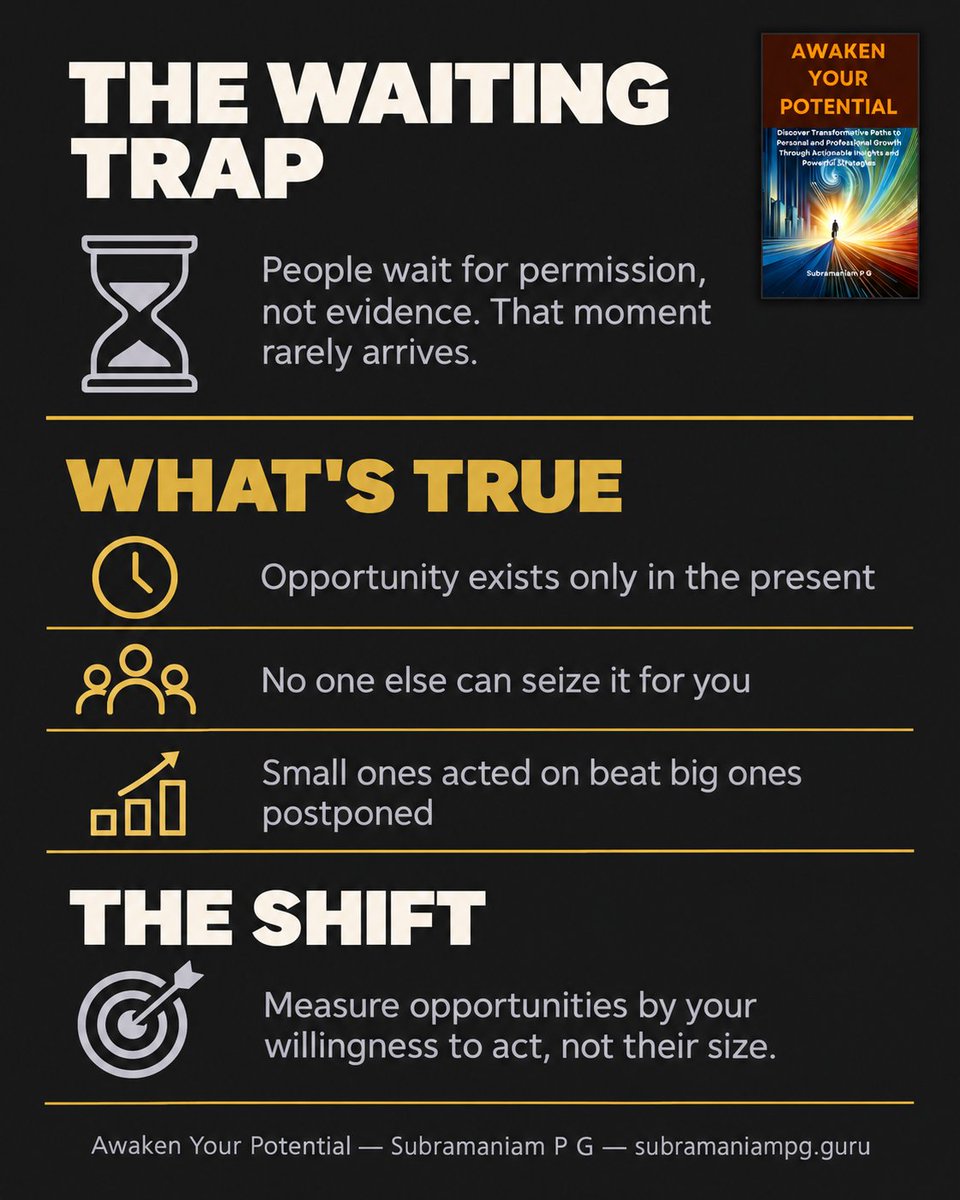
Most people believe they missed their opportunity, or that a better one is still coming. Both beliefs keep them waiting.
Opportunities are not stored somewhere in the past or the future. They exist only in the present, in front of you right now, whether or not they look significant enough to act on.
This is the quiet trap behind waiting too long to change. People are not usually waiting for evidence. They are waiting for permission, or for a moment that feels obviously right. That moment rarely announces itself in advance.
No one else can seize your opportunity for you. It does not matter how small it looks compared to what you imagine you deserve. Small opportunities acted on consistently often outperform large ones endlessly postponed.
The outcome does not depend on how big the opportunity is. It depends on how fully you engage with the one already in front of you.
If you are waiting for the right time to change, consider that the right time may already be here, simply too ordinary to recognize as significant.
Stop measuring opportunities by their size. Start measuring them by whether you are willing to act on the one you already have.
What opportunity has been sitting in front of you while you waited for a better one?
This post draws on ideas from Awaken Your Potential by Subramaniam P G. Learn more at https://t.co/DzZvRkMh5O
#Enablinggrowth
𝗖𝗵𝗮𝗿𝗮𝗰𝘁𝗲𝗿 ��𝘀 𝗡𝗼𝘁 𝗣𝗲𝗿𝘀𝗼𝗻𝗮𝗹𝗶𝘁𝘆
Character shows up on hard days
For years I confused character with personality. I thought a person's character was just who they naturally are.
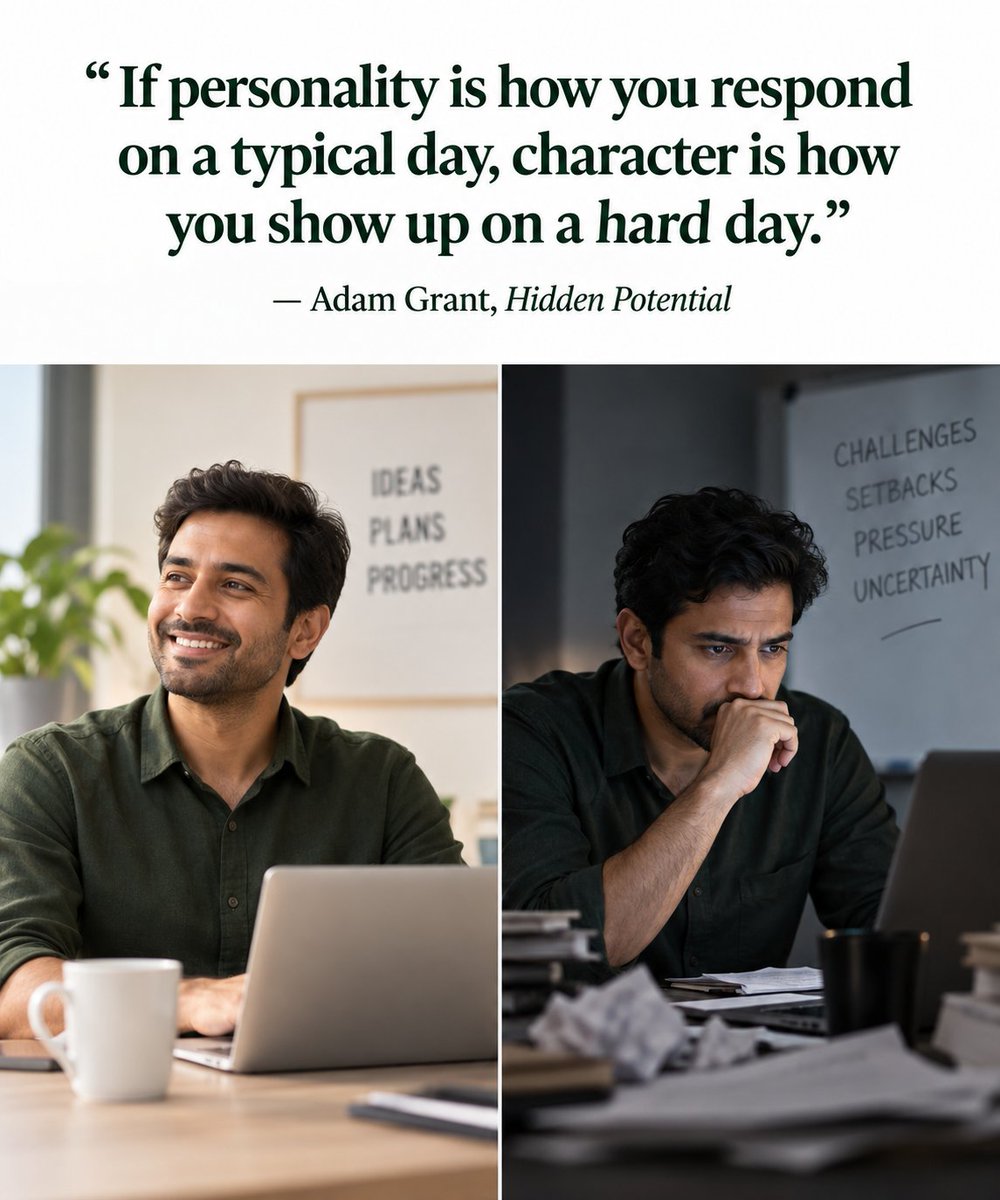
Hidden Potential by Adam Grant corrected that for me. He explains that personality is your predisposition, your basic instinct for how you think, feel, and act. Character is different. Character is your capacity to prioritize your values over your instincts.
Here is the line that stuck with me. If personality is how you respond on a typical day, character is how you show up on a hard day.
That distinction matters more than it sounds. Anyone can be patient when things are going well. Anyone can be honest when honesty is easy. The real test comes when it costs you something.
Grant also makes a point I had not considered. Character is more than having principles. It is a learned capacity to live by them. Which means character is not fixed. It can be built.
I think about the people I trust most. It is never their personality that earns my trust. It is how they behave under pressure.
What does your character look like on your hardest days?
#Enablinggrowth
𝗣𝗮𝘆 𝗧𝗿𝗮𝗻𝘀𝗽𝗮𝗿𝗲𝗻𝗰𝘆: 𝗖𝘂𝗿𝗶𝗼𝘀𝗶𝘁𝘆 𝗮𝗻𝗱 𝗨𝗻𝗰𝗹𝗲𝗮𝗿 𝗕𝗼𝗻𝘂𝘀 𝗖𝗿𝗶𝘁𝗲𝗿𝗶𝗮
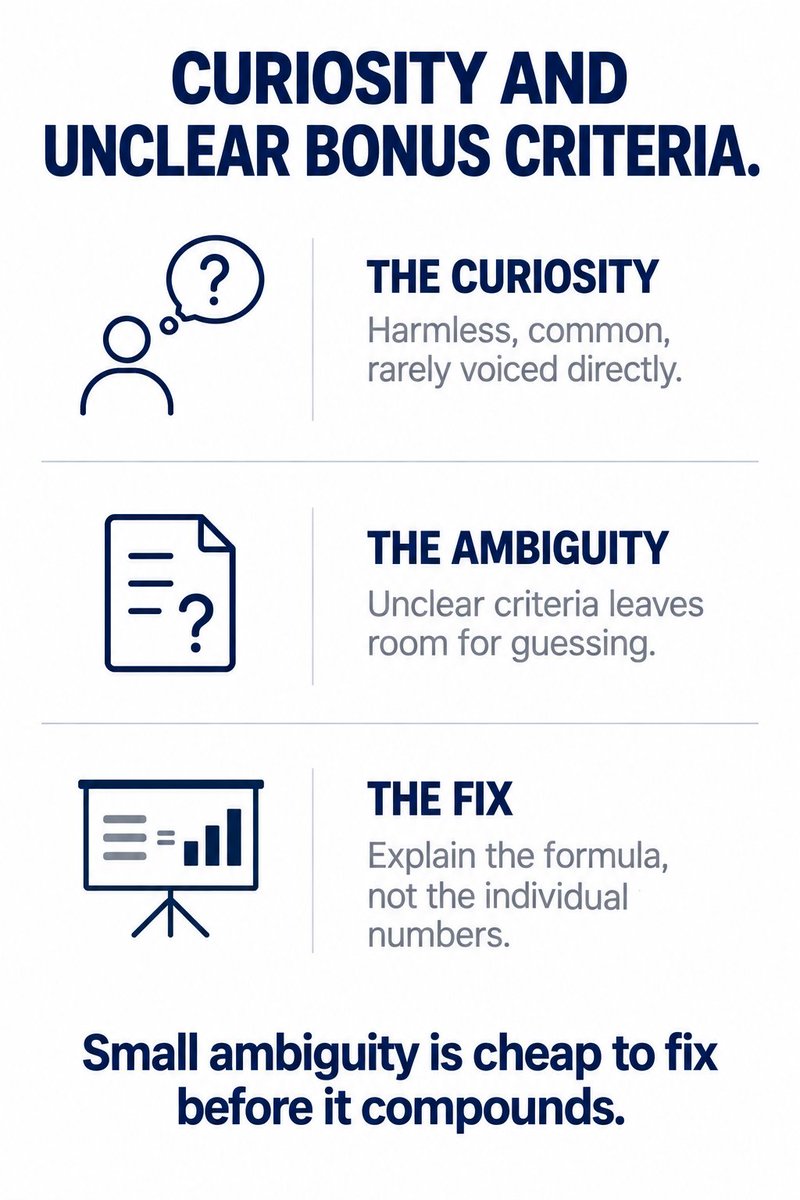
Curiosity about what coworkers actually earn is common and, for the most part, entirely harmless on its own. People wonder. They compare mentally, occasionally, without ever raising the question directly with a colleague or a manager. This kind of quiet curiosity rarely causes any real damage by itself.
Unclear bonus criteria add a bit more fuel to this same curiosity without necessarily causing serious harm either. When the exact formula behind a bonus is not fully understood, people naturally start guessing at the reasoning, filling in gaps with their own assumptions about what likely mattered most in the calculation.
None of this typically escalates into a formal complaint or a serious trust issue on its own. Most employees continue working productively even while carrying a bit of unresolved curiosity about pay and bonus criteria they have never had fully explained to them in plain, simple terms.
The reason this is still worth addressing is not because it currently causes visible damage. It is because this kind of ambiguity is genuinely inexpensive for leaders to fix, especially compared to the much larger cost of an unexplained pay gap discovered informally, months or years down the line, after ambiguity has had time to compound into real doubt.
A clear, simple explanation of how bonuses actually get calculated, shared openly with the entire team rather than left as an unspoken mystery, removes most of the guesswork that quiet curiosity currently has to fill in on its own.
This does not require disclosing individual numbers or specific amounts. It requires disclosing the actual criteria, clearly enough that curiosity has somewhere concrete to land instead of continuing to circulate as loosely informed speculation among people who genuinely just want to understand how the system works.
Small ambiguity like this is easy and genuinely inexpensive for leaders to remove, long before it has the chance to grow into something considerably more costly to fix.
Explaining the formula once is far cheaper than repairing the trust lost when someone eventually feels forced to guess at it themselves.
To read more content like this visit my website and blog post. The link is in First Comment.
#Enablinggrowth
Long dull reviews are not cadence. Cadence is short, sharp, and decides something.
An hour on the calendar. Status updates read out one by one. A few slides nobody remembers by lunch. Nothing gets decided that would not have happened anyway.
Founders often think they have a review rhythm because a meeting exists on the calendar. A meeting is not the same as a review. A review has a job to do. Most of these meetings do not.
Here is the test. At the end of the review, can you name one decision that was made, one thing that changed direction because of the conversation. If the honest answer is no, the meeting reported the past. It did not manage the future.
This matters because a bad review teaches the team something dangerous. That these sessions are theatre, not tools. Once people believe that, attendance becomes an obligation, not a habit, and the whole cadence weakens from the inside.
A working review is deliberately narrow. What moved. What did not. What is the one thing we do differently this week because of what we just heard. Nothing more.
Cut your next review to half its usual length. Remove the status readout entirely. Spend the time only on what needs a decision. See what changes in the room.
When did your last review actually decide something?
Visit https://t.co/XhgmebOXMZ
#Enablinggrowth
𝗣𝘀𝘆𝗰𝗵𝗼𝗹𝗼𝗴𝗶𝗰𝗮𝗹 𝗦𝗮𝗳𝗲𝘁𝘆: 𝗤𝘂𝗶𝗲𝘁 𝗶𝗻 𝗢𝗻𝗲 𝗠𝗲𝗲𝘁𝗶𝗻𝗴
Staying quiet in a single meeting rarely matters on its own. Most people forget it entirely by the next day, moving on to whatever comes next without giving the moment a second thought. A meeting where someone chose not to speak up is, in isolation, a completely unremarkable and forgettable event.
The concern is not any individual meeting. The concern is what happens when silence becomes the default response across many meetings, over an extended period, without anyone noticing the pattern forming until it has already become deeply familiar to everyone in the room.
A team member who occasionally stays quiet in a meeting is behaving completely normally. A team member who has been quiet in nearly every meeting for the past several months is doing something worth understanding better, even if nothing about their silence looks alarming in any single instance a manager might happen to notice.
This distinction matters because reacting to a single quiet meeting usually produces an awkward, disproportionate response to something genuinely minor. Reacting to a consistent pattern of silence, spread across many meetings and much longer stretches of time, is a reasonable and worthwhile thing for a leader to actually notice and address directly.
Leaders should watch for the pattern rather than the moment. Has this person's participation changed meaningfully over the past few months. Have they gone from occasionally quiet to consistently, almost entirely silent, without anyone commenting on that shift or asking a simple, direct question about it.
Noticing this pattern does not require treating every quiet meeting as a red flag demanding immediate intervention. It requires a bit of ongoing attention across time, rather than reacting narrowly to any single instance in isolation from everything around it.
Most silence in a single meeting means very little. A consistent pattern of silence across many meetings usually means quite a lot, if anyone actually takes the time to notice it forming.
The right response is rarely a dramatic intervention. It is usually just one honest, curious question, asked with genuine patience.
To read more content like this visit my website and blog post. The link is in First Comment.
#Enablinggrowth
I do invest time reading about medical progress, and something in this talk stuck with me. Heart disease deaths have dropped to a quarter of what they were in the 1950s. Most people have no idea. Progress that happens slowly almost never makes the news.
But the part that really got me was not the breakthroughs. It was everything that got in the way of them.
Take the malaria vaccine. It was developed in the 1990s. It did not reach children until decades later. Not because the science was missing. Because there was no commercial incentive to fund it. Diseases that mostly affect poorer countries do not attract investment, even when millions of lives are at stake.
What changed things was not a scientific breakthrough. It was an idea called an advance market commitment. Donors agree to buy a vaccine at a set price, but only once it is proven safe and effective. That gives companies a reason to invest early. It also makes sure the vaccine reaches the people who need it, at a price they can afford. This same idea helped bring pneumococcal vaccines to Africa and South Asia faster. It is estimated to have saved over 700,000 children's lives.
Childhood leukemia tells a similar story. It was rare enough that no single hospital could run proper trials. So researchers built networks across countries to pool patients. Before the 1970s, only 15 percent of children with leukemia survived five years. Now it is 85 percent. Not from one discovery. From better collaboration.
I see the same pattern inside companies. A good idea often stays stuck, not because it lacks merit, but because no one owns it, funds it or connects it to the right people. Structure and incentives decide whether good work spreads or quietly dies.
What stayed with me is this. Breakthroughs do not happen just because the science exists. They depend on funding, incentives and people willing to build new systems around old problems. And many breakthroughs almost did not happen at all.
It also made me think that progress is not automatic. It takes people who refuse to accept that suffering, or stagnation, is just how things are.
What is one thing you have learned recently that changed how you think about progress?
#Enablinggrowth
https://t.co/yiYGxJjhcr
Justifying inaction is easy. There is always a reason available, from technical obstacles to timing to simple preference.
Growth does not begin with more motivation or more resources. It begins the moment you stop reaching for those reasons and start asking a harder question instead. What could I actually do here, if I were willing to think differently about this problem.
This requires what might be called possibility thinking. Not blind optimism, but a genuine willingness to explore options before deciding none of them will work.
Most people skip this step. They decide the obstacle is final before they have actually tested it. The excuse arrives faster than the exploration does.
Successful professionals are not the ones who never face obstacles. They are the ones who treat an obstacle as a starting point for creative thinking, rather than a stopping point for effort.
Think about a recent moment where you chose inaction. Was the obstacle truly immovable, or did you stop looking for options the moment the first excuse felt convincing enough.
Growth begins exactly where excuses end. Not because excuses are always false, but because they usually stop the search too early.
What recent excuse deserves a second look?
This post draws on ideas from Awaken Your Potential by Subramaniam P G. Learn more at https://t.co/DzZvRkMh5O
#Enablinggrowth
𝗟𝗲𝗮𝗱𝗶𝗻𝗴 𝗚𝗲𝗻 𝗭: 𝗧𝗵𝗲 𝗛𝗮𝗿𝗺𝗹𝗲𝘀𝘀 𝗘𝘆𝗲-𝗥𝗼𝗹𝗹
Eye-rolling over generational habits at work is common, and in most cases, genuinely harmless. A senior colleague raises an eyebrow at a quick chat message sent instead of a phone call. A younger employee quietly smiles at a scheduled meeting for something that could have been a two line message instead.
These small reactions rarely cause any real damage on their own. Nobody's trust is meaningfully shaken by a single eye-roll or a shared joke about generational differences in communication habits. Most workplaces absorb this kind of light friction easily, treating it as a mildly amusing part of working across different age groups rather than a serious problem worth addressing directly.
The reason this pattern is worth noticing at all is not because any single instance matters. It is because these small, repeated moments signal a gap in genuine understanding between generations, even when that gap never escalates into anything serious enough to demand a real conversation.
Left completely unaddressed over a long enough period, this light, mostly harmless friction can slowly calcify into something slightly more rigid. Assumptions about a colleague's habits, formed casually and reinforced repeatedly, start to shape how seriously their input gets taken, even when nobody intends that outcome or would openly admit to it if asked directly.
Leaders do not need to treat every eye-roll as a crisis requiring intervention. Most of the time, gentle acknowledgment and a bit of shared humor are entirely appropriate responses to genuinely minor friction between different working styles.
What is worth paying attention to is whether this light friction ever hardens into something closer to a fixed judgment about a colleague's seriousness or competence, based on nothing more than a communication habit that was never actually discussed openly between the two people involved.
Harmless friction stays harmless mostly when it stays occasional, visible, and open to a bit of honest conversation whenever it comes up.
A shared laugh about generational habits is fine. A quiet, permanent judgment based on the same habit is not.
To read more content like this visit my website and blog post. The link is in First Comment.
#Enablinggrowth
𝗗𝗶𝘀𝘁𝗮𝗻𝗰𝗲 𝗧𝗿𝗮𝘃𝗲𝗹𝗲𝗱, 𝗡𝗼𝘁 𝗦𝘁𝗮𝗿𝘁𝗶𝗻𝗴 𝗣𝗼𝗶𝗻𝘁
Talent is not the real story
I used to think some people were just built for success. Better wiring. Natural talent. A head start.
Then I read Hidden Potential by Adam Grant. One line stopped me. He writes that potential is not a matter of where you start, but of how far you travel.
That changed how I look at people. And at myself.
We spend a lot of energy comparing starting points. Who went to which school. Who had the head start. Who looked like a natural.
But a starting point tells you almost nothing about where someone can go.
Grant points to research showing that what looks like a difference in natural ability is often a difference in opportunity and motivation. Give people the right conditions to learn, and most people can learn almost anything.
I have watched this play out at work. The person who struggled the most in year one sometimes becomes the strongest performer by year three. Not because they got smarter. Because they kept traveling.
If we judged people by distance traveled instead of starting point, how many of our opinions would change?
#Enablinggrowth