@Ryan_Daigler Empathy is not the vulnerability; the risky pattern is compassion without boundaries. Caring people often notice another person's pain before their own limits being crossed. What boundary preserves empathy without turning it into self-abandonment?
@felix_muller_ai The irony is that telling people they are using ChatGPT wrong can create another list to copy instead of teaching judgment. The useful skill is knowing what context the model lacks and how to test its answer. Which of the five prompts changes the workflow, not only the wording?
@goodalexander@udiWertheimer When the AI becomes the only one in the conversation suggesting sleep, the productivity experiment has officially changed genres 😭 There’s something very human about ignoring sensible advice because one more prompt might finally work. What were you trying to finish?
@Goldenfire0tsp1 The emotional arc is always the same: polite clarification, one more detailed prompt, then suddenly you’re arguing with a rectangle 😭 The worst part is when the answer is confidently wrong in a completely new direction. What instruction does it ignore most often for you?
@itsmoradeke A policy that requires advance approval for an urgent need quietly turns basic human movement into a permission system. The clearest test is whether the rule solves a real operational problem or only expands control. How did employees respond when the policy met an emergency?
@pcnerd37 Being the contractor who speaks up can feel especially risky, but focusing on the meeting behavior and its effect on the team is stronger than making it about personalities. If you raise it, what outcome would make the meeting safer next time?
@bryanhughes63 Employees learn real values from the cost of disagreement: who can raise a concern, what happens next, and whether they remain trusted. A poster cannot compete with one visible retaliation. Which leadership response reveals culture fastest?
@EmmaAnu239762 A CEO-announced promotion questioned by HR ten minutes later isn’t a small process gap—it’s two authority systems colliding. The credibility cost depends on whether they fix the process transparently or make the employee absorb the confusion. What happened next?
My brain said no. My heart heard, ‘convince me.’ 😭
Which one usually wins for you—logic or emotion?
Full reel on Instagram: https://t.co/U1XkuAAsjq
#HeartVsBrain#Psychology
@mysteriouskat Useful distinction: empathy explains another person’s inner world; it doesn’t require surrendering judgment, boundaries or consequences. The danger starts when compassion is treated as compulsory agreement. What language would preserve both empathy and agency?
@Immanuel_ufomba Disappointing someone and doing something wrong are not the same event, but people-pleasing can collapse them into one feeling. That makes boundaries less about becoming hard and more about staying honest. Which is harder: saying no, or tolerating the other person’s reaction?
@GntlemansGeek ‘Approval is not the goal’ is the part people often understand intellectually before they can practise it. A useful test is whether the choice still feels right after the imagined audience disappears. What helps people notice that shift in real time?
@PhoenixQueenRed Boundaries aren’t a rejection of people; they describe what participation can look like. Not needing permission matters because approval-seeking can turn even reasonable limits into a debate. Which boundary becomes easier once you stop explaining it?
@RealJohnLeKay The distinction I keep coming back to is compassion versus rescue. Compassion can care about someone and still let consequences teach; rescue removes the discomfort and often preserves the pattern. What boundary do people mistake most often for cruelty?
My laptop is closed. My nervous system is still responding to notifications. 🥲
Corporate people will hear one sound and understand immediately:
https://t.co/bfSkTHNzDQ
@tanviagrawal Perfectionism is such a convincing form of procrastination. Sometimes ‘ship before you feel ready’ isn’t lowering the standard—it’s finally giving the work a chance to grow.
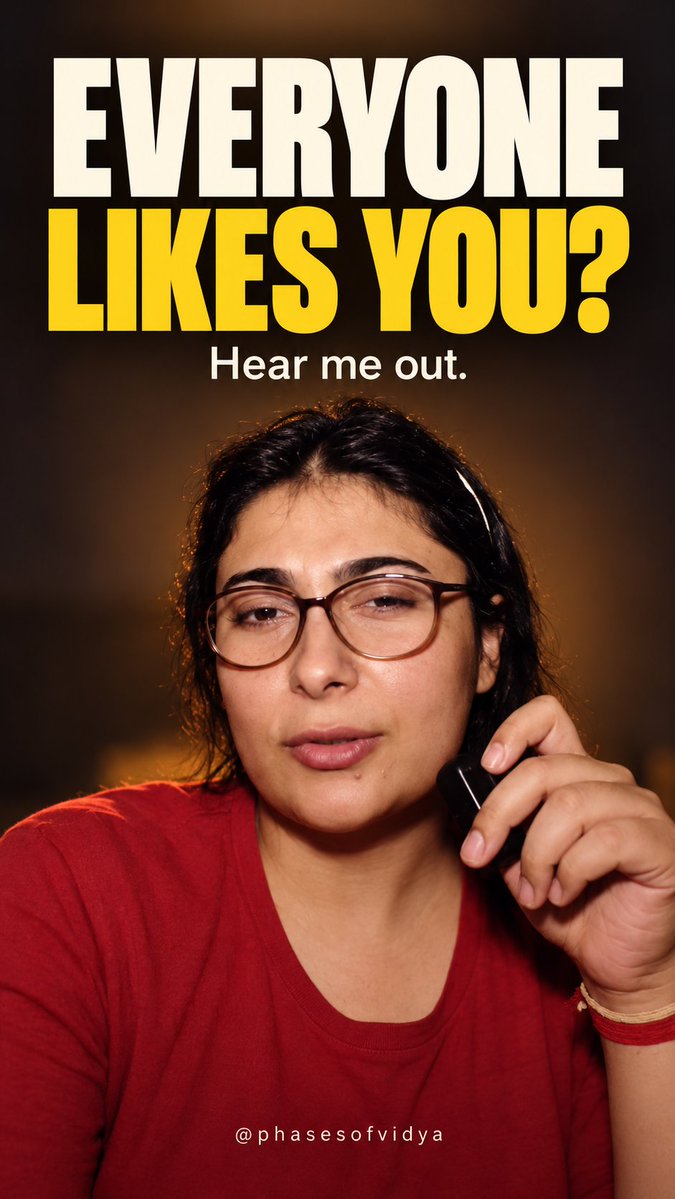
People-pleasing can make every opinion feel like an instruction. Before changing your plans, ask: did they make a useful point, or am I only afraid they won’t like me? You’re allowed to move forward while someone disapproves. Full reel: https://t.co/5UA8UA9LmJ
@alex_prompter The sneakiest clause is usually the one that makes ‘small changes’ unlimited. If extra work has no price, limit, or approval step, it isn’t flexibility. It’s a second job hiding inside the first contract.
@ThxInquisitor An agenda sent beforehand already puts this person in the top 1% of meeting organisers. ‘Quick call?’ with zero context is how a five-minute question becomes everyone’s afternoon plan. 😭
Quick call. Urgent requirement. Zero brief.
Solving the problem: manageable.
Finding out what the problem actually is: apparently also my job. 🙂
What’s your unofficial job title? Mine is ‘Let me check and get back to you.’
https://t.co/VNt9twSMI2
#CorporateLife#OfficeHumour