Premodern societies tended to be rent by terrible wars. In the early modern period, tens of millions died in wars in Europe, India and China. Just one society found a kind of solution: Japan. Between 1603 and 1853, Japan enjoyed near-perfect peace. The ruling Tokugawa family achieved this through creating what might be seen as the largest prison in the history of the world, the city of Edo (modern Tokyo).
https://t.co/29RvgozjUc
Most of Japan was governed by about 260 nobles, called ‘daimyo’ (see first map). To secure their loyalty, the government required that the daimyo leave their families permanently in Edo, essentially as hostages to the state. Most daimyo women thus never saw the domains over which their husbands and sons ruled. The daimyo were also required to alternate years in Edo personally.
The result was that most of the surface area of Edo was given over to daimyo palaces, or to accommodation for the hundreds of thousands of samurai retainers they brought with them (see second map). This was arranged through an elaborate zoning system, probably the largest use of zoning before modern times.
Edo was extraordinarily top-heavy socially: about half of its population were samurai. Samurai were theoretically a warrior class, but since Japan was at peace, they did little real work apart from gentlemanly occupations like calligraphy. Their main income came in the form of tiny hereditary stipends from their daimyos or the government.
These stipends were fixed in perpetuity around 1600, declining gradually with inflation over the next quarter of a millennium. Most samurai thus lived in dignified but extreme poverty, their income determined by the favour in which one of their ancestors had stood centuries earlier.
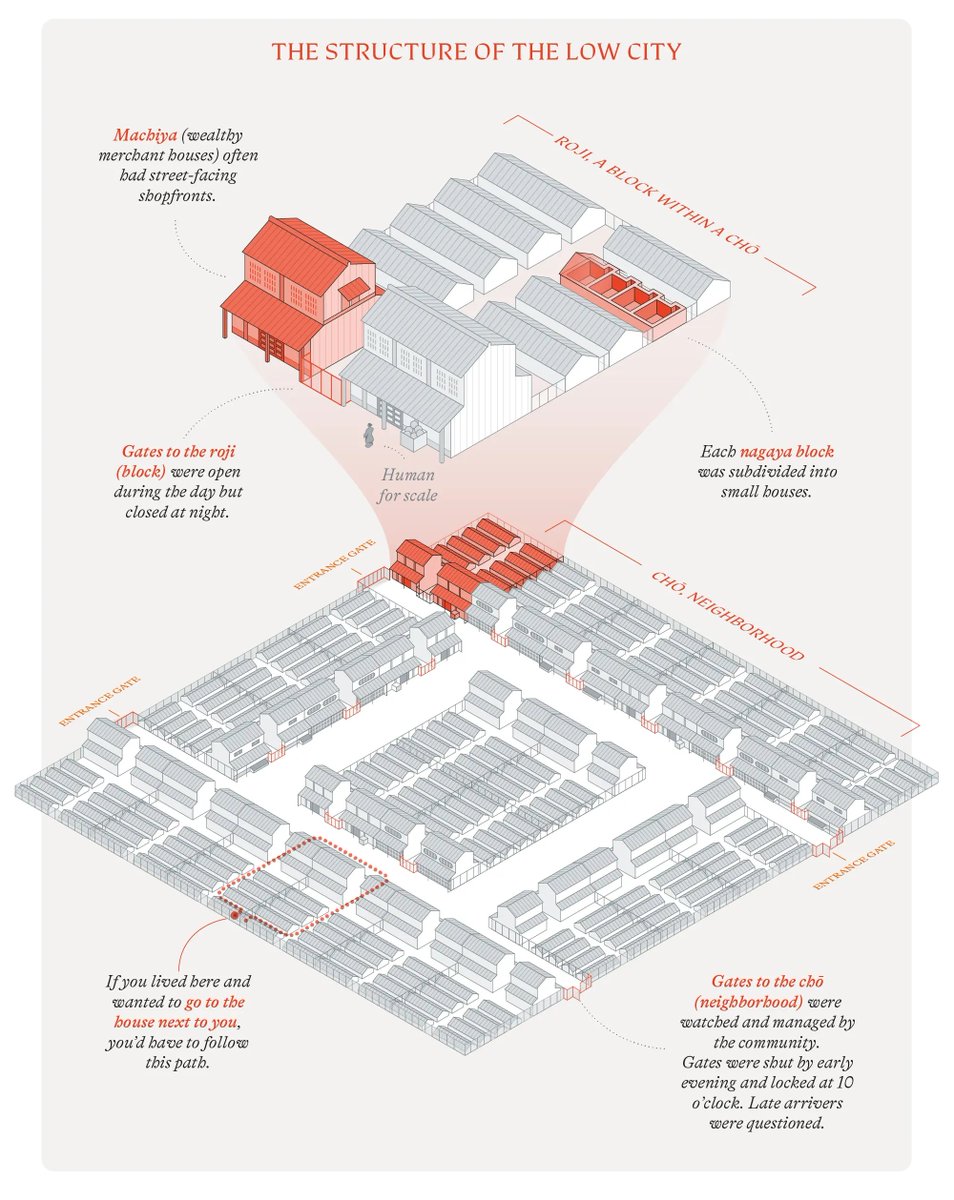
The commoner population was also tightly controlled. Commoner Edo was divided into some 1,500-2,000 fenced and gated blocks. These were then subdivided into gated alleys lined with small houses (see third map). The Low City was thus divided up by tens of thousands of internal checkpoints, all of which closed at night. Edo was not under threat of attack in the Tokugawa period and the city as a whole was not fortified. The purpose of this immense labyrinth of walls and gates was to control and monitor the movement of the population.
Prisons are useful things, and the Tokugawa system was a kind of success, making Japan the most peaceful society on earth. But it is also a disconcerting reminder of the power of rent-seekers, and how a whole city can be warped by the political exigencies they create. Edo is a particularly striking case of this, but it is far from alone.
"Baudrillard claims that current society has replaced all reality and meaning with symbols and signs, and that human experience is a simulation of reality."
Remember when European banks imported the US subprime-crisis by buying up US banks? We should be very happy about Europe largely staying out of this one.
A University System Went All In on A.I. Now It’s Tearing Itself Apart. / yeah a simultaneous rollout without a lot of sandboxing and faculty input is not well advised https://t.co/xSRuV6Ub0R via @NYTimes /
My addition to air conditioning discourse, and why Americans might be a wee bit more obsessed with it than Europeans.
Most of the US Southeast is at North Africa's latitude. 'Southern Italy' is at Ohio's latitude. Paris is in North Dakota, the UK is at Manitoba levels.
Few.
@eiranoirx Or, you can write an app to look exactly the same (non-native) on all platforms, e.g. picking the Win2k style, and focus on making it useful rather than pretty.
@julianhyde@_Felipe Exactly: the production compiler should not check types but simply assume they're correct (maybe with some metadata attached by the developer compiler to the VCS system). Rust has such a compiler but alas, only uses it for bootstrapping.