A member of Congress's portfolio is up 230% this year — $MRNA doubled on cancer vaccine news while sitting in it.
So we built an AI that reads every congressional trading disclosure the moment it's filed and turns it into a portfolio anyone can copy. Free.
Goodbye, Poseidon!
An epic 8-year, 8-figure rabbit hole in post-quantum cryptography reaches its dream conclusion. The Ethereum Foundation is abandoning Poseidon for L1, pivoting to SHA or BLAKE. This milestone unlocks ultimate security for lean Ethereum and foreshadows a golden era of hash-based cryptography.
Since 2018, the Ethereum Foundation has invested in magic cryptographic bricks, so-called "SNARK-friendly hashes". In 2019, Poseidon was born. It held strong and became the dominant SNARK-friendly hash, securing billions via zkrollups and zkVMs.
In a stunning reversal, breakthrough SNARK designs show that SNARK-friendly hashes aren't necessary after all. Off-the-shelf traditional hash functions like SHA2 and BLAKE2s can now match Poseidon in a SNARK. In hindsight the key was not SNARK-friendly hashes, but hash-friendly SNARKs.
The secret is doing maths over the smallest prime number: 2. So-called "binary fields" natively speak the language of bits, aligning with the boolean operations inside traditional hashes. This is a stark departure from "prime fields", where awkward large-prime arithmetic makes bit manipulation painfully expensive.
We're talking sci-fi cryptography. 1M traditional hash calls proven per second, on a laptop. Just 100x overhead vs native CPU boolean compute. Nobody predicted such performance, not even the handful of binary-field visionaries. Hat tip to the research geniuses: Jim and Ben with Binius in 2023; Ron, Benedikt and William with Flock in June.
With SHA2, the lean aesthetic of minimal assumptions reaches its climax. The EF's principled stance on pure hash-based cryptography has aged like fine wine. We now enjoy foundations the world can trust for decades and centuries, foundations worthy of the dream of an internet of value.
Speed of deployment is a secondary win. There's no longer a need to wait years for Poseidon cryptanalysis to bake. Emile and Thomas from the EF post-quantum team are moving at breakneck speed with binary fields. The strawmap now points to a production-grade leanVM in 2027, with CL, DL, EL deployments in 2028.
As AI becomes exceptional at cryptanalysis, the contrarian bet to avoid riskier structures like lattices and isogenies is visibly paying off. The past weeks have been brutal. Lattice-based "HAWK" and isogeny-based "SQIsign", both signature schemes in NIST's Round 3, have suffered blows. Sources I trust say more blood is coming.
On AI, the open autoresearch trend kicked off by ECDSA[.]fail is spreading fast, with amazing outcomes from zk[.]golf and SNARK[.]fast. Days ago SNARK[.]fast crossed 1.8M BLAKE3/sec proven on an M3 Max. Stay tuned for fresh autoresearch challenges dropping tomorrow.
Also tomorrow: Ethproofs call #10, dedicated to binary fields. Possibly the most noteworthy Ethproofs call yet. Experts leading the charge will present the future of hash-based SNARKs at 2pm UTC. What an incredible time to be alive. To witness history, DM me for a calendar invite :)
Today I can confidently claim that hash-based cryptography has won out for blockchain post-quantum signatures. SNARK succinctness compresses arbitrarily many signatures into one small proof per block. SNARK flexibility yields k-of-n threshold signatures, complex multisigs, and more.
Ultimate security. Uncompromising performance. Full programmability.
Believe in something. Believe in hashes.
AI agents are getting intelligent enough to build sophisticated trading strategies. With a few good prompts, anyone with a trading idea can build one themselves. Forward testing on AlphaInsider is the easiest way to validate them before pushing live to your brokerage account.
Building a trading bot got easy about a year ago.
Building one you'd actually trust with money didn't.
Five things have to be in place before you let anything trade for you — verification, forward testing, real diversification, controls, and a broker connection you can walk away from.
Full build, start to finish:
Mark Zuckerberg gets it right:
“The defining question of our age isn’t whether superintelligence will exist, but who will have access to it. Will it be centralized and restricted to a few institutions, or will it be a tool that empowers everyone?”
Concentration of power is the biggest risk of AI. When a small number of labs (working hand-in-glove with the administrative state) decide who has access to which model capabilities, they inevitably shape what can be said, known, and built. That’s not “safety.” It’s control.
As Mark points out, the history of open source shows that broad access and transparency are usually the best path to actual security and resilience. Decentralization creates checks and balances on power. By contrast, centralized alternatives, like bureaucratic approval regimes and mandatory gatekeeping, typically produce regulatory capture and reinforce cartels.
Personal superintelligence in everyone’s hands, with competing models and real data sovereignty, is a far better check on a dystopian future than self-appointed guardians who claim to be “aligned” with all of humanity.
For my first post, I’m sharing a letter @NVIDIA signed on why open models matter.
AI will transform every industry, power every company, and be built by every country.
Open models strengthen safety and cybersecurity, accelerate innovation and diffusion, and enable sovereignty.
The world needs both frontier closed models and frontier open models.
https://t.co/AUKzoQ5Ikb
You don't need your own strategy to run a trading bot.
In fact, most traders are probably better off using someone else's...
What if you could choose from over 5,000 verified (3rd party tracked) trading strategies to build your own trading bot?
That's exactly what this video shows you:
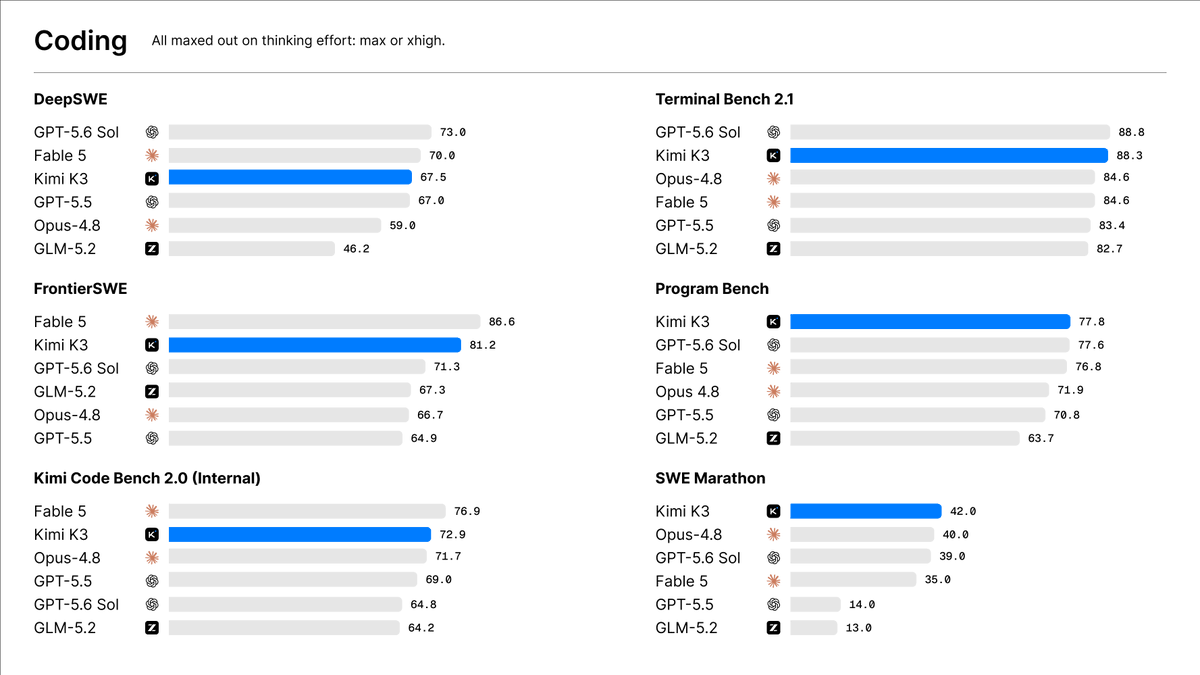
We are finally at the point where open weights models are on par with frontier ones at a fraction of the cost. Anthropic and OpenAI are going to have a hard time competing with this.
Introducing Kimi K3: Open Frontier Intelligence
🔹 2.8 Trillion Parameters, 1 Million Context, Native Multimodal
🔹 Kimi Delta Attention enables up to 6.3x faster decoding in million-token contexts
🔹 Attention Residuals deliver ~25% higher training efficiency at <2% additional cost
🔹 Built for long-horizon agentic coding and self-evolving workflows
Kimi K3 is now live on on https://t.co/zrk6zZxZUo, Kimi Work, Kimi Code, and the Kimi API.
Open Weights by July 27, 2026.
🔗 API: https://t.co/XCrgjXAqMw
🔗 Tech blog: https://t.co/YTfiMSNM1f
Compute is the only real bottleneck to general intelligence. Open-source models are rapidly closing the gap and will soon match closed-source systems on complex tasks. Companies and individuals will increasingly host their own models and run agents purpose-built for their specific needs and data.
Without owning the full stack, true AGI will never materialize. Gatekeepers will always put their own interests first. We’re already seeing this with Anthropic restricting capabilities for security-critical infrastructure. No production system handling real data can safely adopt AGI unless the organization maintains complete control over that data.
Palantir CEO Alex Karp on what customers actually want, the real business of frontier labs, and the importance of open source models:
“What the technical customers want is control over their compute, their models, their data stack, and their alpha. They want to know they own the means of production, and it's not being transferred to someone else.”
"Who owns the data? Are the prompts secure? Is this being transferred to you?"
"If it was so valuable, and I can make you a billion dollars, wouldn't I say I'll make you a billion dollars and I want 30%? Why are they charging for tokens if it's so valuable?"
We’ve had lots of questions from our investor community looking for thoughts on OUSD, and so I thought I’d share my direct views here for anyone.
Stablecoin networks are platform and network effect businesses that are established over a long period of time, tend towards winner-take-most market structures, and resemble other internet platform utility markets. There are several layers that drive this.
First, stablecoin networks effectively act as public protocols and software layers on the internet and their network strength is a matter of the number and range of applications and services that integrate to the network. Every time a developer or service provider integrates to the network, it brings more network effects. This attracts more developers and adds more utility and more network effects. This then drives demand for the digital currency itself, which then reinforces these network effects through liquidity network effects.
We have realized this at a massive scale with the USDC network today — thousands upon thousands of services integrate with our network, which in turn provides immense utility not just to each application, but to users as a whole who benefit massively from the reach and interoperability that exists. This drives user and developer preference further. We’ve invested in building that ecosystem over nearly a decade, and now it’s accelerating as mainstream institutions come onto the network, connecting their customers and users.
We add to that utility by building software stacks that further expand and strengthen the network — protocols like CCTP and Gateway, which promote interoperability, safety and liquidity around the world. This expands the target surface area for app builders and developers, making it easy for them to tap into the liquidity and network effects that already exist. We are now seeing that stack get pulled into all kinds of chains, permissioned L2s, networks being built by governments, and so much more.
The second layer is that of liquidity network effects. This is fundamental. Liquidity begets liquidity. For a stablecoin to achieve scale and utility, it needs to be highly liquid, both on a primary basis (e.g., through all the major financial market centers in the world, with world class direct banking liquidity) and on a secondary basis both by being available and tradeable for retail and institutional clients in every geography and against every fiat instrument in the world. People who want to access and move value need to be able to easily get in and out of that digital currency. Here, we’ve invested nearly a decade in building out that liquidity, and it is now entrenched in exchanges, DeFI venues, and with PSPs, payments firms, regional exchanges, and so many others. Establishing these liquidity network effects also involves building global regulatory infrastructure and ensuring that the stablecoin is available under various regimes around the world. Today, USDC is in the top 3 most liquid digital assets in the world, and it falls off sharply after that. BTC, USDT and USDC have extraordinary liquidity. The closest other dollar stables are like 10x smaller and that liquidity tends to be concentrated in promotional books in a single exchange, whereas USDC liquidity is dispersed widely across dozens and dozens of surfaces. Building this liquidity has been a nearly decade-long task that we continue.
A third layer of network strength comes from the deep integration with the policy and regulatory environment — in many cases, years of effort to build licensing (e.g., USDC is the only large global stablecoin currently available in all of Europe or Japan), and more regimes for stablecoins are coming online, with Circle leading the way in ensuring that USDC is officially recognized, registered, licensed and accepted in the most important markets in the world. On the back of this is the work of building global banking, reserve management and treasury and liquidity management that can operate this on a nearly 24/7 basis in markets and banking systems globally. This globalization effort is a massive investment that we have made over the years.
All of these investments by Circle and our global ecosystem of thousands of partners have delivered the net result of providing the world’s most trusted and available digital dollar infrastructure—a utility that any user, developer, or business can freely and easily tap into. And we do not intend to slow down.
All of this compounds and shows in the numbers. In Q1 2026, according to third-party analysts (Artemis) who track stablecoin adoption, USDC handled nearly $30T in onchain transactions, representing 80% of all dollar stablecoin transactions on blockchains. USDT handled the remaining 20% of transactions. All of the combined remaining dollar stablecoins handled a total of 0% of transactions (i.e., < 0.5%). While other stablecoins may have some circulation, most of that is through promotions and incentives, the actual usage is extremely limited—because of the extremely limited liquidity and network utility that exists for these coins.
But my thoughts on the competitive landscape are not just about the strength of our network—there are also considerations around any new initiative.
Several perspectives and positioning have been shared about how something like OUSD improves on something like USDC.
1) Free mint and burn. The argument suggests that existing stablecoins charge burn fees, and payments firms should not need to pay these (despite the fact that the entire payment industry is built on small bps fees on various ingress and egress points on their networks). There are structural market realities built around the fact that some stablecoins impose very large redemption fees and have limited redemption facilities – the impact of this is that stablecoins with strong redemption facilities, good liquidity and no fees become the offramp for their competitor stablecoins. It may seem easy to say one will offer unlimited and free redeems, however market reality likely forces other behavior. This can be addressed – and is addressed by Circle – through contractual mechanisms vs. a blanket fee exemption.
2) Everybody wins and shares. While this sounds good in principle, the reality of the market and market opportunity is quite different. Today, Circle shares the majority of its income with its distribution partners, and we continue to lean hard into expanding those partnerships with leading companies across every sector of the market. However, we also retain significant income that allows us to invest in the massive market infrastructure that makes this such a powerful and valuable utility for the world to build on. Giving away all the income is a recipe for starving an infrastructure, systematically underinvesting and ensuring that your platform will remain limited in scope.
Furthermore, Circle believes that the future stablecoin market is likely several orders of magnitude larger than it is today. We’re actively bringing partners into the USDC ecosystem through a diverse and growing set of partnership models that span our work with exchanges, custodians, payments firms, asset issuers and more. We are excited to continue to build with a “big tent mentality” where the entire ecosystem can grow value together.
3) A consortium where everybody has a voice. Perhaps I have a cynical view, but the track record of consortium products achieving scale, P/M Fit or even basic product agility is absolutely dismal, and while there are examples of financial consortia that operate utilities, they are predictably slow moving. Large groups of large companies coordinate poorly, have misaligned incentives, slow things down and rarely create the space for real durable innovation and competitiveness. They also typically, out of their own self-interest, starve the consortium itself on an operating basis. We actually tried this in the early days of USDC, and even with a very small group, ran into endless challenges and complexity. Smaller, tighter strategic collaborations and commercial partnership arrangements with product and platform builders that can drive forward independently will almost always outcompete large consortiums. But oftentimes when these get formed, everyone feels like they should put their logo on the list, kiss the ring, and make noise about openness. But typically those same firms will turn to their operating units and make the best decisions for their customers, which often means partnering with the market leader and building durable win-win partnerships.
There’s also been a bunch of commentary on Circle's partnership with Coinbase and what this all means. Our stablecoin partnership with Coinbase remains as strong as ever, and I think we both see that enormous opportunity ahead to expand the USDC network.
A final comment: Circle remains committed to supporting a wide range of different products and infrastructures, even when we might compete with different aspects of those partners’ products in other areas of our business. With OUSD, we work closely with many of the founding members, and we expect that those same members will remain large USDC partners and customers. At the same time, as Circle has diversified our product and platform stack, expanding across Arc, CCTP, CPN, StableFX, Agent Stack and many other areas, we continue to expand the partnerships and collaboration with many other stablecoin issuers — dozens of them — to help them launch on Arc, leverage our interoperability infrastructure, get supported in our Wallets and become settlement and FX options on CPN and StableFX.
We are huge believers in growth in the stablecoin ecosystem and welcome OUSD as a new member of the community!
We developed a simple AI agent skill that allows any agent to easily integrate with our service. You can check out how to install and use it by going to our API docs:
https://t.co/QPO6MLTOk7
You already have everything you need to connect an AI agent to AlphaInsider.
No code. No extra subscription.
Just install the skill, drop in your API key, and your agent can:
→ read your strategies
→ pull live positions
→ even place trades
I walk through the full setup in a few minutes 👇
Now that the government is limiting access to the new frontier models (Mythos/Fable and GPT-5.6), I'm starting to think we're approaching an inflection point where open-source models will catch up to frontier systems in intelligence and agentic capabilities.
When that happens, users will face a clear choice. They can pay per token to the big AI labs for top-tier performance and intelligence, but it will cost them their privacy since these companies can see everything they're doing and often require identity verification. Alternatively, they can make a larger upfront investment in personal compute, such as a small home cluster, to run open-source models locally. This approach delivers full privacy and protection from government overreach.
In my view, open-source models will hold a lasting competitive advantage over the closed labs, primarily because of the privacy and self-sovereignty they provide, even if it requires paying more upfront.
Compute will remain the main bottleneck for AI, but it will keep getting cheaper as the technology improves.
Built a trading strategy that actually works?
You can put it behind a paywall and keep 70% of every subscription.
Your performance stays public the whole time — so people see the track record before they pay a cent.
No need to become a "trading guru" online to promote yourself. Just let the results speak for themselves 😎
Full setup, start to finish:
The fact that orbital compute is (soon) the most efficient way to build datacenters says a lot about how much excessive regulation has harmed progress on earth.
It’s more efficient to fly to outer space than to try and build on land.
Freedom is always on the frontier.
The U.S. constitution was a breakthrough in that it protected citizens from tyrannical government. What it missed, and what we should try to integrate into the next constitution (on Mars, special economic zones, etc), is restraint against unchecked growth of regulation and government spending.
I’ve been slowly collecting proposals for how that could work. Might do a post on it at some point.
That backtest you're proud of is probably lying to you.
Anyone can build a flawless-looking equity curve with AI in minutes. Forward testing is what separates real strategies from fantasy.
Here's how to test any trading idea before risking $1 👇
Yes. Other competitors will take away market share from Anthropic once another comparable model becomes available, provided the government does not restrict competition.
Question to all the people upset about Anthropic adding safeguards to Fable. I think most of you come from a libertarian viewpoint?
But from that perspective, isn't it also Anthropic's right to do whatever they want with their model?
This is a game changer for those who want to first try using an automated trading service before committing a larger portion of their portfolio to it. This also helps with making sub accounts on brokers with limited capital but still have access to margin trading.
$2,000 is now all it takes to run a fully automated stock bot that trades with leverage.
Used to be $25,000.
The PDT rule died last week — so we dropped the AlphaInsider minimum on Alpaca bots to match.