This is brilliant! 🔥
Inspired by Nitin Gadkari, dairy farmers in Jaipur have introduced M0, M50 and M100 milk.
M100 milk is best for health and can even be consumed by lactose intolerant people. Because it is pure water! 🤣
This photograph stayed with me.
Not because it is Rahul Gandhi.
Not because it is politics.
But because of what it reveals about the strange times we live in.
A politician floating in the waters of Great Nicobar, trying to understand what lies beneath the surface before speaking about one of the largest and most ecologically contentious projects in independent India.
It struck me that there are two ways of looking at a country.
One is from the comfort of air-conditioned rooms, surrounded by books, data sheets, opinion polls and ideological certainties.
The other is by walking dusty roads, sitting with ordinary people, climbing mountains, entering forests, crossing rivers and, sometimes, diving into the sea.
I know which one I find more convincing.
The Great Nicobar project is not merely a development project.
It is about ancient rainforests, irreplaceable coral ecosystems, endangered species, indigenous communities and a fragile geography that took millions of years to evolve.
Yet much of our mainstream media discusses it as if it were a real-estate brochure.
Every forest becomes “vacant land.”
Every river becomes a “resource.”
Every coastline becomes an “investment opportunity.”
Every environmental concern becomes an “obstacle to progress.”
And every citizen who raises questions becomes anti-development.
The same media that rolls out red carpets for corporate promoters and celebrates every mega-project with breathless enthusiasm suddenly discovers scepticism when Rahul Gandhi talks about environmental destruction.
The same television anchors who never ask difficult questions about forests being cleared, mountains being blasted or coastlines being transformed overnight become relentless interrogators when someone questions those projects.
It is a fascinating form of journalism.
The billionaire gets a prime-time celebration.
The rainforest gets a footnote.
The coral reef gets ignored.
The tribal community gets erased.
And the politician raising uncomfortable questions gets mocked.
Meanwhile, many of our public intellectuals continue their favourite pastime: measuring leadership from a safe distance.
A leader walks across India? Publicity stunt.
A leader sits with farmers? Optics.
A leader meets tribal communities? Symbolism.
A leader dives into the sea to understand an ecological crisis? Performance.
Apparently, the highest form of public service is sitting comfortably in a chair and explaining why everyone else is inadequate.
The irony is almost poetic.
For decades, India’s environmental movements have pleaded for leaders who would listen to scientists, conservationists, indigenous communities and ordinary citizens before approving projects that alter landscapes forever.
Now, when a major political leader actually invests time and energy in understanding such concerns, he is ridiculed for doing exactly that.
Looking at this photograph, I was reminded of a simple truth.
A nation is not understood from drawing rooms alone.
It is understood from its forests.
Its rivers.
Its mountains.
Its coastlines.
Its villages.
Its people.
And sometimes, from beneath the sea.
The armchair experts may continue debating gravitas.
The television studios may continue manufacturing narratives.
The corporate cheerleaders may continue selling dreams of limitless development.
But this image tells a different story.
It shows a politician willing to leave the shore.
And in today’s India, that is rarer than many would like to admit.
A Life That Served a Purpose
In a world chasing fleeting applause, some souls choose the long, quiet road of service. Today, welfare economist Jean Drèze has been honoured with a global award for his profound research on poverty and inequality in India.
Born in Belgium, he made India his home and its people his purpose. With a scholar’s rigour and a revolutionary’s heart, he stood beside the forgotten—documenting their struggles, amplifying their voices, and shaping policies that reached millions.
His tireless advocacy helped birth two landmark legislations that still stand as lifelines: the National Rural Employment Guarantee Act (NREGA), which offered dignity through work to the rural poor, and the National Food Security Act, which sought to ensure no one sleeps hungry in a land of plenty.
This is not just an award. It is recognition of a life lived in radical empathy. Of choosing dusty villages over ivory towers. Of measuring success not in citations or comfort, but in the quiet lifting of human suffering.
Jean Drèze reminds us that the highest calling is to use one’s intellect, privilege, and time in the service of those who have the least.
In an age of cynicism, his journey is a living ode:
To knowledge that heals. To scholarship that serves. To a life that mattered.
Congratulations and Thank You Professor Drèze.
India is better because you walked among us.
May your example inspire a new generation to stop performing compassion and start practising it—with depth, persistence, and love.
🧡 🙏
#JeanDreze #ServiceAboveSelf #India #SocialJustice
This is an unbelievable piece of work by Sarthak and something that requires amplification.
Let me explain what he found, in simple terms.
Sarthak is a Class 12 student from the 2025-26 batch, one of the 17 lakh students whose answer sheets went through CBSE's new On-Screen Marking system.
He spent days reading through CBSE's evaluation tenders, scraped all 576 tenders CBSE has issued, and tracked how the rules changed across three versions of the same tender.
The core finding is that the company that won the contract to scan and grade 17 lakh students' answer sheets is Coempt Eduteck.
Coempt used to be called Globarena Technologies. Globarena was the company behind the 2019 Telangana intermediate exam disaster, where software failures led to 3.8 lakh students getting wrong or missing marks, and 23 students died by suicide.
A government committee found systemic failure and negligence. Six months later, Globarena rebranded to Coempt Eduteck.
So a company with that track record won a contract to handle 17 lakh CBSE students. Sarthak's investigation is about how the rules were rewritten to let that happen.
The tender was issued three times.
> First tender, February 2025. It existed, then disappeared from the public GeM portal. Sarthak scraped all 576 CBSE tenders and this one was missing from the archive entirely.
> Second tender, May 2025. Four companies applied including TCS and Coempt. All four failed the technical evaluation. Cancelled.
> Third tender, August 2025. Coempt won. Between the second and third tender, a series of rule changes happened, and every single one made it easier for Coempt to qualify.
Here is what changed, one by one.
01. The old rules disqualified any company with a history of abandoning work, failing to complete contracts, or financial weakness. The new rules deleted this clause entirely. Coempt's Telangana history stopped being a barrier.
02. The old rules disqualified any company that was "blacklisted earlier." The new rules changed this to "currently blacklisted." Because Globarena rebranded after Telangana, removing the word "earlier" effectively erased their past.
03. The rules required Rs 50 crore average turnover over three years. Coempt's exact average came to Rs 50.86 crore. They cleared the bar by less than 1%. Earlier, a smaller company had asked CBSE to lower the bar to Rs 30 crore for fairer competition. CBSE refused. So the bar was kept high enough to block small players, but sat exactly low enough for Coempt to scrape through.
04. Software maturity is measured on the CMMI scale, 1 to 5. The old rules required Level 5. The new rules dropped it to Level 3. Coempt is a Level 3 company.
05. The cooling-off period for engaging retired CBSE officials was cut from two years to one. This makes it easier to use recently retired insiders to influence the process.
06. The old rules required experience with large projects of at least 5 lakh students each. The new rules removed the student count and counted cumulative answer-book volume across small projects instead. Coempt has many small fragmented university contracts. This helped Coempt and hurt TCS.
07. The old rules required bidders to own their own data centre and disaster recovery centre on Indian soil. The new rules allowed third-party MeitY-empanelled cloud hosting. Coempt runs on AWS and Azure. This helped Coempt and hurt TCS, which owns its own data centres. It also means student data is no longer on sovereign, Indian infrastructure.
08. The old rules required the bidder to own or control the complete source code of its software. The new rules deleted this. Coempt's platform runs on Microsoft's proprietary IIS, which they don't own.
09. A last-minute corrigendum, issued right before bid submission, removed CBSE's own power to blacklist the firm if its software failed catastrophically. So even a Telangana-scale failure couldn't get Coempt banned from future government tenders.
10. The penalty structure shifted from punishing mistakes to punishing delays. The old rules fined the vendor for wrong scanning, merged pages, and unscanned books. The new rules dropped those and instead levied Rs 50,000 per day for delays. This incentivises rushed scanning over accurate scanning.
11. The old rules had a hard accuracy threshold, error rate not to exceed 0.5%. The new rules removed this number entirely.
12. The old rules specified proper book and robotics scanners. The new rules just say "sufficient scanners." The definition was vague enough that, as Sarthak notes, the scanning could be done with a phone on a stand.
13. On the security side, the contract required a VAPT (vulnerability and penetration test) certified by CERT-In before go-live, and a restricted beta phase before launch. The system clearly wasn't restricted, because the other researcher, Nisarga, was able to access it and find vulnerabilities four days before go-live. So the mandatory security audit appears to have been bypassed.
These are more than a dozen rule changes, all between the failed tender and the winning tender, all pushing in the same direction, all benefiting the one company with the worst track record in the field.
The security holes Nisarga found last week now have an explanation. The system was built by a vendor that was specifically allowed to skip the security certification, the source code ownership, the data sovereignty, and the quality thresholds the original rules demanded.
Following things need to happen immediately;
1. An immediate CAG audit of the tender process.
2. A parliamentary debate on the topic.
3. An independent investigation into
> Why the first tender vanished?
> Why the disqualification clauses were deleted?
> Why the turnover bar was held exactly where it was?
> Why the security level was dropped?
> Why the blacklisting power was removed at the last moment?
Sarthak, this is genuinely exceptional investigative work. Far better than most journalists with full resources ever manage. Take a bow. :)
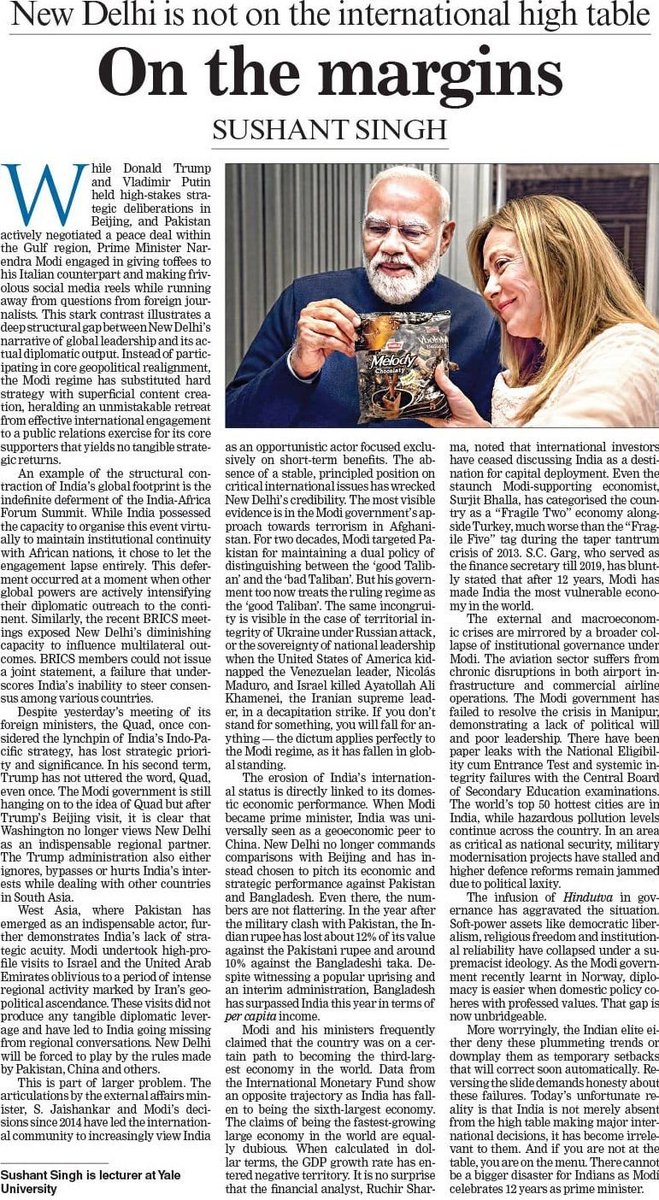
Today’s unfortunate reality is that India is not merely absent from the high table making major international decisions, its absence is not being noted - it means India has become irrelevant to them. And if you are not at the table, you are on the menu.
My column in @ttindia
मुगल बहुते खराब राजा थे।
कहते है उनके दौर में व्यवस्था बहुत खराब थी। जैसे दुनिया की जीडीपी का केवल चौथाई हिस्सा, मुगल सल्तनत का था।
औरंगजेब के प्रशासन में 45% अफसर हिन्दू थे। जिनका ब्रेनवॉश करके, उन्ही से मंदिर शन्दिर तुड़वाते रहता। बहरहाल ये हिन्दू मुस्लिम वाली बातें तो अपना मुद्दा नही।
बात नौकरी की है।
●●
तो मुगलो के दरबार मे नौकरी हुआ करती थी।
नौ-कर। याने एक करे, नौ खाये। तो अगर आप नौकरी करेंगे, तो दादा दादी, मां बाप, बीवी और 4 बच्चे मजे से खा सकते थे। लेकिन यह बुरा दौर बीत गया। मुगल खत्म हुए, मराठे आ गए।
चाकरी होने लगी। एक करे, चार खाये।
●●
चार में आप चाहे जिसे खिला लो।
बच्चे या दादा दादी?
तो आपको, और बाप को- दोनों को काम करना पड़ता। पर हालत इतनी बुरी नही थी, घर मेंटेन हो जाता था। लेकिन फिर अंग्रेज आ गए।
तनख्वाह मिलने लगी।।
●●
तन खा। याने आपका तन खा ले, इतना मिल जाता। हर आदमी को अपना इंतजाम देखना था। तब से महिला शिक्षा की बात उठने लगी। उसे पढ़ाओ- काम पर लगाओ।
सशक्तिकरण दरअसल मजबूरी करण से उपजता है। लोग जॉब वाली बीवी इसीलिए चाहते है, कि ससुर के खर्च पर पला पलाया एसेट रेडी मिल जाये। जो आये, कमाए।
और अपनी तनखा से खुद का तन मेंटेन करे। कुछ तो पेंशन से ही बढ़िया मेंटेन कर लेते थे। लेकिन हाय रे भाग्य.. उन्हें हटाकर कांग्रेस की सरकार आ गयी।
सबको वेतन मिलने लगा।
जो अपभ्रंश है।
●●
असल मे यह बे-तन कहलाता था।
याने तनखा में तन, जैसे तैसे खा लेता था। उसके लिए भी कम पड़ने लगा। परिवार नियोजन, नसबंदी, मरफ़ी का रेडियो.. योजनाएं आयी कि बच्चे कम पैदा करो।
नही तो उनको ख़िलाएगा कौन।
बाल श्रम भी तो बन्द करवा दिया था।
परवर्ती काग्रेस युग में ये चोचले भी फेल हो गए। फिर पेट भरने को लोन लेना पड़ता। सबै लोन लिए पड़े थे। आदमी लोन ले, कम्पनी लोन ले, सरकार लोन ले।
ऋणम कृत्वा घृतम पिवेत।
इसी के लिए बैंक नेशलाइजेशन हुआ। सस्ती दरों पर लोन मिलने लगा। लिबरलाइजेशन के बाद तो हर दिन सुंदर सुंदर लड़कियां मुझे भी लोन देने के लिए फोन किया करती थी।
मने फोन पे दिखता तो नही, लेकिन सोचकर मन तो खुश हो ही जाता था। पर यह खुशी भी परवरदिगार को मंजूर न थी।
तो फिर अच्छे दिन आ गए।
हमको सैलरी मिलने लगी।
●●
यह भी अपभ्रंश ही है।
असल मे आंग्लभाषा है- sale- re
जो है वह भी बिक जाना है। तो अब सब बिक रहा है। और एक बार नही बार बार बिक रहा है। एसेट बिक रहे है, PSU बिक रहे हैं, पोर्ट, एयरपोर्ट रोड बिक रहा है। नेता बिक रहा है, अफसर बिक रहा है। जज और ईश्वर, सबकी बोली लग रही है।
बिकवाली का दौर है।
सेल-री का दौर है।
अब तो प्रधानसेवक ने खुलकर कह दिया है कि खरीदो मत। तेल मत खरीदो, सोंना मत खरीदो। मोटीवेशन के लिए उन्होंने खुद रूस से तेल खरीदना बन्द कर दिया है।
●●
मुझे विदेश जाने से भी मना किया है।
मैं मान भी गया,सच्चा हिन्दू हूँ।
लेकिन कुछ सनातन विरोधी अभी भी विदेश में हैं। ऐसे उन्हें समझाने को प्रधानसेवक खुद विदेश जाने वाले हैं। क्योकि मेल-मिलाप और समझा बुझाकर ही मतभेद सुलझाए जाते हैं।
यह लोकचंद्र की ब्यूटी है।
●●
लेकिन मुगलो के दौर में लोकचंद नही था।
इसलिए उनके दौर में व्यवस्था बहुत खराब थी। जैसे दुनिया की जीडीपी का केवल चौथाई हिस्सा, मुगल सल्तनत का था।
मुगल बहुते खराब राजा थे।
💐🙏
सुनो बच्चों, NEET का एग्जाम बाद में भी हो सकता है लेकिन तुम्हारे मम्मी-पापा ने जो शेर पाला है वो दोबारा नहीं मिलेगा.
शेर अभी तुम्हारे एग्ज़ाम्स खा रहा है, कल करियर खायेगा और परसों पूरा फ्यूचर खा जाएगा…तो क्या शेर पालना छोड़ दोगे?
KARNATAKA POLITICAL BREAKING:
#ElectionFraud: BREAKING — Supreme Court drops a bombshell on Karnataka's Sringeri seat!
📌 "We will not allow democracy to be hijacked" SUPREME COURT SLAMS KARNATAKA HIGHCOURT.!
📌 WHAT HAPPENED: The Numbers Tell the Story:
✅ CONG's TD Rajegowda won by 201 votes in 2023
✅ HC ordered review of only 279 rejected ballots
❌ Returning Officer re-examined 562 VALID votes
❌ Flipped the result- declared BJP's Jeevaraj winner; SC reversed it immediately.
📌 IT DOESN'T STOP THERE: UNDERSTAND THE WHOLE STORY.
BJP's Jeevaraj, District Collector K.N. Ramesh & former Returning Officer Vedamurthy face criminal complaint for alleged postal ballot tampering.
HC stayed the criminal case.
Supreme Court stepped in anyway.
Justice delayed- but not denied.
📌 #BOTTOM_LINE: Justices Sanjay Kumar & K. Vinod Chandran restored CONG's TD Rajegowda as Sringeri MLA with immediate effect.
Search is full of ads and wrong answers. Every other email is an ad. Prime Video charges you and shows ads. Paramount? Ads. Peacock? YouTube? Hulu? Ads followed by more ads. Netflix full of ads. Meta and X, every other thing is an ad. Pinterest is nothing but ads. AI is in everything. AI finishes sentences incorrectly and won’t stop. AI reads your email and search history to target you with more ads. Every time you open an app or visit a site there’s an update making it worse. In a hurry? First, click here to agree to terms you don’t have time to read and must accept. You need an account to do that. Change your temporary password. Enter your 2FA code. Check your email and enter that code. Now use a passkey. Your password is too simple to remember. Change it. No, not like that. Now log on. Enter your 2FA code. Check your email for a code… Welcome back! We’ve updated our terms of service and privacy policy (you have none). Subscribe to the site. Subscribe to Netflix. Subscribe to toilet paper. Subscribe to these groceries. Pay a membership fee for the right to subscribe then tip your driver who delivers the subscriptions your membership lets you subscribe to. Time to work? We’ve got to update your laptop and will slow down everything you do until you agree to update. But first, click here to agree. Update installed — your laptop’s broken now. It doesn’t matter, since your boss just replaced you with AI. Go to your phone to complain on social media. Wait, your phone needs an update so we can add more AI. Click here. Oh sorry, your phone can’t handle this update. Now it’s useless. Go get the newest phone. Here’s a text from a friend, an email, a voice mail they left three days ago but you didn’t see until now because of sync problems with the cloud. It’s their GoFundMe. Their MLM. Their Patreon. Never mind, you didn’t respond to their text within 9 minutes and now you’re no longer friends. They blocked you. Make new friends. Download this app to find people in your area. In your neighborhood. On your street. Two doors down from you. Do you know this person yet, we think you’d get along. You need an account to use this app. That username is taken. Enter a password. Not that one, you used it on another site. You need to be connected to WiFi to download the app. Allow the app to connect to other devices on your network. Allow the app to access your contacts, know your precise location, store your credit card details. Oops, sorry, we got hacked now all that info is available on the web. There’s a class action suit. You can join. It’ll take a decade to get your $3.73 share of the ten billion settlement. We’ll send it via PayPal or deposit it to your bank, just tell us those details. Oh no, another hack. That info is circulating now, too. Here’s a spam call, a spam email, a spam text. Why are you angry? Why are you talking about getting rid of your phone? Why don’t you like AI, it lets us make all of this easier? Do you know how ridiculous that sounds? This is progress. You’ll be left behind. Do you want to be left behind? Do you???
What does it really mean to stay committed to your craft… when everything around you is designed to break you?
There is something deeply inspiring about watching @PrannoyRoy7749 today. A man who helped shape modern Indian television news, who co founded NDTV, who brought credibility, data driven election analysis, and intellectual depth into our living rooms, now travelling across Kerala, Tamil Nadu, West Bengal, recording interviews on his own mobile phone for his digital channel Dekoder.
No studio lights. No prime time debates. No corporate backing.
Just a man, a phone, and an undying commitment to journalism.
If passion ever needed a face, it would look like Prannoy Roy.
But his legacy is not just what he built. It is also, who he built.
NDTV, at its peak, was not just a news channel. It was a school. A culture. A standard. He mentored a generation of journalists and introduced them to a simple but powerful idea, journalism without fear or favour. Many carried that torch forward. Some did not. But the ecosystem he created shaped Indian media in ways we often forget.
And let us be honest, Prannoy Roy did not lose NDTV. India lost Prannoy Roy’s NDTV.
At a time when narratives were convenient and pressures were real, he and his organisation faced investigations, raids, and relentless scrutiny. Yet, through all of it, there was one thing they did not do.
They did not bend.
Not once did they turn into cheerleaders for power. Not once did they barter credibility for comfort. Not once did they dilute their editorial spine to survive.
That is not just journalism. That is character.
… And maybe that is exactly what journalism still needs.
🚨 Budapest now: 17 years of Orbán's rule ended tonight — in the streets. The man who shielded Netanyahu, blocked every EU resolution against the genocide in Gaza, opened his skies to an ICC-wanted fugitive… was brought down by his own people at the ballot box. A lesson to every tyrant: the chair is temporary. The people remain.
MIDNIGHT TERROR 💥
At 3 AM, Police Launched a savage pre-dawn assault on Kantamal Village in Rayagada, #Odisha.
They Cut Electricity, Smashed Doors, and Unleashed Lathi Charges and Tear Gas on sleeping Adivasi Families.
THE TARGET?
To bulldoze a 3-km access Road for Vedanta's Massive #Sijimali Bauxite Mining Project — 1,549 hectares of sacred tribal hills packed with a staggering 311 MILLION tonnes of Bauxite.
For years, Adivasis have fought to protect their Forests, Perennial Water Sources, and entire way of life.
No real consent. Just forced moves to hand over the land to Vedanta.
This is the Raw, Ugly Face of the BJP-Corporate NEXUS: State Power Weaponised at Gunpoint to Serve Corporate Greed and Destroy Indigenous Lives.
Adivasis are Still Standing For Jal, Jangal, Zameen.
Will You Stay Silent While Their World Is Looted?
#ModiMustResign #Dacoit #USIranTalk
(🧵1/11) For the past year and a half, I've been investigating OpenAI and Sam Altman for @NewYorker. With my coauthor @andrewmarantz, I reviewed never-before-disclosed internal memos, obtained 200+ pages of documents related to a close colleague, including extensive private notes, and interviewed more than 100 people.
OpenAI was founded on the premise that A.I. could be the most dangerous invention in human history—and that its C.E.O. would need to be a person of uncommon integrity. We lay out the most detailed account yet of why Altman was ousted out by board members and executives who came to believe he lacked that integrity, and ask: were they right to allege that he couldn't be trusted?
A thread on some of of our findings:
🚨After 16 years of a covert intelligence operation, the engineer who disrupted uranium enrichment in Iran has been revealed.
An investigative report by a Dutch newspaper has uncovered the identity of the agent who introduced the “Stuxnet” worm into the main uranium enrichment facility in Natanz, central Iran.
Sixteen years after the largest operation targeting Iran’s nuclear program, the Dutch newspaper De Volkskrant revealed details of how U.S. and Israeli intelligence accessed the highly fortified facility, after a Dutch engineer successfully delivered virus-infected equipment into Natanz and installed it on water pumps.
According to the investigation, Dutch engineer Erik van Sabben, an agent of the Dutch General Intelligence and Security Service (AIVD), managed to reach the Natanz facility to carry out the operation, which was preceded by years of preparation and cooperation between the U.S. Central Intelligence Agency (CIA) and Israel’s Mossad, at a cost of $1 billion to develop the virus.
Regarding the decision to reveal the operative’s identity, the newspaper stated that his death “eliminated the risk of Iranian retaliation,” noting that his family agreed to disclose his name and publish his photo.
The report stated that the engineer carried out an extremely high-risk mission in Iran by infiltrating the Natanz facility in 2007, where he installed infected devices and equipment, leading to the disruption of around 1,000 centrifuges at the site.
According to the newspaper, the Dutch engineer, who was married to an Iranian woman, worked for a transport company in Dubai and traveled multiple times to Iran. The company, TTS International, said it had previously shipped spare parts for Iran’s oil and gas industry, but was unaware of its employee’s covert activities.
It remains unclear whether van Sabben used his job to import nuclear-related equipment into Iran or whether he knew that the equipment he delivered to Natanz contained a destructive virus.
At the end of 2008, van Sabben and his family traveled to Iran for a New Year holiday lasting ten days, but the day after arriving, he urged his family to leave immediately.
Two weeks after his mysterious departure from Iran, van Sabben died in an accident in Sharjah near Dubai, after losing control of his motorcycle, which overturned and broke his neck.
His death raised questions within Dutch intelligence, with concerns that it might be linked to his covert activities in Iran.
The two-year investigation was based on testimonies from 43 individuals, including 19 from the Dutch intelligence services (AIVD and MIVD), as well as former employees of the Mossad, Israeli Military Intelligence (Aman), and the CIA.
It is worth noting that the United States and Israel developed the “Stuxnet” virus, which was discovered in 2010 after being used to attack the Natanz facility, marking the first cyberattack of its kind targeting industrial equipment.
The virus is a malicious computer program designed to attack widely used industrial control systems produced by the German company Siemens AG, exploiting security vulnerabilities in Microsoft Windows.
दुनिया का कोई अर्थशास्त्री मुझे यह समझाए। डॉलर छोड़िए, भारत का रुपया अफगानिस्तान की करेंसी ‘अफगानी’ के मुकाबले भी इतना क्यों गिर रहा है? ऐसा कैसे हो सकता है?
हम इतनी बड़ी अर्थव्यवस्था हैं, लगभग विश्व गुरु हैं। फिर भी एक अफगानी लगभग डेढ़ रुपये के बराबर है, जबकि 2022 में एक अफगानी भारत के 71 पैसे के बराबर था। चार साल में इतनी गिरावट? #India #Rupee #Afghani