IMO AI use is largely a trauma response. US propaganda has conditioned people into tying their self-worth to their economic output, and by extension their internal feelings of productivity. They simply cannot enjoy their passions, doing as much as possible as fast as possible is the only thing that quells their existential anxiety.
I see evidence of it everywhere. People who have zero stake in me or my work will get seething mad because I simply enjoy doing a task without AI, or that I said that I do not want to use AI for something. Some dude last month had a major crash out in my replies and accused me of "holding back the entire industry" because I'm vocal about my disdain for AI.
It's become so normal, nobody even takes a step back and thinks about it for a second. Why on earth would someone get sent into an uncontrollable rage as a result of seeing someone else enjoying themselves doing a task at whatever pace they feel like?
It's also not uncommon to get hit with the classic "this is why Europeans don't have trillion dollar companies". I'm sorry...what? Who tf wants that?
People have fresh food, clean water, roofs over their heads, 20-30 days of mandatory paid leave per year, maternity leave, healthcare, livable wages, normal working hours, vacations, and so much more. What sane person would throw it all away so that some other dude can have a billions of dollars?
The "do as much as possible as fast as possible" people are genuinely a nuisance to society. They rarely ever enjoy themselves, and they take away other people's enjoyment of life with their incessant need to maximize the output of everything possible.
It's a trauma response. Existential anxiety caused by the belief that productivity and economy output are the ultimate measures of a person's worth.
@JackRhysider@cqwww@IntCyberDigest@SimpleXChat I missed where anything signal is doing would stop you from having an AI agent using signal-cli to communicate with you as a "user"
AFAICT protecting people's client instances from snooping doesn't impose a blocker on the use case you've described.
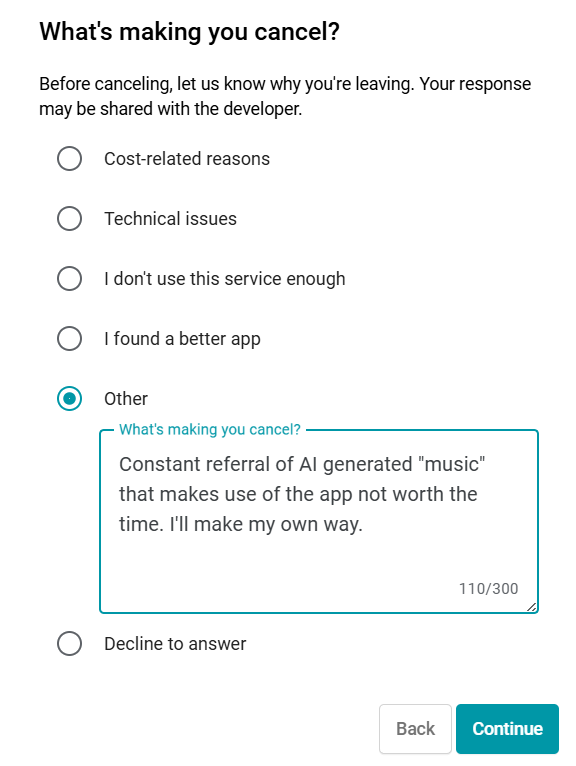
you know what? fuck you @youtubemusic I'm cancelling my fucking subscription because you keep fucking forcing ai generated bullshit down my fucking neck.
fuck you, fuck spotify, and fuck every imbecile contributing to this fucking epidemic
@youtubemusic Please please I pray stop feeding AI into my auto playlists. I keep thinking they are real artists, and it utterly breaks my heart.
Have a separate area for AI music 🙏 and clearly label any music that has any AI elements in it 🙏.
I need human music.
#AIMusic
Strike two: "Anne Bloom" is the latest offensive AI slop that @youtubemusic has randomly injected into my stream. 100s of songs, all the same formulaic soulless garbage. This is not art. This is offensive. You're on notice, YT. #aislop
Combine this with "It's November. We have to get the updates / changes / implementation done before the holiday freeze period!" and you have, well, <gestures wildly>
Its fun watching people try to form conspiracies. "You really think all these outages are a coincidence? The government is hiding something!". Yeah, they're hiding the fact that every tech company replaced like 80% of their employees with bots that guess words, hardly anyone left knowns wtf they're doing, and admitting it's not working out would implode the economy because people invested half the US GDP into this shit.
FFMPEG had one of the most valid crash outs in infosec history IMO. There's a huge elephant in the room when it comes to the fact that cybersecurity is extremely unbalanced. You have like 1,000 people pointing at problems for every 1 person fixing them.
Vulnerability research is extremely important, but it's become somewhat of a marketing stunt. First with fuzzers, and now with LLMs. It's a lot of "look what my new toy can do" rather than earnest attempts at actually fixing security problem.
What Google did to open source developers was especially egregious. They're a $3.6 trillion dollar company, who spent billions upon billions of dollars building a bot that points at problems really really fast, then they just dumped them all on a bunch of unpaid open source project maintainers to fix.
Then because of Google's 90 day disclosure policy, the maintainers have 90 days to fix the issues. After 90 days, Google goes public with the issues, making their project look bad if the vulnerability is yet to be fixed, and also potentially harming users if it gets exploited.
The 90 day policy was intended to give developers a reasonable amount of time to fix issues, while also applying some pressure with the threat of disclosure. Otherwise, you do get a bunch of goober ass vendors that will just ignore all security issues reported to them, then act completely surprised when their software gets hacked.
But when you're a small team, non-profit, or a solo developer, and you have a trillion dollar company's AI just blasting you with infinite problems to fix (each coming with a 90 countdown & a threat), that becomes extremely untenable. They're essentially inadvertently blackmailing developers into becoming unpaid interns.
Then on top of that, Google profits unimaginable amounts of money from the use of open source code. They use FFMPEG's code extensively across several highly-profitable products, meanwhile FFMPEG's developers work for free. There's no reason Google couldn't have donated money, engineers, AI tokens, or something towards fixing the problems. They can more than afford it.
I don't think Google has any malicious intent at all, it's just that the whole incentive structure behind vulnerability research is completely whack. All the glory goes to people who find issues, not those who fix them, so there's not a whole lot of interest in helping with fixes. Some vulnerability researchers will submit fixes with their reports, but most don't.
Honestly, in 2026 cybersecurity basically just feels like the equivalent of 50,000 people following the housecleaner around yelling "you missed a spot". Abysmally little effort has gone into anything outside of pointing out vulnerabilities.
@atrupar No, by itself, it doesn't. Ask an information security expert before making proclamations like that, please.
I mean, it sounds like "hacking" in the "I learned about hacking from the CSI TV series" sense, I guess.
Rough week for the ultracrepidarianism practitioners, you've had to pivot from global espionage to cloud service availability to FAA communications expertise in the span of three days! Take some "me" time, give yourself some latitude. 😂
Say goodbye to paper! @CVGAirport controllers are switching from antiquated paper strips to electronic flight strips for safe and efficient operations. @USDOT
Get more from @Local12 ⬇️