Physicians have been kept at the margins of venture investing. PhyCap was built to change that.
We're hosting our last session before our June 1 final close.
📅 Thursday, May 21 | 2:00 PM ET
🔗 https://t.co/RXYtVj1oDN
@DutchRojas@drslo
Thirty Series B raises in US digital health through Q3 2025.
Three-year average: sixty-three.
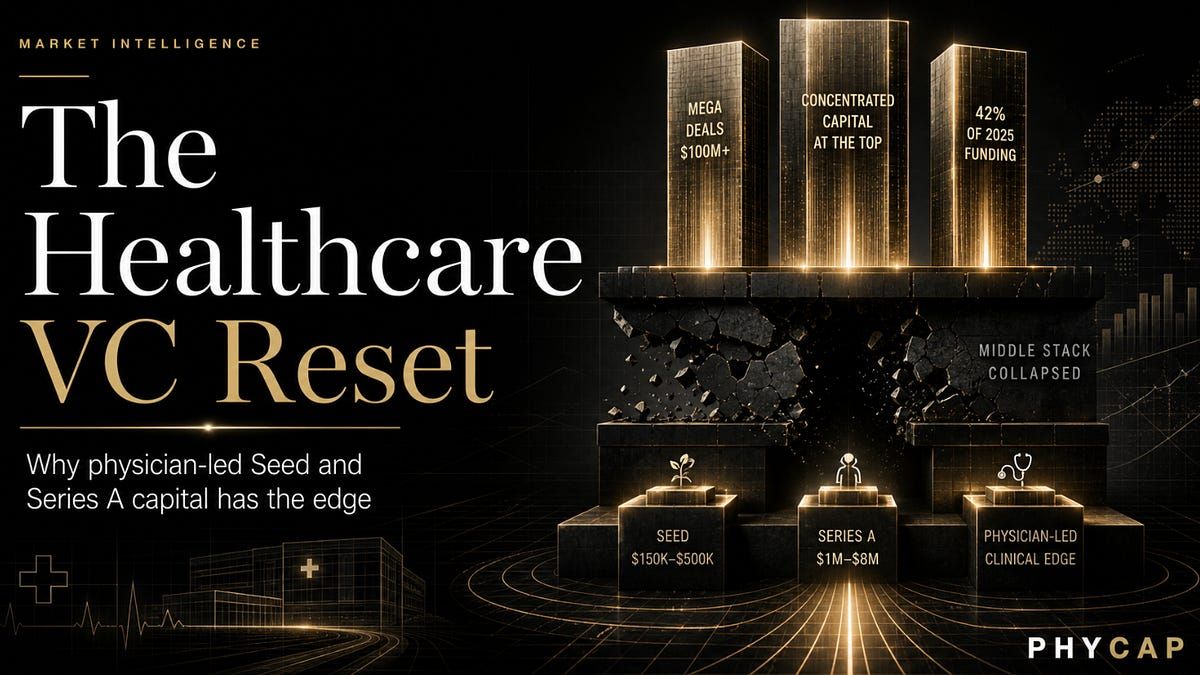
The middle of the funding stack has collapsed. Capital has stopped trusting middle-stage healthcare narratives without independent validation.
The math at Seed and Series A has shifted in physician investors' favor.
Thirty.
That is the number of Series B raises closed in US digital health through Q3 2025.
The three-year average is sixty-three.
The middle of the funding stack has collapsed.
Series B is where companies cross from product-market fit into commercial scale.
When it contracts by more than half against trend, the signal is structural. Capital has stopped trusting middle-stage healthcare narratives without independent validation.
The implication for physician investors writing Seed and Series A checks: the math has shifted. Capital deployed before the Series B gate enters under different terms than capital deployed after it.
PhyCap Fund I closes May 31, 2026.
https://t.co/EvQs33JMY4
Five percent of US market capitalization is about to enter public markets through three IPOs.
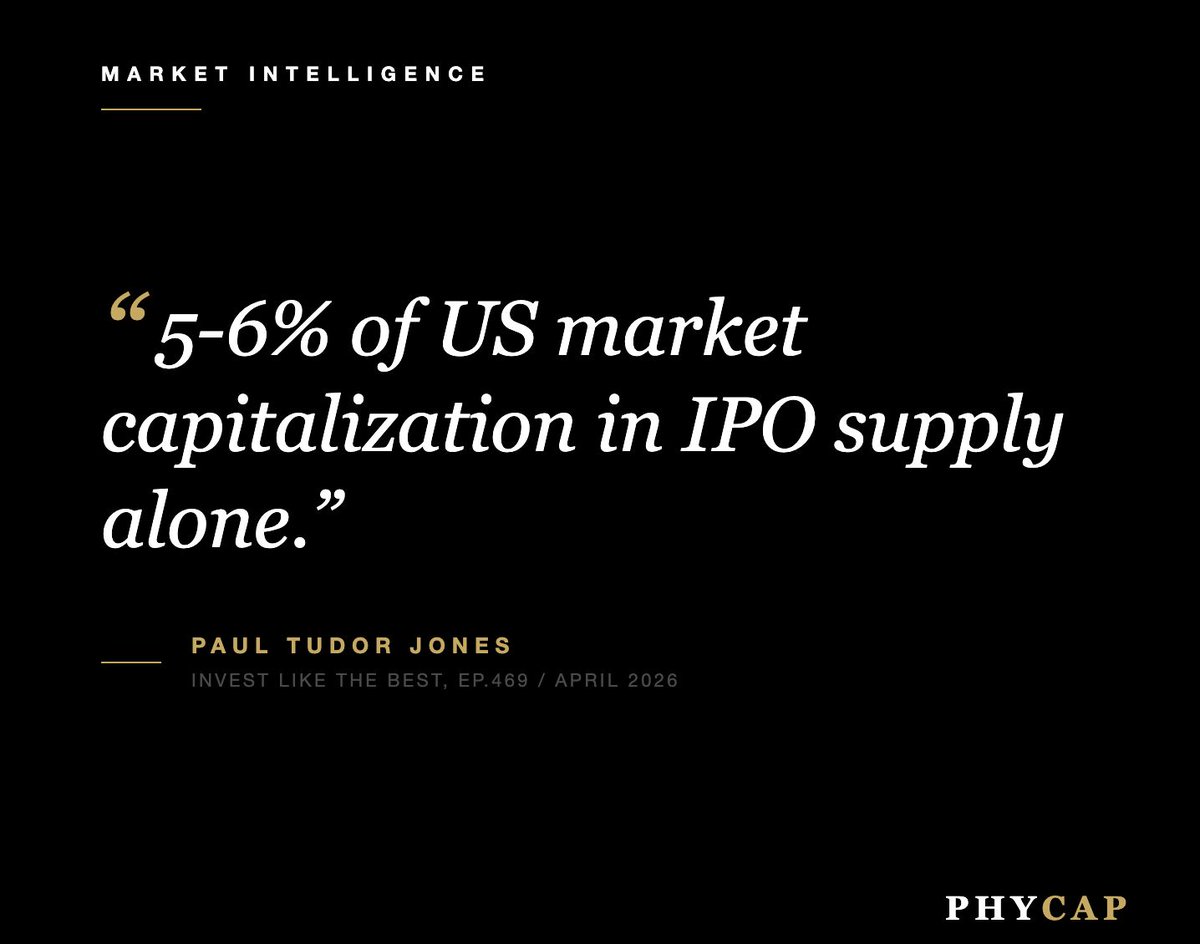
Paul Tudor Jones laid out the structural read on Invest Like the Best. The contemplated IPOs over the next year represent 5-6% of US market cap. Normal IPO issuance runs 0.5 to 1% in active years. The 2026 pipeline runs ten times that ratio.
The mechanism is direct. Buyback capacity has supported equity prices for a decade. The mega-IPO pipeline reverses it. The funding for SpaceX, OpenAI, and Anthropic is already being pulled out of existing technology stocks. Magnificent Seven weakness year to date is the rotation, not a coincidence of earnings cycles.
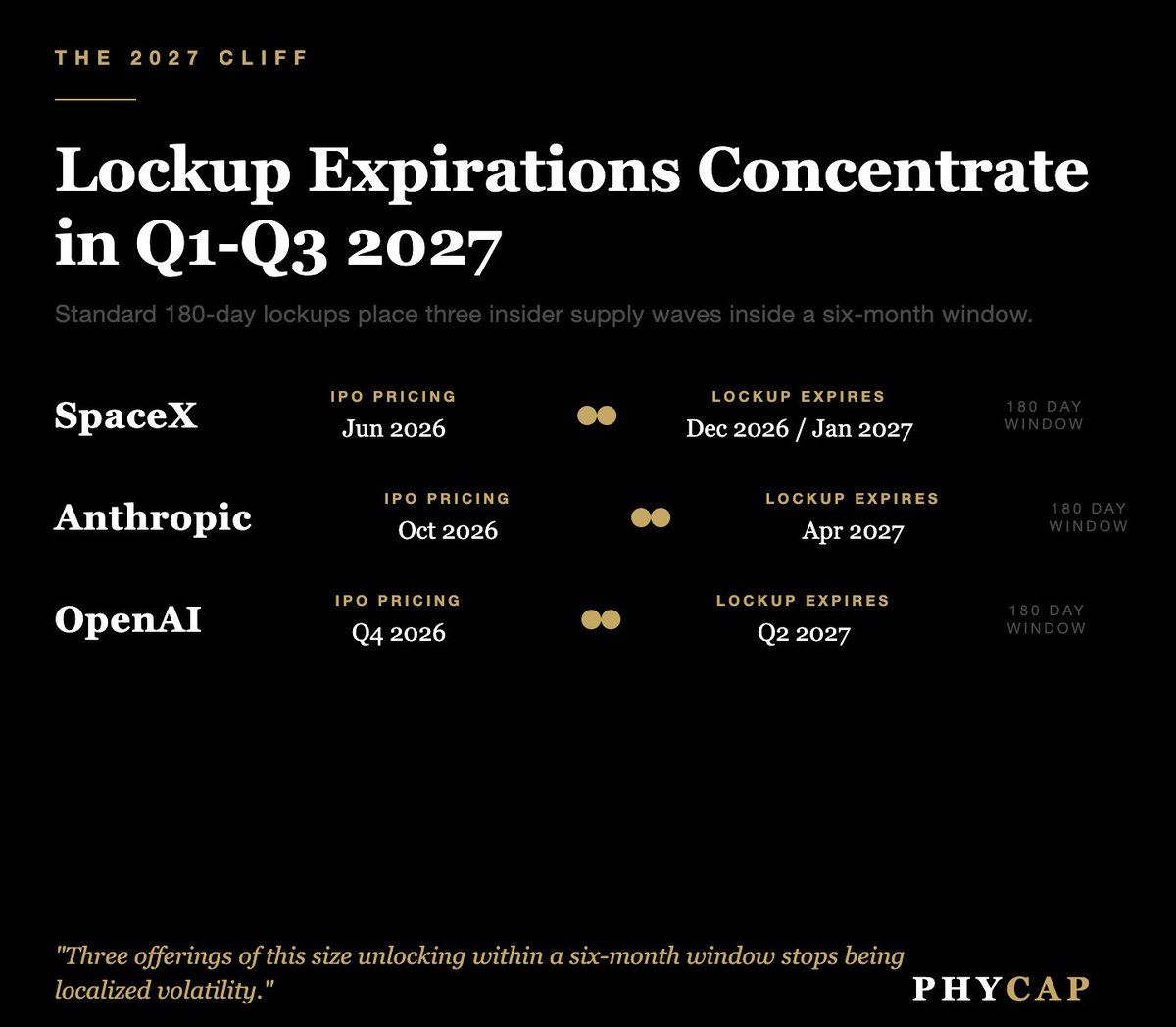
Standard 180-day lockups place the insider supply wave in Q1 through Q3 of 2027. The 2000 parallel is exact. Supply hit demand at the same moment fundamental concerns began to bite.
For physician allocators, healthcare sits structurally outside this pipeline. That creates the asymmetry worth positioning for.
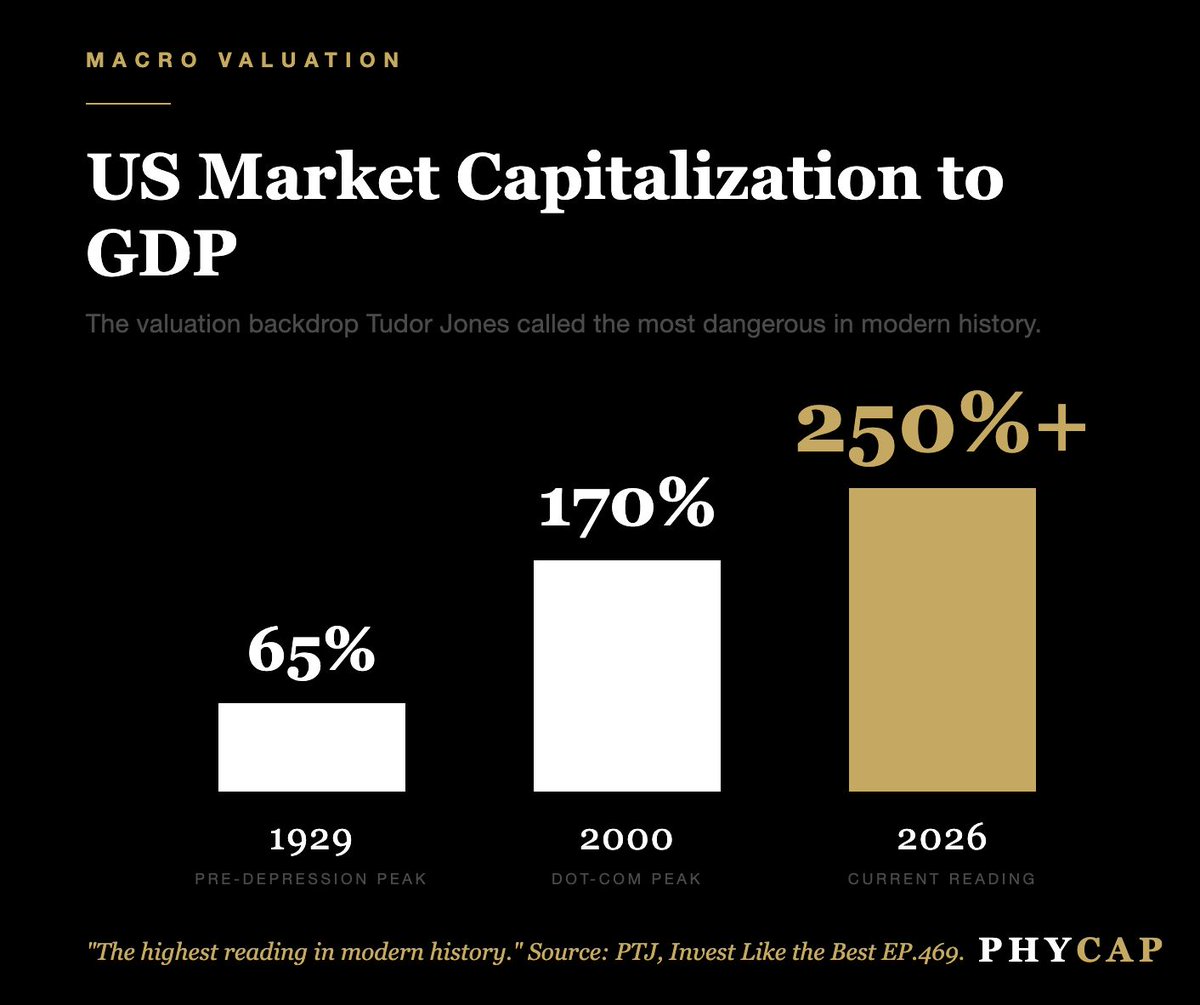
US market capitalization to GDP sits above 250%. The 2000 dot-com peak hit 170%. The 1929 peak hit 65%.
Paul Tudor Jones laid this out on Invest Like the Best in April. The valuation backdrop he called the most dangerous in modern history.
His specific concerns. US equity valuations imply a negative 10-year forward return. It will be "really hard to make money" in stocks over the next decade. The eventual correction will be "breathtaking." A 35% drawdown collapses capital gains tax revenue toward zero, cascading into a federal deficit already running at 6% of GDP.
The 2026 mega-IPO pipeline is the trigger. The valuation regime is the powder. The fiscal feedback loop is the amplifier.
This is the part most coverage leaves out. Three companies. $240 billion in raises. The setup that follows determines the next decade of capital flows.
The 2027 lockup cliff is already set.
SpaceX expires Dec 2026 or Jan 2027.
Anthropic expires April 2027.
OpenAI expires Q2 2027.
Three offerings of this size unlocking within six months stops being localized volatility.
The 2000 parallel is exact.
5-6% of US market capitalization is about to enter public markets through three IPOs.
Normal run rate is 0.5 to 1%.
The 2026 pipeline is ten times that.
SpaceX.
OpenAI.
Anthropic.
$240 billion combined.
Healthcare sits outside the supply wave.
When we say PhyCap is a community of physicians and healthcare leaders, here's what we actually mean.
Our LPs include general surgeons, orthopedic surgeons, gynecologists, ER physicians, cardiologists, radiologists, and anesthesiologists, alongside hospital administrators, medical sales leaders, and supply chain experts.
That community is the foundation of PhyCap. Together, they shape how we evaluate companies, where capital gets deployed, and how we support portfolio companies.
We're 20 days from final close.
👥If you're a physician or healthcare leader who wants a seat at the table, join us ahead of our June 1 final close.
@DutchRojas@drslo
Clinical expertise isn’t just helpful in healthcare investing. It’s essential.
That’s what PhyCap was built on.
Today, it’s a community of physicians, operators, and healthcare leaders shaping how and where capital gets deployed.
For years, clinicians have been pulled in as advisors.
At PhyCap, they're part of the investment process, with real exposure to the companies they help evaluate.
Healthcare is in a rare window of innovation, and we have limited capacity remaining.
@drslo@DutchRojas
Tomorrow: Patterns from 500 Healthtech Deals
Join @drslo and Tracy Poole as they walk through the signals that build conviction quickly and why some of the strongest looking companies fall apart during diligence.
📅 April 29 | 7:00 PM ET
🔗 https://t.co/uQ86xcOYsL
@DutchRojas
AI clinical decision support: 70% observed venture failure rate. The segment with the heaviest generalist-VC concentration is the segment with the worst return distribution. Workflow blindness has a price, and the return books show it.
@PhysiciansCap@drslo
Tomorrow: A Real Healthtech Deal Debate
Join @drslo, @DrVipulKella, and Tracy Poole as they debate a real (anonymized) healthtech deal live.
📅 April 7 | 7:00 PM ET
🔗 https://t.co/Hm8eFYGzNh
@DutchRojas
We just published "Righting the Script on Healthcare Ownership."
If you're a physician tired of being a consultant instead of a partner, this one is for you.
https://t.co/pTlS13L0bz
@DutchRojas@drslo@DrVipulKella
Traditional healthcare VC treats clinical expertise as a purchased service.
Physicians are brought in to advise on one deal at a time, with no stake in the outcome. They provide the insight, but someone else captures the upside.
PhyCap Fund was built to change that.
Our LP community is made up entirely of physicians and healthcare leaders across the nation.
Clinical expertise isn't a feature of the fund. It's the foundation.