My new preprint on neural networks with synaptic plasticity (i.e. nodes & links co-evolving) https://t.co/9aTHZujDTm, we get exact entropy production rate at arbitrary transient time and a power-law relationship between its stationary value and the population-average correlation
I am presenting online today at 15.30 Denver time, my latest work Robustness-speed-dissipationTrade-off for Adaptation of Gene-regulatory Networks you can watch using the link https://t.co/93BxuKjQ3W , which will be broadcast live from 11:30-13:30 and 14:00-16:00 (Denver time).
Our workshop's webpage is online https://t.co/yrZjG36YMC. Our amazing list of speakers includes A. Altieri, J. Bechhoefer, K. Kaneko, S. Ito, R. Klages, E. Fodor, F. Mori, K. Takeuchi, S. Toyabe, C. Plate, M. Angeles Serrano, G. Odor, W. Merbis, and Hildegard Meyer-Ortmanns.
This study applies an agent-based model to societal issues to understand how heterophobic interactions, or those that repel individuals from those with opposite opinions, affect societal cohesion.
See how: https://t.co/0h6TPl8khE
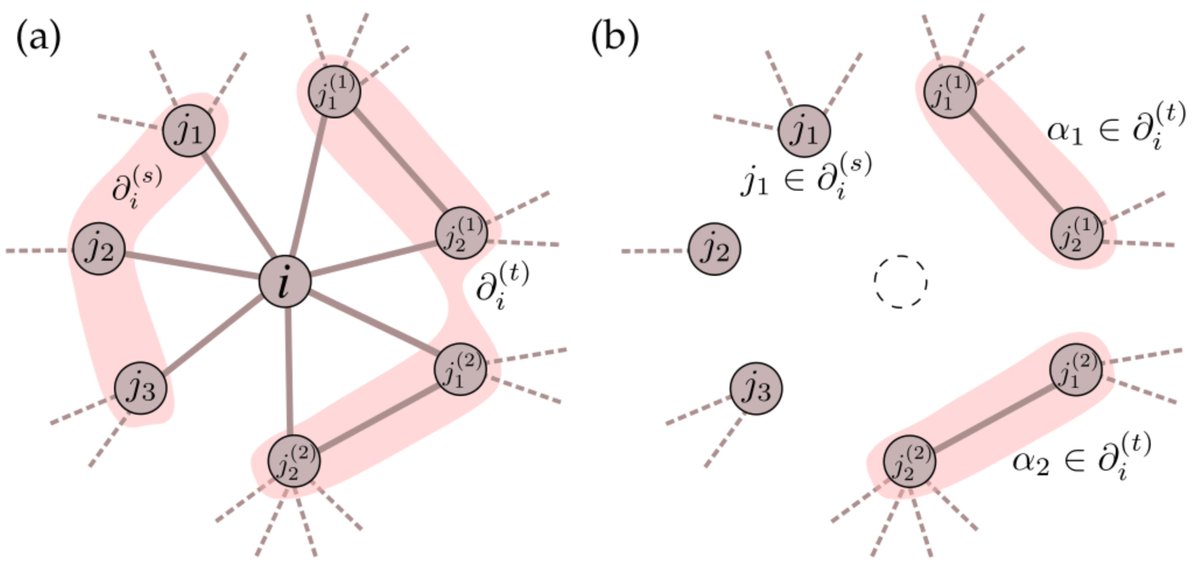
@PessoaBrain We put a mathematical theory at the full microscopic level for networks (including genetic network as an illustrative example) co-evolving adaptively with the nodal states here https://t.co/clbFoiI8EV .
🦋Come to our next Science & Cocktails “Making Sense of Chaos” on 27/04 at 7pm!
In this event, @doyne_farmerexplores explores how complexity theory can revolutionize economics, and address global challenges.
More info + registration: https://t.co/1QBtC6H3wZ
Together with @notalbertalonso and Karel Proesmans, we show how irreversible a neural network is in terms of its dissipation rate and how optimal information processing at the edge of chaos is related to this robust energy expenditure https://t.co/c3JbcjSF2v
The idea of using path-integral for stochastic evolution
is not new, but using it to analytically describe coevolution of the nodes of a network and the network itself, requires a substantial extension. We made it possible in https://t.co/romNSydcKG for “collective adaption”.
@PessoaBrain We have recently developed the path integral approach to model coevolution of the nodes of a network and the network itself. In our language “adjacent possible” is implicitly implemented by the adaptation-related probability for the next move to happen.
Our paper https://t.co/romNSydcKG with 2 perspective: evolutionary biology, phenotypic robustness emerging from dynamic genotype-phenotype map; Hopfield-networks: the network tries to retrieve dynamic patterns that in turn shaped by the network structure in the previous iteration
@VictorGalitski Very interesting! We found a similar destruction of spin-glass-ordering in biological robustness, where, as the spin-temperature is increased the coevolutionary dynamics of spins (phenotype) and couplings (genotype) self-organise into a ferromagnetic phase https://t.co/uWeEI5WijU
We identify the thermodynamic origin of a phase transition to chaos by showing it corresponds to a change in the functional form of the entropy production rate upon crossing the onset of chaos. This connects the dynamic and thermodynamic aspects of chaos https://t.co/0dFVVYgu3P
New work with Tuan Minh Pham (@physicsidea) and Fernando Metz (@FernandoL2006)!
"Effects of clustering heterogeneity on the spectral density of sparse networks"
https://t.co/8sgbVG8GFG
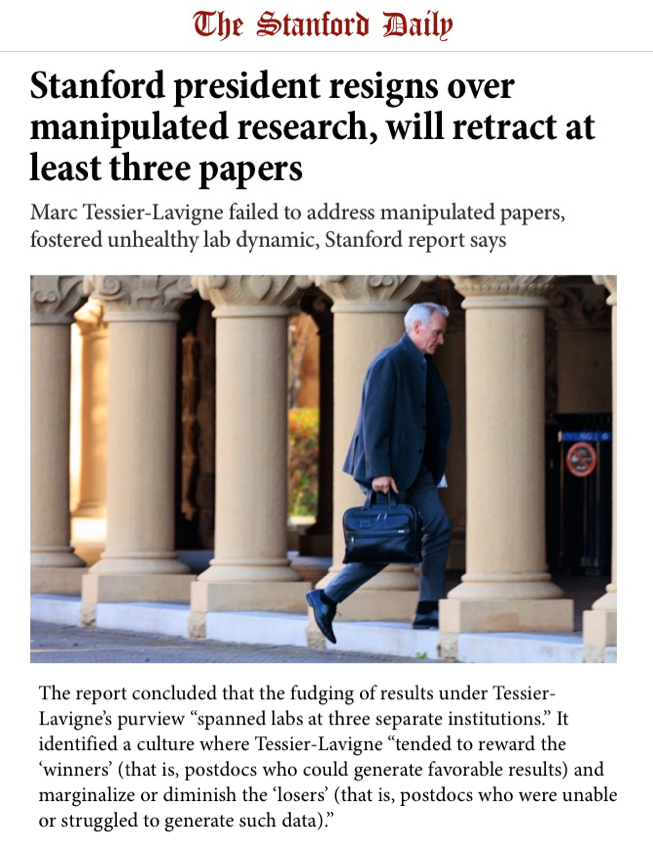
Not able to produce “favorable results” in the lab? You are a “loser”.
Stay in the shadows of those who can bring cool data to the Big Prof.
Sounds familiar? It's not only about this case at Stanford.
It's about academic culture in general:
- Keep pushing for metrics. Quantity over quality. Look for flashy conclusions.
- Skyrocket your profile. Build your research enterprise. Outcompete everyone in your field.
Isn’t it how academia works today? 🤨
▫️
Albert Einstein remarked: “An academic career, in which a person is forced to produce scientific writings in great amounts, creates a danger of intellectual superficiality”.
Peter Higgs said he could NOT replicate his discovery in today’s academic climate: “Not enough peace and quiet in the present sort of climate to do what I did in 1964”.
▫️
Wonder about the results of this “culture”?
1. Thousands of FAKE research articles are published. 30% of all scientific articles may be fake products of paper mills. There is even a special lengthy page on Wiki called “Replication crisis”.
2. Life-draining tenure requirements that fuel the rat race. Why? To ensure the university ranking and recognition is going up.
3. Most PhDs don’t see themselves in science anymore. In many places, you are not required to be creative and knowledgable. Instead, you should demonstrate you can win a race.
Everyone knows it but few things change.
▫️
I am happy that Stanford showed courage and carried out investigation. It is an excellent example of HOW to react to manipulated papers and unhealthy lab dynamic.
It's just another reminder that:
We should STOP focusing on taking “professional selfies”.
We should STOP trading our passion for glory.
Focus on science instead
#AcademicChatter #AcademicTwitter #phdchat
We made it possible to extend dynamical mean field theory to a wide class of adaptive systems, i.e. those having an adaptation process for parameters controlling the dynamics of the state variables. Our theory predicts a generic phase diagram https://t.co/OP9cbEezxO