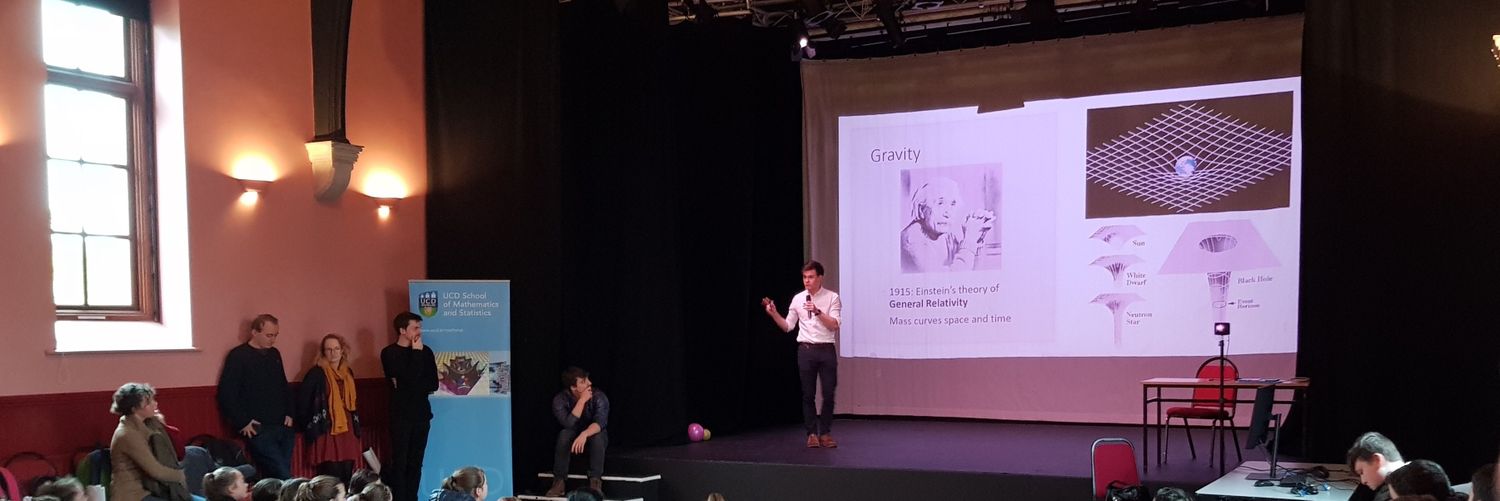
I’ve been on this site for over a year and I haven’t actually explained what it is I do for a living.
I study what happens when a black hole (BH) /neutron star (NS) spirals into a supermassive black hole (SMBH). These systems are called extreme mass ratio inspirals (EMRIs). 1/7
Hey, I've been using the site formally known as twitter less and less over the years and given it's current state I've finally moved over to where the skies are always bluer
If you want to keep following me check out my bio!
I'll post a longer thread outlining the main ideas of this paper soon.
In the meantime I'd like to extend a huge thank you to my collaborators @w_vojtech, Maarten van de Meent, and @Niels_JW
My newest paper is finally on the arXiv today!! It's all about near-identity averaging transformations for extreme mass ratios with eccentricity and spin precession and how to best deal with evolving through orbital resonances
https://t.co/sjPJndVLBh
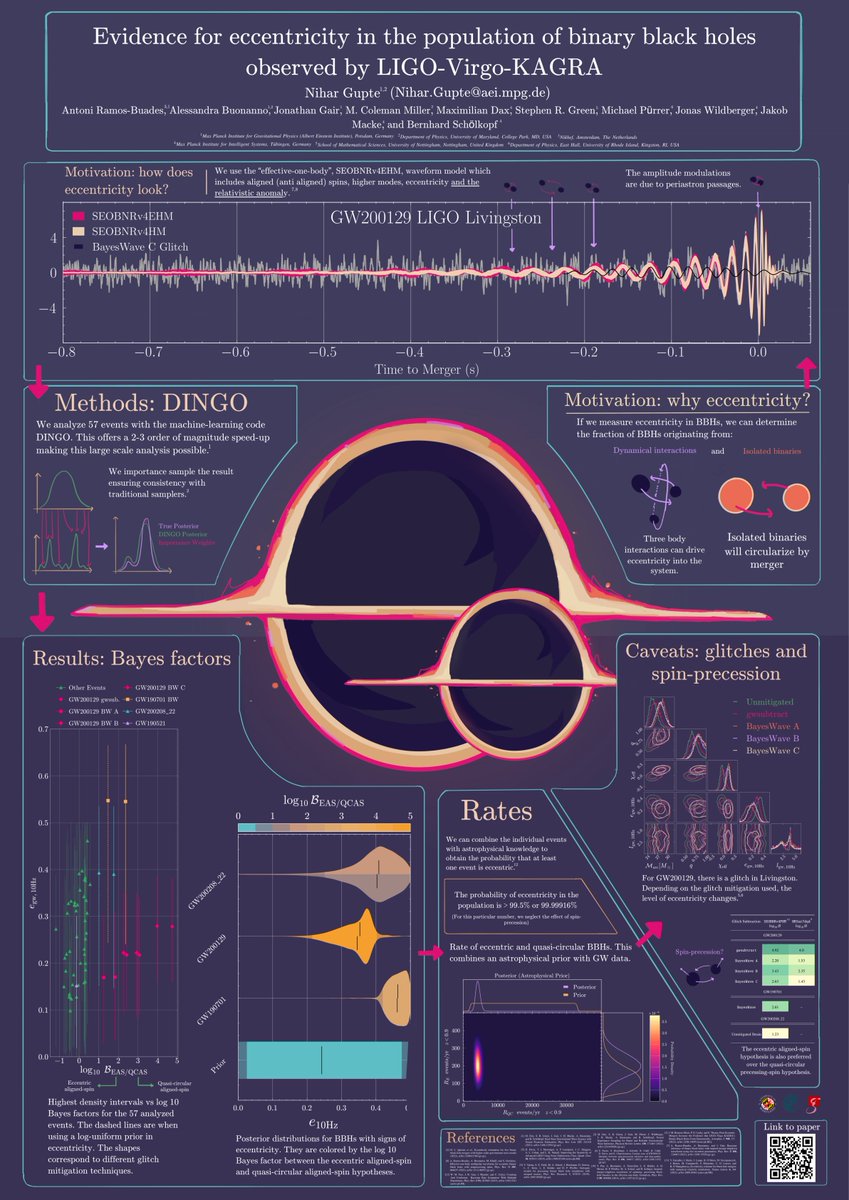
Hi everyone! Today I wanted to announce a paper that we have been working on for over a year now. We found some signs of eccentricity in binary black holes observed by LIGO-Virgo-KAGRA: https://t.co/iI0djzDXne. I thought I would go over the paper a bit in this thread!
1/15
I made a movie illustrating the gravitational memory effect for a colleague and thought that I'd share it here! For those who don't know, gravitational waves permanently distort spacetime, as shown here through the change in the position of some test particles.
Ever wonder how a paper actually gets written? ✍️
Our recent paper on effective-source approaches for eccentric orbits has been accepted for publication by Phys. Rev. D. To celebrate, here is a compilation of how the paper came together.
@Niels_JW @APSphysics
@balthazar3827@ToughSf This is a pretty counter intuitive idea. If we define the volume of the BH as the event horizon, then the "volume" scales with the Schwarzschild radius cubed, and that scales with the mass. So V ~ M^3
Since density = M/V ~ 1/M^2
So as mass increases, "density" decreases
The UK's return to @HorizonEU is a significant moment, yet let's not underestimate the formidable challenges that persist in science and research stemming from the Brexit disaster. Mainly the cost of Visas and healthcare. Before 2016, these problems did not exist... ⅕ 🇪🇺🇬🇧
Lovely to see my thesis highlighted by @LISACommunity. If you're interested in some light reading, you can follow the link to the PDF. Otherwise make sure to check out the full range of other research projects that have gone into making the LISA what it is
Dr. Philip Lynch @PhysLynch got his PhD at University College Dublin in 2022 and is now working at Albert Einstein Institute, Potsdam.
His thesis can be found here 👉 https://t.co/420VXMbJpc
#LISAMission#LISAPhDTheses
Some lovely plots for the history books: the Hellings-Downs curve, predicted in 1983, and finally observed by @NANOGrav! Their detection paper is up now: https://t.co/PU86ZpW8FP
Results just released from @NANOGrav and international partners show - for the first time - the signature of long-wavelength gravitational waves rippling through space. (1/n)
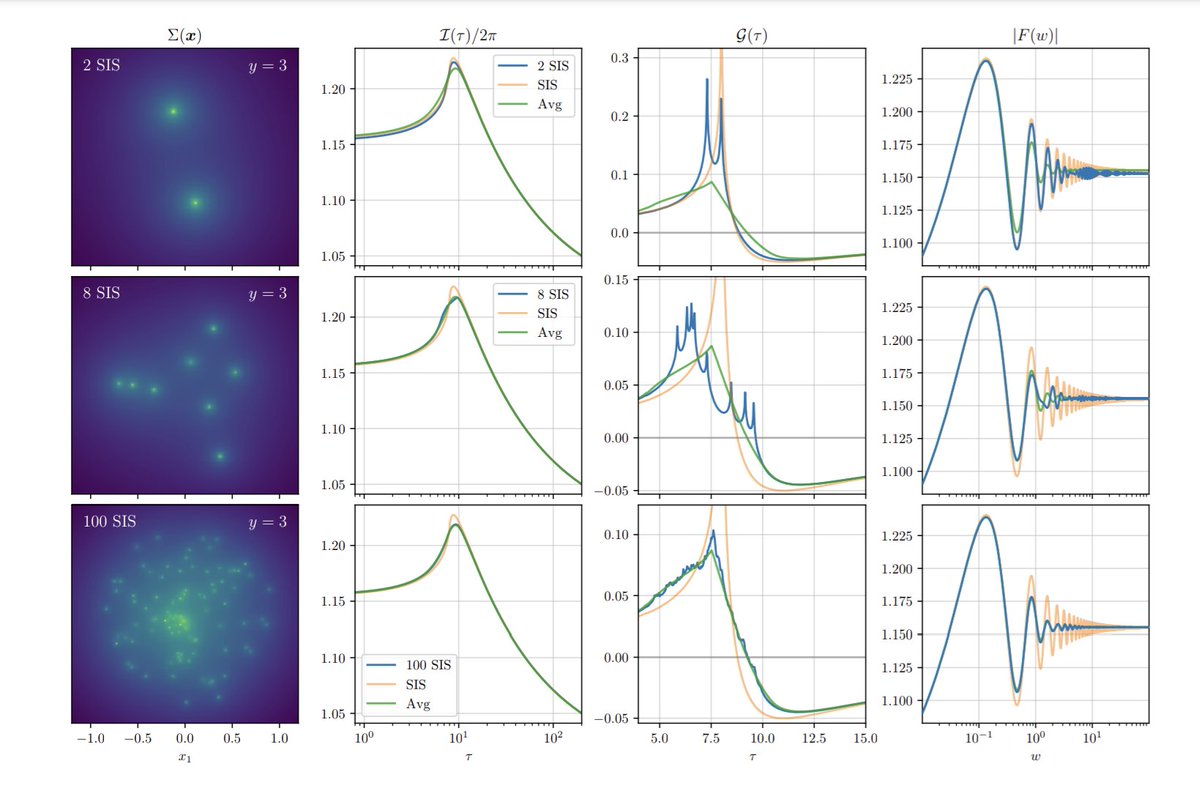
Our work on weak lensing of gravitational waves is finally out:
https://t.co/3pfB5M9ZIh
I'm on vacation today, but I'll go over our results as soon as I'm back. I'll just leave you with one of our awesome plots 🎉
🎉 Paper Day! 🎉 (an exciting one too!)
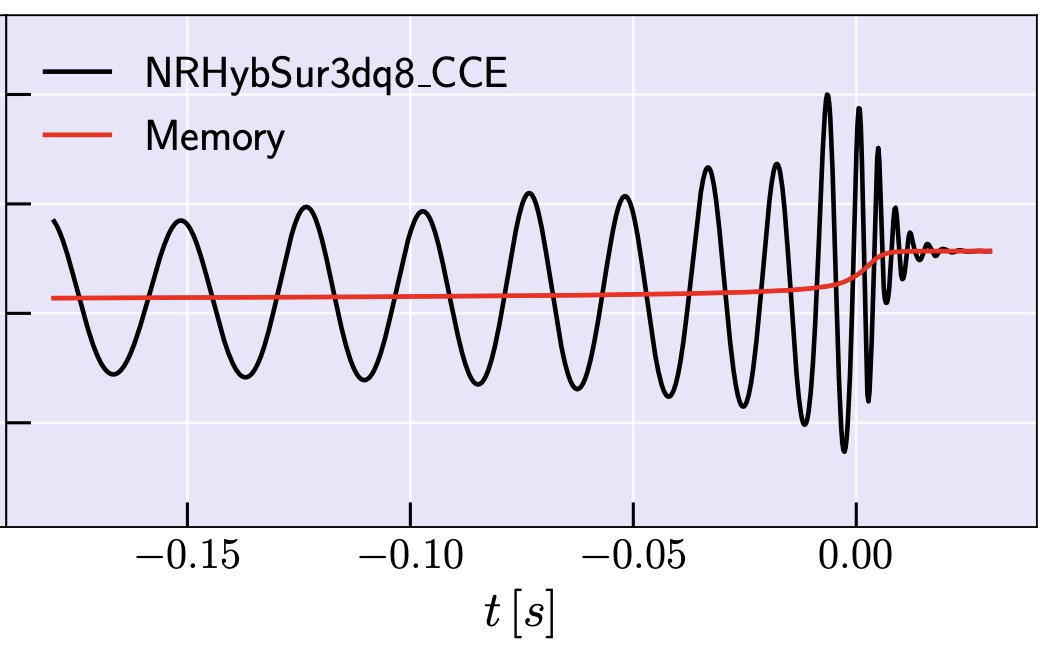
Numerical relativity surrogate model with memory effects and post-Newtonian hybridization [https://t.co/oGKrDE5R4a]
Yoo, Mitman, Varma, et. al.
(@vijay_x_varma and also @duetosymmetry!)
What's the hype about?! A 🧵...
1/16
🎉 New paper day! 🎉 Though I'm a bit busy at a conference so no thread planned at the moment. Punchline is: the latest numerical relativity waveform surrogate model includes memory, and is properly hybridized with post-Newtonian waveforms! Check it out at https://t.co/YMatOKzKoZ
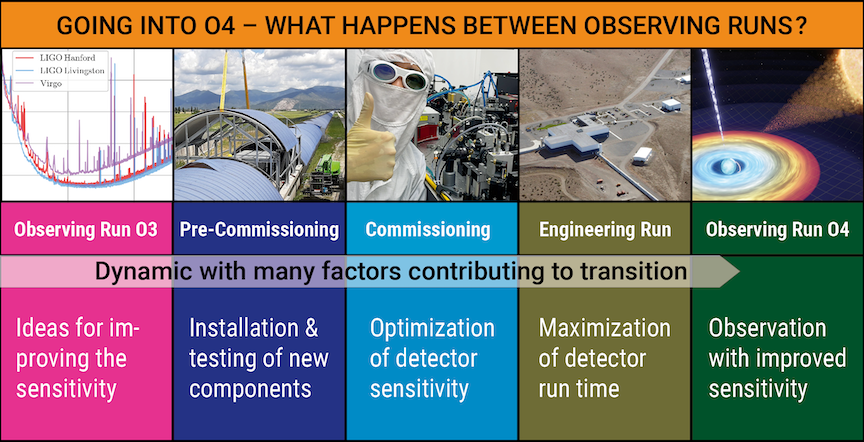
Welcome to the fourth observing run! #O4IsHere
O4 will last 20 months, with @ego_virgo and @KAGRA_PR joining us in the run. We expect the detection rate will be roughly twice in our past observing run
More news linked from https://t.co/kHnyuP8I2I #ObservingRun4
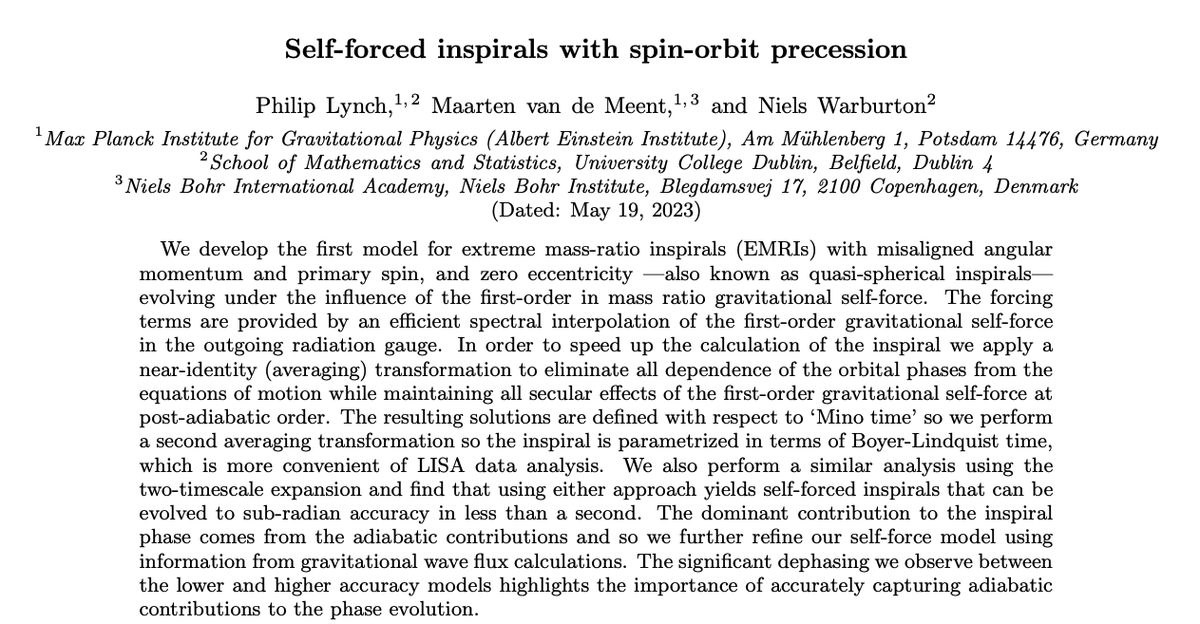
Our newest paper is finally on the arXiv! This paper has been in the works fro well over a year now, so it's great to finally get it out there! Let's have a quick run through of the basic ideas 🧵1/16
https://t.co/wjffVZtCjk
There are some obvious limitations here. Our calculation only uses one value of spin (a= 0.9M). We also neglect 1PA effects like the 2nd order GSF (as it's not known) and the spin on the secondary (future work). 15/16








![KeefeMitman's tweet photo. 🎉 Paper Day! 🎉 (an exciting one too!)
Numerical relativity surrogate model with memory effects and post-Newtonian hybridization [https://t.co/oGKrDE5R4a]
Yoo, Mitman, Varma, et. al.
(@vijay_x_varma and also @duetosymmetry!)
What's the hype about?! A 🧵...
1/16 https://t.co/pxcLggM6Ca](https://pbs.twimg.com/media/FyBup7BXoAEYRFa.jpg)