Rhea Finance published their exploit post-mortem. $18.4M drained - attacker opened margin positions, routed borrowed funds through his own pools, and force-liquidated the empty positions against the reserve pool.
This wasn't a simple hack. The attacker combined two known DeFi attack vectors into something new.
The setup: deploying tokens, creating many pools on Rhea with prices he controls, and preparing hundreds of accounts. Two days of infrastructure work before the actual drain.
The exploit: margin trading lets you borrow tokens and swap them into a position. Slippage protection sums outputs across all swap steps to make sure you got enough back. But it doesn't track that output of one step becomes input of the next.
Attacker builds a swap chain through his own pools:
- Step 1: 1000 USDC → 999 AttackerToken (min_amount_out: 999)
- Step 2: 999 AttackerToken → 1 USDC (min_amount_out: 1)
Slippage check: 999 + 1 = 1000. Looks healthy.
Reality: 1 USDC returned to the protocol. 999 USDC sitting in attacker's pool.
The check counted AttackerToken from step 1 as final output. But they were just transit - immediately spent as input for step 2. Attacker removes liquidity from his pools and walks away with the borrowed funds.
Closest precedent: KyberSwap ($54.7M, 2023) - same principle of counting the same value twice across sequential operations.
~$9M of $18.4M already recovered/frozen. Post-mortem is one of the most detailed in DeFi - full chronology, tx hashes, exact code line.
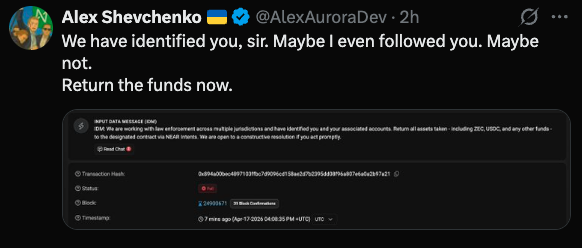
The Near Intents team (@AlexAuroraDev) clearly implied that the attacker has been identified, and it’s even someone with a public X account whom he may be following.
Identity is the starting point.
Conversation is what matters.
Awesome to see XMTP built in to https://t.co/FsVvhj9Vx4, turning profiles into secure conversation entry points.
💬 Messaging secured by @xmtp_ is live on https://t.co/u3KMDoMj6k
> Every profile (XMTP-enabled) is now a chat entry point
> Text, images, emoji, reactions, quote replies, tips & link previews
> Rich profiles inside every conversation
“Ethereum was not created to make finance efficient or apps convenient. It was created to set people free”
This was an important - and controversial - line from the Trustless Manifesto ( https://t.co/QAvZfiNxpe ), and it is worth revisiting it and better understanding what it means.
“efficient” and “convenient” have the connotation of improving the average case, in situations where it’s already pretty good. Efficiency is about telling the world's best engineers to put their souls into reducing latency from 473 ms to 368ms, or increasing yields from 4.5% APY to 5.3% APY. Convenience is about people making one click instead of three, and reducing signup times from 1 min to 20 sec.
These things can be good to do. But we must do them under the understanding that we will never be as good at this game as the Silicon Valley corporate players. And so the primary underlying game that Ethereum plays must be a different game. What is the game? Resilience.
Resilience is the game where it’s not about 4.5% APY vs 5.3% APY - rather, it’s about minimizing the chance that you get -100% APY.
Resilience is the game where if you become politically unpopular and get deplatformed, or if a the developers of your application go bankrupt or disappear, or if Cloudflare goes down, or if an internet cyberwar breaks out, your 2000ms latency continues to be 2000ms.
Resilience is the game where anyone, anywhere in the world will be able to access the network and be a first-class participant.
Resilience is sovereignty. Not sovereignty in the sense of lobbying to become a UN member state and shaking hands at Davos in two weeks, but sovereignty in the sense that people talk about "digital sovereignty" or "food sovereignty" - aggressively reducing your vulnerabilities to external dependencies that can be taken away from you on a whim. This is the sense in which the world computer can be sovereign, and in doing so make its users also sovereign.
This baseline is what enables interdependence as equals, and not as vassals of corporate overlords thousands of kilometers away.
This is the game that Ethereum is suited to win, and it delivers a type of value that, in our increasingly unstable world, a lot of people are going to need.
The fundamental DNA of web2 consumer tech is not suited to resilience. The fundamental DNA of _finance_ often spends considerable effort on resilience, but it is a very partial form of resilience, good at solving for some types of risks but not others.
Blockspace is abundant. Decentralized, permissionless and resilient blockspace is not. Ethereum must first and foremost be decentralized, permissionless and resilient block space - and then make that abundant.
🙌Excited to partner with @realtbook to support WISE Credit Score across our Identity Graph, extending coverage into the Sui and TON ecosystems.
Together, by integrating https://t.co/KSUGbJmFGc’s Identity Graph with TBook, we’re enriching user profiles and strengthening WISE Credit Score as a cross-chain, borderless reputation layer.
@ai_evals it's from MIT’s Latin motto “Mens et Manus” which means Mind and Hand. We think LLM is the brain and we want to build hands for the brain to deliver results not just answers.