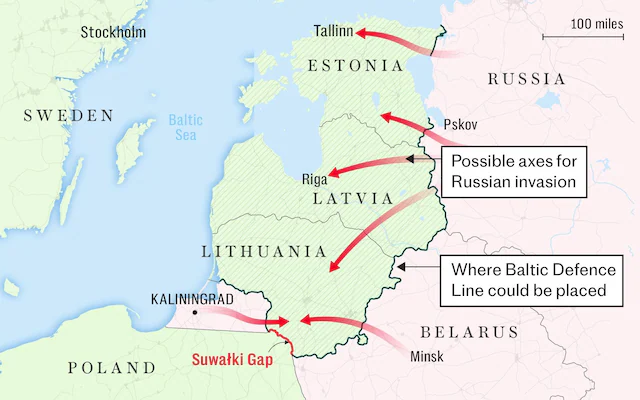
@holger_r Yup... Narva and Suwalki, simultaneously....
Locking down sea and air...
Cut off and trade for Ukraine...
Vlads end game might be ultimatum to Baltic warmongers - "sign away" Ukraine in exchange of unblocking Baltics.
@holger_r Yup... Narva and Suwalki, simultaneously....
Locking down sea and air...
Cut off and trade for Ukraine...
Vlads end game might be ultimatum to Baltic warmongers - "sign away" Ukraine in exchange of unblocking Baltics.
@BalticSnowTiger@igorsushko Who you're planning to mobilize in Baltics?
Squirrels...?
They go into hibernation in next few weeks.
Vlad know hibernation and suspense...
@InfoAgeStrategy If you look at Polish history... over the past 300+ years....
Each time they were arrogant and messed up...
Starting from not listening to commands of their Lithuanian generals...
And ending up with a horse barking at a tank just to be turned into a schnitzel.
@igorsushko Neither will close - Baltics are "trading chip" on the table, not meat grinder like Ukraine or Poland.
There is simply no "meat" to grind in Baltics, hence no "meat" is necessary to "put against it...
@NovaLoquor Neither of the 3 big ones (France, Germany, UK) are... or can be able to be ready...
That is exactly why this is such a good time to strike.
+ winter...
+ low ammo in US...
+ France and Germany want to ban election due to certain loses...
@NovaLoquor You are very correct in your assumptions.
The difference between past WW and upcoming for Baltic nations is the very existence of their nations.
This time they might not come back as independent states and culture might be lost forever.
Je vois beaucoup de commentaires qui disent que la Russie ne fera rien dans les pays baltes car ses troupes galèrent depuis des années en Ukraine. Je pense que c'est naïf. Envahir ces territoires serait un parti très risqué pour la Russie, et ça risquerait de provoquer une escalade. Mais il y a plusieurs raisons pour lesquelles la Russie pourrait prendre ce risque.
1️⃣ L'Estonie, la Lettonie et la Lituanie sont de petits pays. Ils sont peu peuplés et peu denses. Le plus peuplé, la Lituanie, a moins de 3 millions d'habitants. Ces pays ont de petites armées, qui n'ont pas l'expérience de combat de l'armée ukrainienne. Ni autant d'équipement. Même si elles ont de nombreux réservistes, il n'est pas sûr qu'elles aient le temps de les mobiliser si la Russie fait une offensive-éclair. Il y a des troupes françaises en Estonie, des troupes britanniques en Lettonie et des troupes allemandes en Lituanie. Mais ça ne sera pas forcément suffisant si la Russie fait une offensive rapide. (1/n)
Un karš Baltijā mūsdienās nozīmētu ne tikai teritorijas un valsts zaudēšanu, bet visas tautas pazudināšanu.
Baltijas tautas ir skaitliski pārāk mazas lai izturētu karu.
Baltiešiem lai izdzīvotu ir nevis jāsauc pēc kara, bet jāspēlē inteliģenta spēle starp Rietumiem un Krieviju.
The case for de-escalation with Russia, by Wolfgang Munchau (@EuroBriefing)
There is an awful lot of stuff going on that could blow up in our faces. The US economist Branko Milanović wrote an essay last week in which he described a very plausible escalation scenario. He writes the thirst for war is palpable in the Nordic and Baltic countries and is also growing in the UK and Germany.
'The role of small countries—that through their geopolitical irresponsibility can wreck great damage to the world—tends to pass under the radar. The Nordic-Baltic coalition is essentially calling for a war with Russia, citing its own fears and traumas of Russian/Soviet control and occupation.'
I agree with his assessment. If I listen to assorted Finnish and Baltic politicians, it feels to me like 1914, the year when Germany started the First World War in a mood of euphoria. The person who sets the tone in European foreign policy right now is Kaja Kallas, a former Estonian prime minister who is now the EU’s high representative for foreign and security policy. I see her as the European warmonger-in-chief.
Read more: https://t.co/5hLTk9cO6O
The case for de-escalation with Russia, by Wolfgang Munchau (@EuroBriefing)
There is an awful lot of stuff going on that could blow up in our faces. The US economist Branko Milanović wrote an essay last week in which he described a very plausible escalation scenario. He writes the thirst for war is palpable in the Nordic and Baltic countries and is also growing in the UK and Germany.
'The role of small countries—that through their geopolitical irresponsibility can wreck great damage to the world—tends to pass under the radar. The Nordic-Baltic coalition is essentially calling for a war with Russia, citing its own fears and traumas of Russian/Soviet control and occupation.'
I agree with his assessment. If I listen to assorted Finnish and Baltic politicians, it feels to me like 1914, the year when Germany started the First World War in a mood of euphoria. The person who sets the tone in European foreign policy right now is Kaja Kallas, a former Estonian prime minister who is now the EU’s high representative for foreign and security policy. I see her as the European warmonger-in-chief.
Read more: https://t.co/5hLTk9cO6O
@unherd@EuroBriefing Yes, and today they are also risking the existence of their nations.
1900 - 1950 birthrates allowed those nations to keep their culture and language...
War in Baltics now - would destroy not only their territory, but existence of their language, culture, nation = everything.
Eh ti MolotRib 2.0
C-17A Globemaster III (07-7181 / RCH4555) (Military craft)
Time spent in Riga: Roughly 48 hours 32 minutes
C-40B (02-0042 / RCH790) (VIP craft)
Time spent in Riga: Approximately ~54–57+ hours
@ZieglerCyprus@A_SHEKH0VTS0V Yeah... so tight he spent 2 days sleeping in Riga, not having any meetings there...
C-17A Globemaster III (07-7181 / RCH4555)
Time spent in Riga: Roughly 48 hours 32 minutes
C-40B (02-0042 / RCH790)
Time spent in Riga: Approximately ~54–57+ hours