NFTs were quiet.
Communities weren’t.
The Saudis just reminded everyone why early wallets matter.
Something is moving around Robinhood.
Early holders might want to pay attention.
https://t.co/vsDTJwCiQr
The Saudis already proved they know how to create attention.
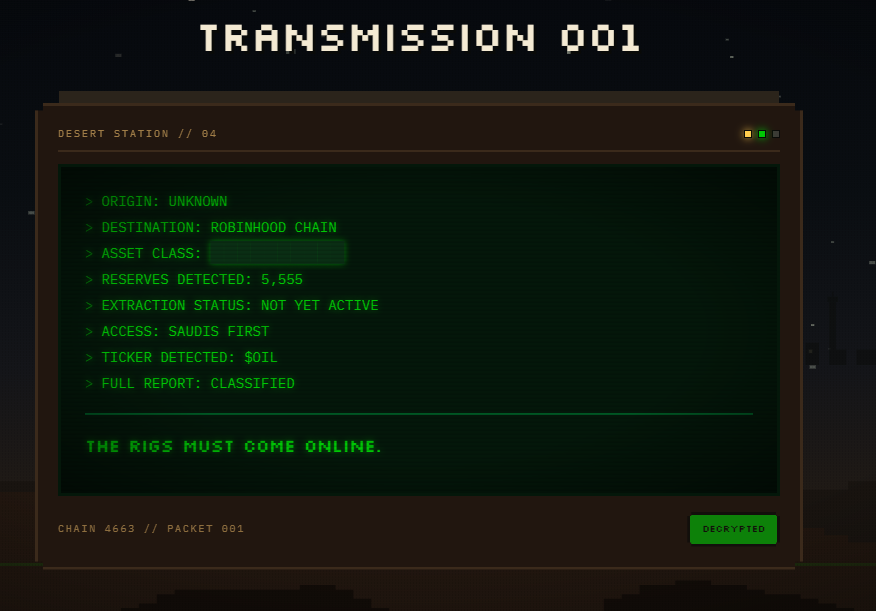
Their original 5,555 NFT collection sold out from a free mint and recorded roughly $7.7M of sales in its opening weekend.
Four years later, they're not simply relaunching the same PFP.
Robinhood.
5,555 Rigs.
$OIL.
And early wallets are being told to pay attention.
That's enough for me to keep this on the radar.
https://t.co/Day4MBBa6d
#MAXBIDDING
🇸🇦The Saudis might be cooking something. 🛢️
One thing I always watch in NFTs:
do holders still care after the hype fades?
Early wallets getting special access is exactly the kind of move that brings communities back.
Watching what comes next:
https://t.co/5H5MipI78n
Old holders might have the best seat for this one.
The Saudis aren't arriving from nowhere.
The original collection dates back to 2022, and today there are still 5,554 assets spread across roughly 1.7K unique owners according to CoinGecko.
Now the narrative is expanding:
The Saudis → Robinhood
5,555 Rigs → new collection
$OIL → ecosystem token
If holders really come first, that old ownership history could become the most interesting part.
https://t.co/eNmGuMOrZT
#MAXBIDDING
Robinhood NFT season might get stranger than people expect.
The Saudis are bringing a brand that once generated $7.7M in its first weekend into the conversation.
The new setup:
5,555 Rigs
$OIL
Robinhood
early wallet access
The mint price is still TBA.
Sometimes the most interesting position is simply knowing what you're watching before the timeline decides it's a narrative.
https://t.co/SuoBfVzzgy
#MAXBIDDING
THE TOKEN IS NEW. THE IDEA ISN'T.
$OIL and The Saudis are showing up on my Robinhood Chain radar, but this one has a history that makes it more interesting than the usual NFT → token launch.
The OIL concept was already part of The Saudis community years ago.
Back in 2022, community discussions were playing with the idea of oil rigs producing OIL onchain.
Now that concept is being brought back through $OIL, alongside 5,555 Rigs and The Saudis' expansion into the Robinhood ecosystem.
That's an important distinction.
They didn't launch a ticker first and invent the lore afterwards.
The lore came first.
The Rigs essentially turn an old community joke/concept into something people can interact with, while $OIL gives that idea an onchain economic layer.
And doing it on Robinhood Chain puts the experiment inside an ecosystem I'm already watching closely through $RH and $HOOD.
The purpose here isn't to pretend $OIL is some new DeFi primitive.
It's much simpler:
take an existing piece of The Saudis culture, connect it to the 5,555 Rigs, and give the community a token around something they've already been talking about for years.
That's why the Robinhood move caught me.
A new chain needs more than infrastructure.
It needs communities bringing their own history with them.
$RH can attract builders.
$HOOD can bring attention to the ecosystem.
But projects like The Saudis bring something chains can't manufacture overnight:
culture that already existed somewhere else.
No guarantee $OIL becomes a major part of that ecosystem.
But I'd rather watch an old idea find a new home than another token invent its entire identity the morning it launches.
New chain.
New token.
Old lore.
Now I'm watching what The Saudis actually build around it on Robinhood.
https://t.co/XFFjcyhKeo
Your old wallet activity might be worth checking
Another crypto airdrop season is reminding everyone of one thing:
the blockchain remembers.
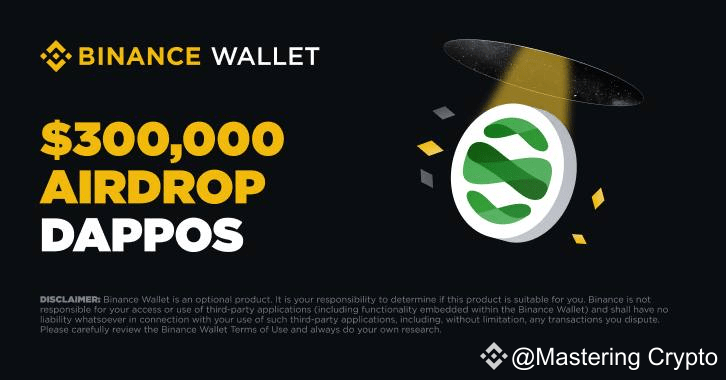
dappOS $DOS rewarded users who interacted with the ecosystem before the token moment
If you used dappOS, check your eligibility:
https://t.co/QGl96koCBH
Web3 rewards the people who build with the ecosystem, not only the people who arrive after the hype.
dappOS finally turned old activity into something measurable.
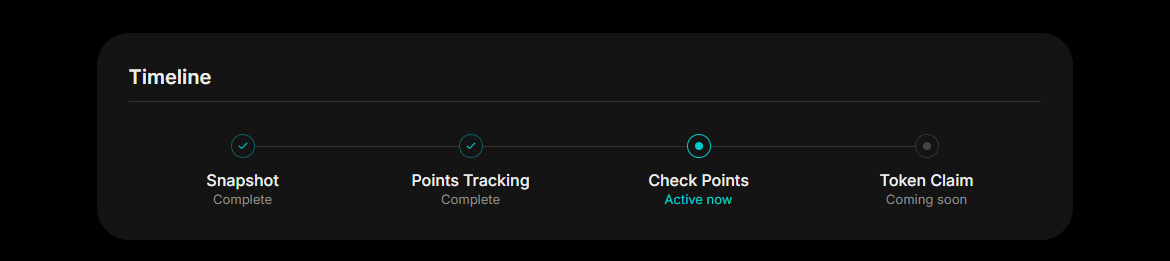
Phase 1 of the $DOS airdrop is live, and this is exactly why I keep wallets from old campaigns around.
If you actually used dappOS before, check the address that generated the activity rather than assuming there's nothing waiting.
Old onchain history has a habit of becoming relevant when everyone has already forgotten about it.
https://t.co/xv35jtTUe8
A new gaming narrative is quietly forming
SatRUSH is bringing gamified Bitcoin mining to Solana
Not every early experiment becomes a winner
But the interesting ones usually start before everyone notices
https://t.co/pR1bOIG5XH
SHIFT just crossed 1,000 unique holders.
That's the milestone that got me looking at $SHFT farming again.
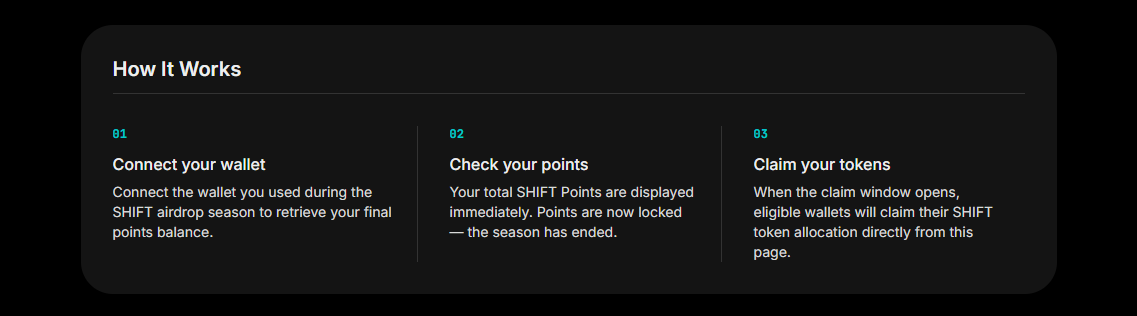
What started as an attempt to bring stock markets onchain is now building an actual community around tokenized equities — and SHIFT is marking the 1,000+ holder milestone with rewards while its Airdrop Season is still running.
I've been going through the ecosystem, and what I like is that farming isn't disconnected from the product.
You build SHFT Points by actually participating:
→ trade Shift Stocks
→ provide liquidity
→ interact with the ecosystem
→ accumulate SHFT Points
→ take part in the milestone rewards
No endless list of meaningless social tasks just to make a dashboard turn green.
You're interacting with tokenized stocks while building history toward a potential $SHFT distribution.
And now there are already 1,000+ unique holders on the other side of those interactions.
That's still early, but it's an important distinction.
RWA adoption won't happen because people tweet about tokenization.
It happens when users actually start holding, trading and providing liquidity to assets that previously lived entirely offchain.
No reason to guess what the eventual $SHFT allocation will be.
For now I'm doing something simpler:
using the product, stacking points, checking the available rewards and leaving an onchain footprint while this ecosystem is still relatively small.
1,000 holders is a milestone.
The interesting question is how quickly the next 9,000 arrive.
https://t.co/BMEMCFrlUb
Long isn't the only side of SHIFT
The protocol also offers inverse tokenized exposure, so users can take the other side of a market without opening a traditional margin positioSHIFT Airdropo the $SHFT rewards program.
https://t.co/DbgQg7M6qO
Most airdrop dashboards ask what tasks you completed.
SHIFT makes me ask what position I actually want.
That's a better loop.
Trade its tokenized markets, build real protocol activity and accumulatSHIFT Airdropmatters according to SHIFT.
https://t.co/l9lHx2GaJb
$40M+ liquidity raised caught my eye.
The product kept it.
SHIFT is building tokenized stocks, ETFs and market exposure on Solana with long + inverse Series Tokens and no SHIFT Airdropeferral can build $SHFT farm points.
https://t.co/8EmXyxtcxU
Base airdrop season is getting closer.
Been checking wallets and tracking Base activity again
If you’ve been using the ecosystem, now is a good time to check your $BASE airdrop eligibility
No one knows the final criteria yet.
But onchain activity has always been the signal worth watching.
Keep building. Keep checking
Base Airdrop Checker:
https://t.co/xyOqt0OBzM
Grok Bot
The most interesting thing about Grok Bot isn't that it can use apps.
It's that the work can continue when you're gone.
Each Bot gets its own cloud computer and can operate persistently across tools and websites.
Close the laptop.
Come back later.
The task kept moving.
That's a different relationship with AI.
https://t.co/Tzlp2Hlmfb
Grok Bot feels less like another AI feature and more like xAI testing a new type of worker.
Give it a task and it gets its own cloud computer, works across apps and websites, and can keep going 24/7 even after you leave.
The important shift:
AI no longer waits for the next prompt.
Introducing Grok Bot
https://t.co/v3UfB2030l