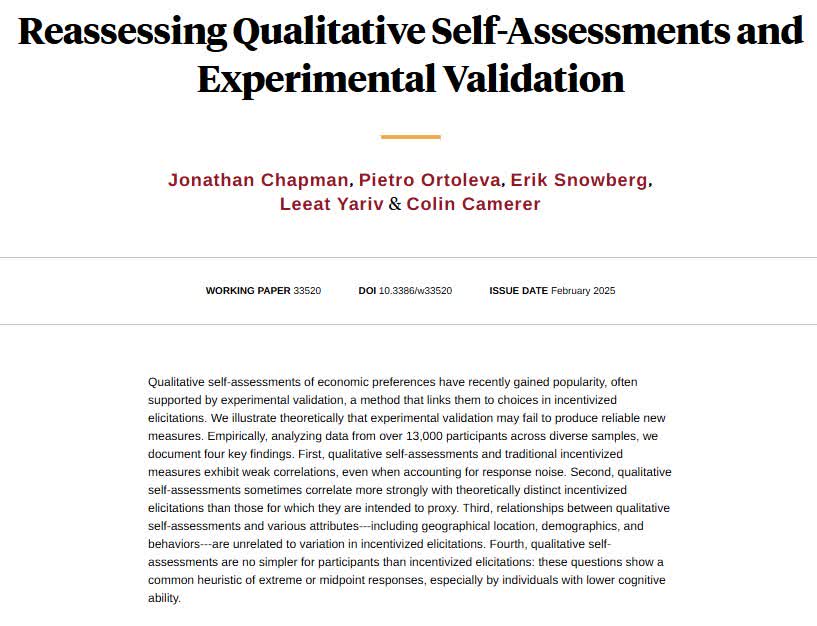
Experimental validation, which links economic preferences to choices in incentivized elicitations, may fail to produce reliable new measures, from @chapman_econ, @PietroOrtoleva, @snowberg, @lyariv, and @CFCamerer https://t.co/VQbEUmddRt
https://t.co/JrZ1q67JEq
We commit to limiting all of our letters on tenure or promotion to at most three pages.
Marina Halac
Margaret Meyer
Pietro Ortoleva @PietroOrtoleva
Philipp Strack
Omer Tamuz
To join, please email [email protected] from your academic account.
A recent working paper from @PietroOrtoleva introduces a new way of modeling the endowment effect: uncertainty about trade-offs and caution. https://t.co/aPbBQkiQsM
As a behavioral economist, I'm especially irked by the "neoclassical econ has false assumptions" crowd. Even though I (obviously) think that the classical model has important limitations.
I feel about them how a Roman reformer would have felt about the vandals.
A new way of modeling the endowment effect from @PietroOrtoleva.
"Our approach is not only conceptually, but also behaviorally different from leading alternatives, and this difference is not only theoretical but has practical consequences." https://t.co/aPbBQkiQsM
.@PietroOrtoleva (#PrincetonU), Simone Cerreia-Vioglio, and David Dillenberger introduce Cautious Utility, a new model based on the idea that individuals are unsure of trade-offs between goods and apply caution. https://t.co/aPbBQkiQsM
The Econometric Society is pleased to announce the election of 29 new Fellows of the Econometric Society.
Click the following link for the full list of 2023 Fellows of the Econometric Society. https://t.co/hC3rEYUEAB
I'll never forget the summer I spent sharing an office with Cormac for six weeks at @sfiscience, while he was collecting rare books and plugging away on an old Olivetti typewriter that he finally auctioned off in 2009: https://t.co/orV2NLCqI5
In a 1695 letter, l’Hopital asked Leibniz about the possibility that n could be something other than an integer, such as n=1/2. Leibniz responded that “It will lead to a paradox, from which one day useful consequences will be drawn.”
https://t.co/ovx6QIMn04
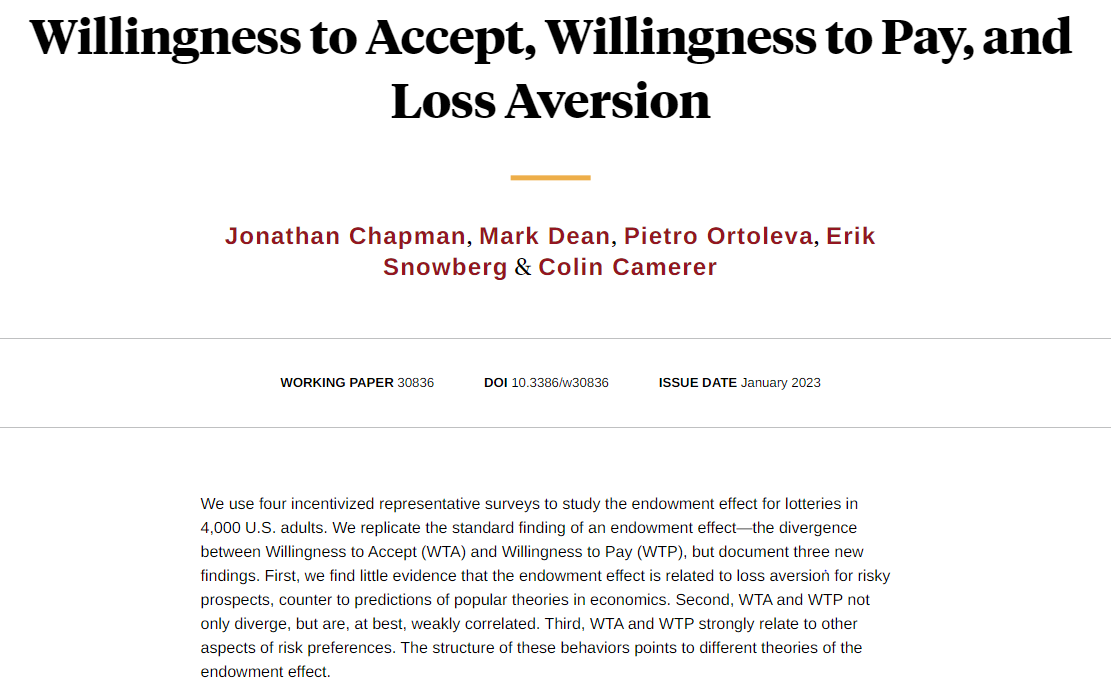
Analysis finds no support for the long-theorized link between the endowment effect and loss aversion (n=4,000) and documents new facts pointing to alternative theories, from Jonathan Chapman, Mark Dean, @PietroOrtoleva, @snowberg, and @CFCamerer https://t.co/r6cTQVhcNr
As part of Blindness Awareness Month this October, I’m participating in the #ShareYourVision campaign. I have Retinitis Pigmentosa (RP), which causes me to gradually lose my vision. You can learn more about my story here:
https://t.co/OtsAGHOWZQ
@FightBlindness#EconTwitter
Oldie-goldie 2007 Berkeley graduation speech by Tom Sargent, the best concise summary of econ I read (12 points)
"Economics is organized common sense. Here is a short list of valuable lessons that our beautiful subject teaches.
1. Many things that are desirable are not feasible.
Our research group at Panthéon-Sorbonne is opening a 2-year Post-Doc positions starting December 1st, at the intersection of behavioral economics and cognitive science. DM me if interested, retweet if you care about me (even just a little) ❤️❤️.
https://t.co/mhOxEbyAi3
We’re seeking nominations for coeditors and board members at the AER @AEAJournals. Nominations that will help diversify our board and team of coeditors are esp. welcome. Submit nominations by Sep. 30: https://t.co/fnbs8UX4DL. Thank you!
For the first time, astronomers have captured a photograph of a star so distant that nothing we do could ever affect it — even in the very fullness of time.
It lies beyond the affectable universe.
Let me explain:
1/n