Two years ago, I had a discussion with Marc.
My thesis was that all datastore SaaS is a race to the bottom in long term. Not because non technical people will code the tools, but because it becomes cheaper for a few technical ones to create software specifically catered to your need than to maintain big space ships that can do everything. And if you play long enough in such conditions real defensibility is behind one of these: safety, regulations (e.g. finance), market effects (marketplaces) and hard to collect assets (like accumulated data).
Now if we assumed for a moment that creating software is not just cheap, but free. Let's say LLM labs finally eat the software and just for mare 59$ a month they can build whatever you ask them to. Does that mean SaaS is done? What I would still pay for instead of building?
And that mostly is access. Access to data, compute, electrons, a market or even permission to operate from a gov. There are rare cavities, like API aggregators that pay per api access as a business and it is pricier to pay for access yourself in bulk. But for the most of it, it's scarcity that is what's left.
There are opinions that currently people are limited by marketing skills and the current moat is UGC, SEO or just good ads. But at the bottom of it, the cheaper software gets, the less it's going to be an issue. As in case of 59$ a month do it all subscription would take your ad as a promt and build the tools for the user.
Even tough I saw this coming two years ago, I still struggle to position myself and find a good bet.
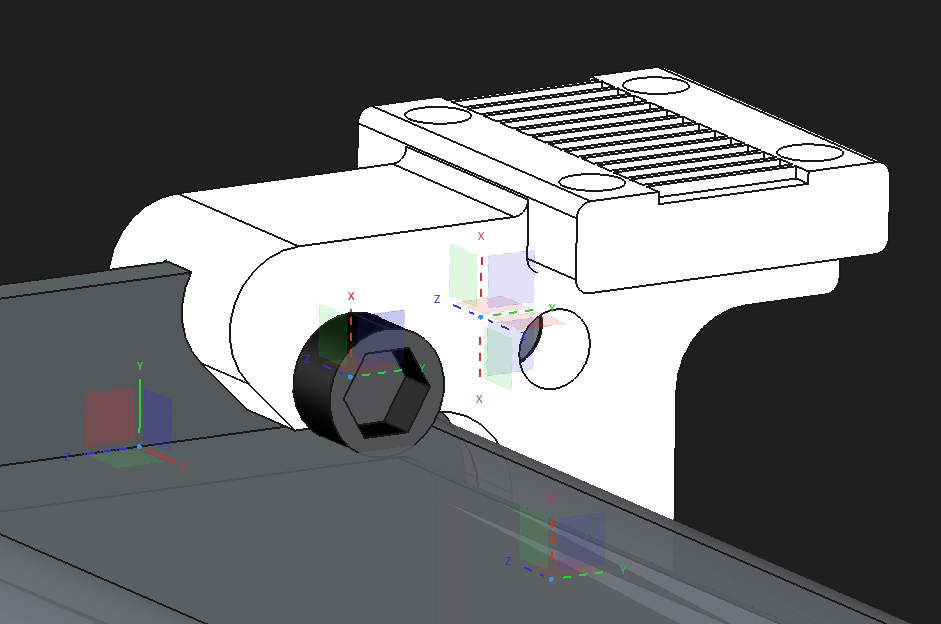
Do all CAD assemblies just suck?
I'm thinking about to switching to OpenSCAD and Godot for assemblies and as a BONUS I'll get physical simulations?
Am I missing something?
@Dirdmaster At least from what I found Openscad has assemblies in a sense of creating modules and combining them in a single file? But not joint assemblies with solvers. As in you can really move something to check motion paths/clearance?
@Dirdmaster Godot has Jolt engine. I'm thinking about translating all parts in the right places and defining joints in godot. Also naturally I should see if everything fits well or collides.
I'm thinking about a few python scripts to glue everything together
I never ever use any apps even when it's available in my mother tongue, because they sound broken af or awkward. And it's not a problem of poor translation. Most official in tech aren't even used in spoken language. It sometimes feels like we didn't adopt international words just to make a point.
(P.S. it's lithuanian)
The CNC plasma inherently has flaws in its structural design. Since it's a portable machine, there's a 99% chance the X and Y axes won't be perfectly perpendicular after each setup.
But the output can still achieve accurate dimensions.
Instead of spending time physically aligning the machine every time I set it up, I'll compensate for the misalignment in software.
I currently see two approaches:
1. A triangular jig with magnets at its vertices, using a 3D Hall sensor to locate their centers.
2. A camera that detects the edges or vertices of a triangular jig.
Either method would give me the exact real-world displacement relative to the machine's assumed coordinate system. From those measurements, I can calculate a simple transformation matrix and compensate for the machine's geometric errors in software.
In both cases, I'll create a Z-height map by probing the surface with the torch itself.