I’ll forever be bullish on crypto.
I think we overestimated how quickly crypto would become the next major computing paradigm. A lot of people were searching for the next platform shift and assumed it would be crypto, but in many ways that ended up being AI.
Over the past decade, ton of capital flowed into crypto, and much of it went toward overbuilding. Instead of focusing on a handful of narrow sectors where crypto had a clear advantage, the industry tried to reinvent everything all at once. What we’re seeing now is a natural pullback and consolidation after that period of excess
I don’t think the core thesis is broken by any means. Crypto’s biggest success may not be apps first (even though we have a few), but rails first. As stablecoins, wallets, tokenized stocks and onchain financial infra via neobanks reach every human and eventually every AI agent, crypto becomes the default settlement layer of the internet.
Once those rails are everywhere, many of the ideas that arrived too early like DAOs, decentralized marketplaces, machine to machine payments, and the ideas Vitalik wrote about in the early days of Ethereum may finally have the distribution needed to get it off the ground.
: : We're excited to announce that @FourPillarsFP has raised Series A Funding from @PanteraCapital and @further.
This round marks our next chapter: scaling from a research firm into an institutional-focused blockchain research and infrastructure provider.
As someone who's loved crypto research for years, I always wondered if our work would actually resonate globally. This round feels like the answer.
600+ reports, 100+ protocol collaborations, 3 years in.
And research will stay at our core as we expand into institutional validators and advisory.
Grateful to everyone who's been part of the journey. More to come.
My favorite Jeff quotes from the Hyperliquid article:
"Losing is a pretty common experience, most people are losers. There’s usually only one winner."
“If you’re not the first person doing something, it’s probably not worth your time to be doing it at all."
“I think people are just a bit too soft in general”
"Be very confident you’re going in the right direction, and execute well on the step you’re taking right now, without knowing exactly where you’re going."
It’s an objective analysis.
First of all, Ethena Labs has done an impressive job in both portfolio and risk management — their transparency should be an example in the industry. OKX already lists the ENA token and may consider supporting USDe in the future as well. In fact, OKX is also a small angel investor in Ethena.
That said, it’s important to remind the market that USDe should not be viewed as a 1:1 pegged stablecoin — it’s a tokenized hedge fund.
Such funds typically employ relatively low-risk strategies such as delta-neutral basis trading or money-market investments, but they still carry inherent risks — including ADL events, exchange-related incidents, and custodian security breaches.
Labeling USDe as a “stablecoin,” or describing recent market movements as “unpegging,” is inaccurate.
A tokenized hedge fund was never designed to maintain a hard peg to USD.
If any exchange decides to include USDe within its collateral framework, it must apply robust and dynamic risk-mitigation controls.
Treating USDe as a simple 1:1 stable asset could introduce systemic risks to the entire crypto industry in the future. @gdog97_@hosseeb
Did Ethena Really Depeg?
I’ve seen a lot of chatter about the Ethena depeg during the market mayhem this weekend. The story is that USDe briefly depegged to ~68c before recovering. Here’s the Binance chart everyone is quoting:
But digging into the data and talking to a bunch of folks over last couple days, it's now clear this story is not correct. USDe did *not* depeg.
First thing to understand about USDe: its most liquid venue is actually not on exchanges, it’s on Curve. There’s hundreds of millions of dollars of standing liquidity on Curve, while only tens of millions on any given exchange, including Binance.
So if you just look at that chart of USDe on Binance, it looks like USDe depegged. But if you superimpose the other liquid venues for USDe, you get a different picture:
We see here that while USDe wicked down on every CEX, it did not do so uniformly. Bybit briefly hit $0.95 then quickly recovered, yet Binance depegged a crazy amount and took forever to regain the peg. Curve meanwhile dipped a mere 0.3%. What explains this difference?
Remember, every single exchange was under immense load on that day—it was the single largest liquidation event in crypto history. Binance was extremely unstable during this period, causing MMs to be unable to shift inventory because APIs were failing and withdrawals and deposits were bricked. Nobody was able to step in and arb.
It’s like a fire broke out on Binance, but all of the roads were blocked and firefighters couldn’t make their way in. This caused a wildfire to break out on Binance, but pretty much everywhere else, that fire was immediately put out by bridging liquidity. (As Guy shows in his post, USDC also depegged a few cents temporarily on Binance due to the same general instability issues—liquidity just couldn’t get ferried in, but this wasn’t a depeg event for USDC either.)
So OK. Unsurprising that while there’s API instability, prices on exchanges are wildly different because nobody can get inventory in. But why did it decline so much deeper on Binance than on Bybit?
The answer is twofold—first, Binance did not have any primary dealer relationship with Ethena to be able to directly mint and redeem on-platform (Bybit and other exchanges have this integrated) which allows MMs to stay on-platform and still perform peg arbitrage. This is huge, as otherwise an MM has to take their money *out* of Binance, go do the Ethena peg arb, and then bring back their inventory. Nobody was doing that in a moment of crisis when APIs were failing (plus so many other coins were cratering).
Second, Binance had their oracle poorly implemented and started liquidating positions they shouldn’t have—good liquidation mechanisms don’t trigger on flash crashes. If you are not the primary venue for an asset (which Binance is not for USDe) then you should look at the price on the primary venue. If you are only looking at your own order book, you will liquidate too aggressively. This caused Binance to start liquidating USDe as though it was worth $0.80 or whatever, which caused a cascade. This is a big part of the reason why Binance is refunding people who were liquidated on USDe (other exchanges AFAIK are not doing so)—they messed up by only looking at their own price instead of the true external price.
So this was a Binance-specific flash crash, which better market structure could’ve prevented. USDe on its primary venue, Curve, was actually trading at a tight peg the entire day. This is really different from what you’d describe as a depeg.
If you remember USDC in 2023 during the banking crisis, this is what an actual depeg looks like:
During the banking crisis, USDC traded down on every single venue. There was *no* place where you could buy USDC for $1. Redemptions were literally halted, so $0.87 was the *true* price. That’s what a depeg means.
This instead was a Binance-specific dislocation. It’s a big lesson for market infra, but critical to understand the nuance here if you are trying to draw inferences about USDe’s mechanism from this weekend.
USDe was fully collateralized and worth $1 on its primary venue through the entire episode and actually increased its backing collateral over the weekend due to the price action. That said, this kind of market instability is ultimately good because it exposes lessons for the whole industry. Guy’s post below lays out how any exchange, including Binance, can avoid this kind of issue in the future.
TL;DR: USDe did not depeg, Binance did.
now may be the best time to build in crypto for the v simple reason that there's a lack of serious competition. i have maybe a dozen of good product ideas but struggle to find the right teams to build them. meanwhile in ai for every half-decent idea there's >20 legit startups working on it, not to mention the big ai labs. meanwhile the regulatory env is as friendly to crypto as ever. great time to be a contrarian.
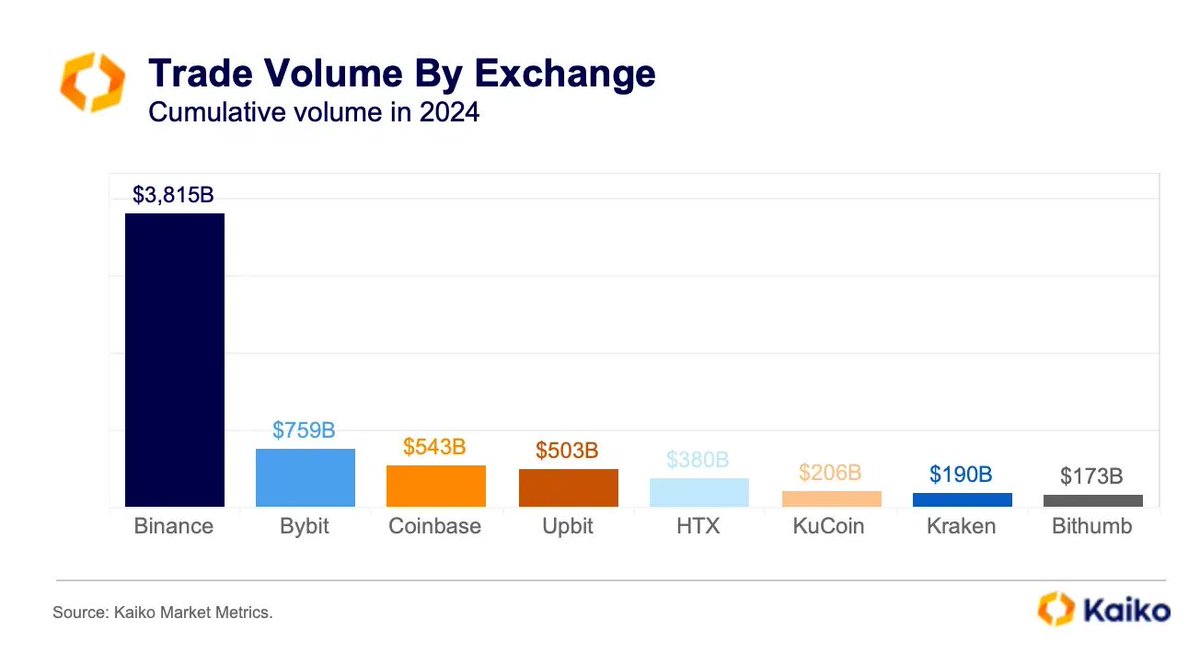
Korea faces a dilemma as the global stablecoin market rises. USD-denominated stablecoins represented over 20% of trading volume on major Korean CEXs, while the local regulatory framework remains underdeveloped.
Never limited to Korea, the surge in stablecoin activity significantly threatens the local currency's position and accelerates capital outflow to offshore platforms.
However, Korea possesses a unique strategic advantage compared to other countries. Trading volume on major exchanges rivals Coinbase, despite Korea's economy being less than 1/12 the size of the US.
Additionally, Korea's tech-savvy population and speculative culture creates ideal conditions for the development and growth of a native KRW stablecoin.
By leveraging the local market's extraordinary trading intensity and digital adoption rates, a KRW stablecoin could not only stem capital exodus but establish Korea as a significant player in the global digital asset ecosystem.
In pursuit of product-market fit, you should be less of a data scientist and more of an anthropologist.
Every week I see teams pretending to be scientists and analyzing metrics on a test group of a few hundred users who came from odd sources unrepresentative of their broader target audience — like a Discord server or a handful of friends & acquaintances.
Instead, keep it simple:
Your analytics dashboard should literally just be a table of users with the following columns:
• Name
• Registration Date
• Last Active Time
• Number of Sessions
Then follow these steps:
1. Sort the list by Last Active Time
2. Look up the most active users on Instagram or Linkedin
3. Then interpret their behavior on your app through the lens of their online identity
4. If you have a messaging channel such as Intercom, send them a generic message asking for their feedback (and maybe offer a $25 gift card)
Do this regularly.
It’s certainly not science but it will tell you more about what’s resonating about the product than a bunch of statistically insignificant data.
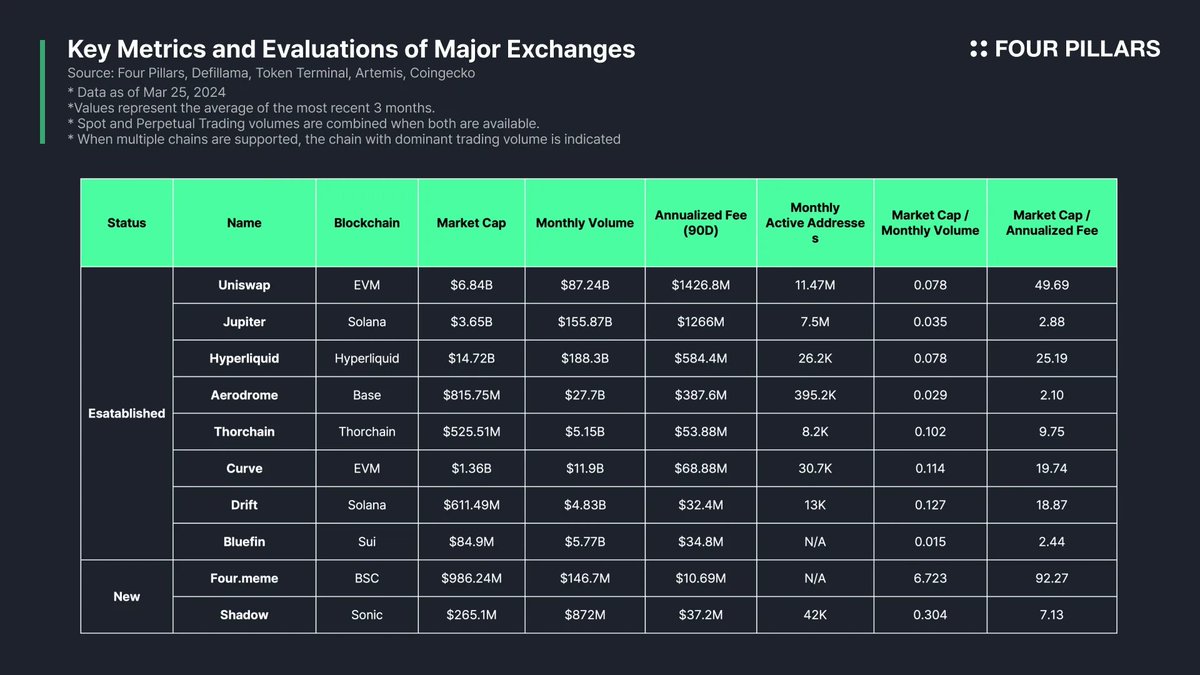
Still, @JupiterExchange and $JUP seem to be one of the most underrated protocols in crypto imo
- Highest spot trading volume not just on Solana, but almost across all crypto DEXs/aggregators
- Market Cap / Annualized Fee (PSR) ratio of just around 3-4, one of the lowest across DEXs/Perps
- Most comprehensive product stack in crypto: Jupiter Swap, Perps, Pro for memes, API and DEX(Meteora)
- Visionary and community-aligned founder (h/t @meow)
- Recent mobile focus with Moonshot acquisition and portfolio integration
- Vibrant community (Jupiverse) and transparent & active governance with incentives (ASR)
- Increasing token-protocol alignment via Jupnet launch and ongoing buybacks
JFG
: : We're Thrilled to Join Initia as a Genesis Validator!
As a trusted research partner, we're here to support @initia's ecosystem with in-depth insights and analysis.
From knowledge to action — come build with us.
Eight trends that won’t change over the next 10 years, irrespective of crypto:
(1) Payments will get faster and cheaper
(2) The amount of global transactions will grow
(3) The amount of agentic transactions will grow
(4) There will be more demand for AI’s fundamental inputs — compute, bandwidth, energy, storage, and data — and efficient markets for these commodities
(5) Financial assets will seek faster, cheaper settlement and deeper liquidity
(6) Private investing will get increasingly democratized
(7) More yield will end up in the pockets of end users
(8) Demand to speculate on non-linear outcomes will grow
From first principles, blockchains are a structurally better means of servicing most, and perhaps all, of these use cases