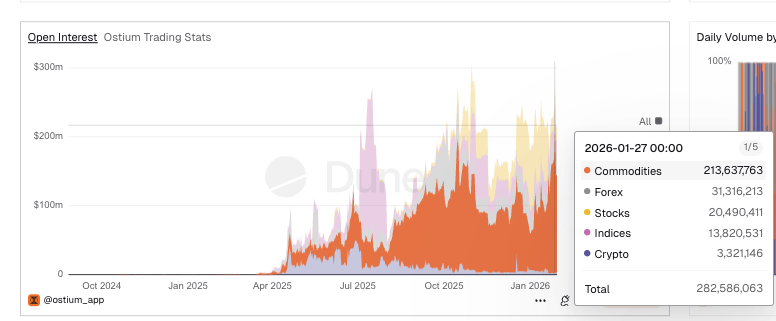
The @ostium Open Interest on Commodities has increased by $75M in 2 days.
$HYPE HIP-3 passed putting a focus toward onchain commodity trading. Ostium is the only platform that competes with @HyperliquidX.
It's not too late to earn an Ostium Airdrop:
https://t.co/ZeYTSwEBg6
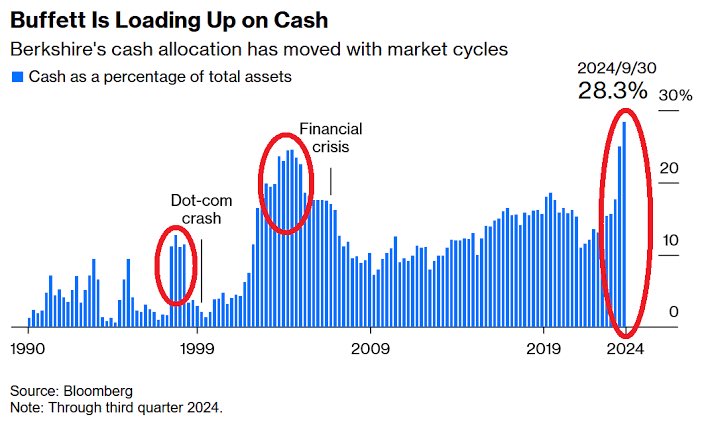
This evolutionary cycle is not just for people but for countries, companies, economies—for everything. And it is naturally self-correcting as a whole, though not necessarily for its parts. For example, if there is too much supply and waste in a market, prices will go down, companies will go out of business, and capacity will be reduced until the supply falls in line with the demand, at which time the cycle will start to move in the opposite direction. Similarly, if an economy turns bad enough, those responsible for running it will make the political and policy changes that are needed—or they will not survive, making room for their replacements to come along. These cycles are continuous and play out in logical ways—and they tend to be self-reinforcing.
The key is to fail, learn, and improve quickly. If you’re constantly learning and improving, your evolutionary process will look like the one that’s ascending. Do it poorly and it will look like what you see on the left, or worse. #principleoftheday
A thought experiment.
Imagine if:
Within the next 89 days, the US, Europe, and Japan agree to go zero/zero on tariffs and remove all trade barriers.
Then Europe and Japan join the US in raising tariffs on China to 145%.
Then the US, Europe and Japan as a united front negotiate with China to remove tariffs and trade barriers, and put in place strong structural protections for IP.
1/ The world’s not going back to normal.
We’re entering a new phase of global markets — and most people are still looking in the rearview mirror.
Trump’s tariffs are just the start. All about new world order.
Let’s break down what’s actually happening: 🧵
A Guide to Navigating Tariff Turmoil
By Joe Wiggins
“When equity markets are rising it is really easy to stick with the key principles required to be a successful long-term investor; unfortunately, it gets far harder when they start to fall and uncertainty climbs. At the exact time when discipline is required, it can so often desert us.”
Joe Wiggins also outlines practical “dos and don’ts” for investors navigating market volatility sparked by tariff news. Among his key takeaways:
Don’ts:
– Don’t obsessively check your portfolio.
– Don’t consume too much financial news.
– Don’t make decisions driven by emotion.
– Don’t trust forecasts from people who didn’t predict the current turmoil.
Dos:
– Do focus on your long-term investment goals.
– Do remember that equity markets recover over time, despite periodic setbacks.
– Do recognize that uncertainty is always part of investing.
– Do go for a walk — sometimes distance brings perspective.