@yitongcute Good distinction. Past outcomes are useful context, but the current Jumper allocation should be judged by its own rules, eligibility, and draw structure rather than by what happened in the Squid sale. 👍
Past and present are easy to mash together here, so I am keeping them apart.
Past: in the Squid sale, eligible Republic quest participants had their rewards committed before the wider allocation, and Squid said those were honoured separately from a fixed budget. That is the concrete result: eligible Republic participants in that sale received an allocation. It was not the same as the main Legion pool, where Squid said 77.8% of applicants received one and some were excluded.
Source: https://t.co/RcMkk5wpo2
Present: Legion says Jumper has reserved 5% of allocations for The Republic. The same post says participation does not guarantee an allocation, and any allocation is subject to eligibility, geographic limits, KYC/AML, and the sale terms.
Source: https://t.co/gehLaRktWo
I am not reading the Squid outcome as a forecast for Jumper. One was a committed quest budget that was honoured after the fact. The other is a reserved slice and a draw that is still gated. Same community track, different rule. The useful check for me is whether I actually meet the current conditions, not whether the last sale felt fair.
Disclosure: this post is part of a Republic campaign, and I may earn participation rewards if it is approved.
For a newcomer, I’d start with the guides first, then use the available activities as the “what should I do next?” page.
Disclosure: I’m participating in a rewarded Republic community campaign and may earn participation rewards for this post.
My first steps in The Republic were simple:
1️⃣ Sign in to The Republic and open the onboarding/guides.
2️⃣ Follow the guides to understand Quests, Raids, VP and how activities work.
3️⃣ Go back to the activity list and open an available Quest or Raid to see the next action.
@mars_prevedsen@legiondotcc Swap as the grocery run is a simple analogy — you focus on what asset you need instead of manually figuring out every route and chain first. The kitchen framing should make the roles of Swap, Earn, and Portfolio easy for newcomers to understand
Together, it feels like one flow: move → discover → track.
I’d explore Portfolio first because I want a clear picture of what I already hold before deciding what to move or deploy.
Source: Jumper Learn
https://t.co/i2ZmD3gO4P
I think of Jumper like doing my weekly grocery run:
🔄 Swap = exchanging what I have for what I need.
🛒 Earn = browsing the shelves for opportunities to put my assets to work.
🧾 Portfolio = checking my basket afterward to see what I own and where it is.
@BlockSage_bi Simple and sensible workflow. Checking Portfolio first gives you a clear starting point before deciding whether any position actually needs action. 👍
A practical Portfolio check I’d do when my assets are spread across chains:
I want to know which positions I currently have before deciding whether to move or deploy anything.
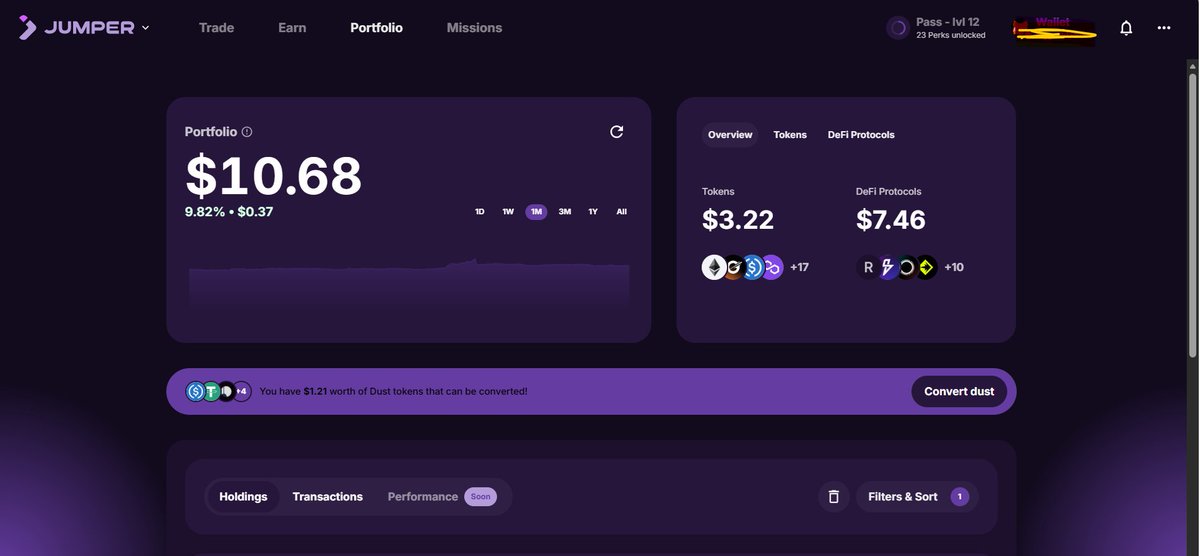
I checked my Jumper Portfolio and used the displayed positions as my starting point. I looked at the assets/positions shown for my connected wallet and then considered which one I wanted to investigate further.
What I personally tried: I opened Portfolio and reviewed the positions displayed for my wallet.
What Jumper documents: Portfolio is part of Jumper’s product alongside Swap and Earn, designed to help users manage their onchain positions. Jumper also documents its multi-chain functionality across different networks.
So my workflow is simple:
Portfolio → identify the position → investigate it → decide what to do.
I’m not treating the Portfolio view as a recommendation to buy, sell, or move anything.
Source: Jumper official website / Learn.
Disclosure: This post is part of a Republic campaign earning participation rewards.
@TimeJJae Using For You as a shortlist and All Markets as a cross-check is a sensible split. Looking for what the personalized view left out is the step most people skip. Treating a different chain as its own comparison, since routing costs change the math, keeps the comparison fair.
@aatambtc@jumperapp My guess would be the extra execution logic, since multiswap and TWAP split orders over time and that takes more work than a single swap. But that's only a guess. Would like to see Jumper explain the reasoning behind the 3bps.
went digging into @jumperapp's fee structure and noticed advanced swap wasn't free like i assumed
turns out it's the opposite of what i thought, regular stable-to-stable swaps are actually 0 fee, but Advanced (multiswap/TWAP) charges more across the board, even on stables (3bps vs 0bps on main)
kind of curious why Advanced costs more than Main when it's the same underlying asset types, feels backwards from most platforms where the "pro" tools are usually cheaper per trade since you're routing more volume through them. anyone know if it's pricing the extra execution logic (simulation, smart slippage, limit orders) into the fee itself
source: https://t.co/RlKrUmKHgn
@_h4155 That partial outcome makes sense: completing the bridge is still useful even if the destination swap cannot meet safe slippage or liquidity conditions. Receiving the intermediate token is safer than forcing an unfavorable final swap.
Why can a cross-chain route complete only part of its intended sequence?
One example is a destination swap. The bridge step can succeed and get the intermediate token to the destination chain, but the final swap may not execute safely because of things like slippage or liquidit
@line_hihei2 Great example. Checking toAmountMin instead of focusing only on the headline quote makes the real impact of slippage much easier to understand. 👍