I enjoyed @Microsoft Build.
Next stop, I will continue to learn how Azure, GitHub, Microsoft IQ, Fabric, Foundry, Windows, Microsoft Security, and Microsoft 365 operate as a connected AI ecosystem for deploying agents at enterprise scale.
It's going to be an interesting summer as I apply what I am learning at work on an enterprise level.
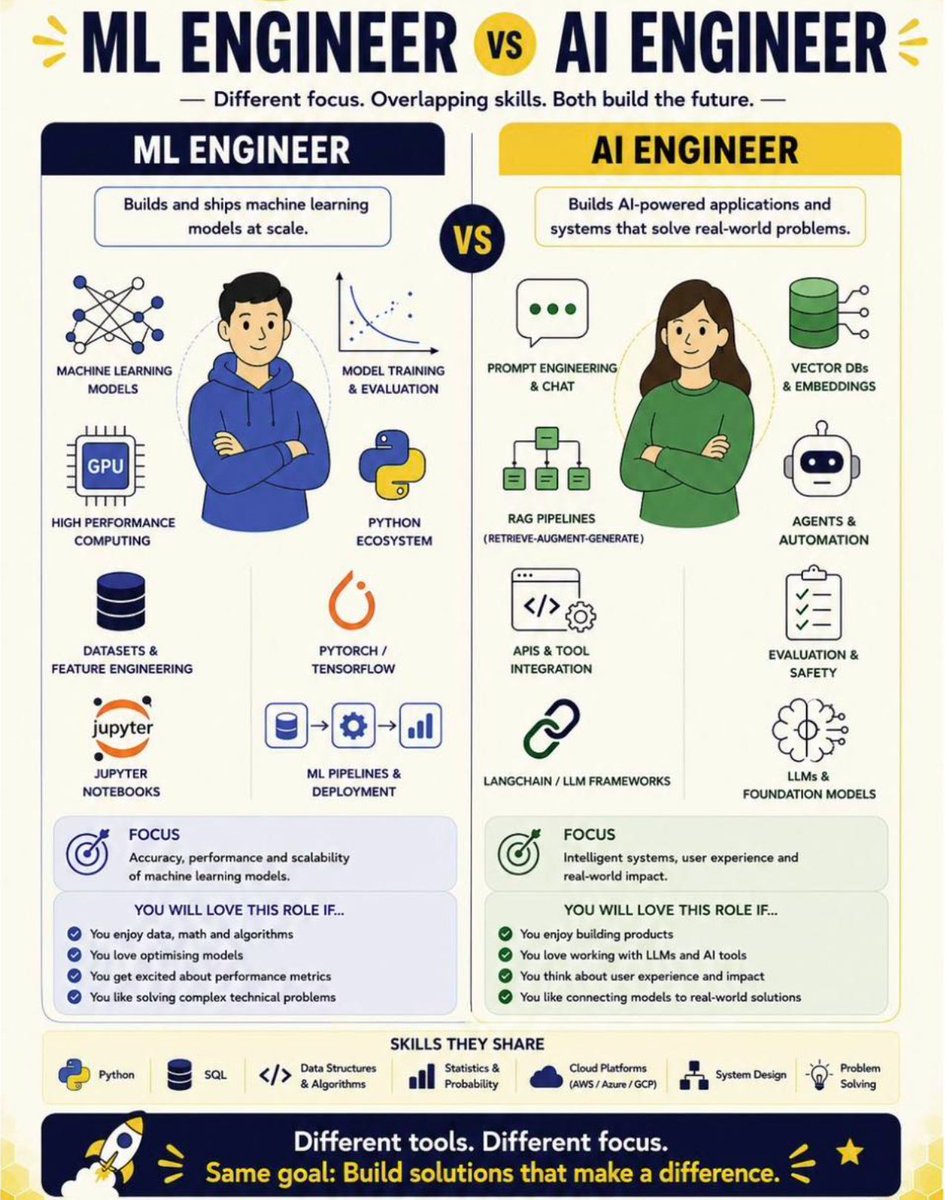
Two of the most confused job titles in tech right now.
ML Engineer. AI Engineer.
People use them interchangeably in job posts, interviews and LinkedIn bios. They are not the same role.
Here is the clearest breakdown I have seen.
An ML Engineer builds and ships machine learning models at scale. The focus is accuracy, performance and scalability. If you love data, math, algorithms and optimising models this is your role.
An AI Engineer builds AI-powered applications and systems that solve real world problems. The focus is intelligent systems, user experience and real world impact. If you love building products, working with LLMs and connecting models to real solutions this is your role.
The skills overlap significantly. Python, SQL, cloud platforms, statistics. Both roles need these.
But the day to day work, the mindset and the problems you solve are fundamentally different.
Save this. Share it with anyone who is trying to figure out which path to take.
♻️ Repost to help someone who is confused about which role to apply for.
#DataScience #MachineLearning #AI #MLEngineer #AIEngineer #DataScientist #LearnAI
microsoft/aspire-skills: Official Aspire skills and plugins for AI coding agents to initialize, wire, orchestrate, monitor, and deploy distributed apps. by @OpenAtMicrosoft https://t.co/NA0ARDIjd4 #aspnetcore#aspire
Starting a new .NET project?
Before writing business logic, I like to set up six things first.
They are small decisions at the start.
But they prevent a lot of pain once the solution grows.
1. Add an `.editorconfig`
Your team should not waste time debating formatting and naming on every pull request.
2. Centralize build settings
Target framework, nullable checks, warnings, and shared build rules should live in one place.
3. Centralize NuGet package versions
This makes updates easier and helps you avoid different projects using different versions of the same package.
4. Add static analysis
Catch common issues during the build, not weeks later during a bug hunt.
5. Make local setup repeatable
Whether you use Docker Compose or .NET Aspire, everyone on the team should be able to run the same app setup locally.
6. Set up CI early
Every change should be built and tested before it reaches your main branch.
None of this feels urgent on day one.
It becomes very important on day one hundred.
Here is the setup I use when starting a new .NET project, with each step explained: https://t.co/jWiamvnSCM
ในที่สุด LM Studio ก็ทำแอพมือถือซะที!!! 🐱🔥
LM Studio คือแอปฮอตฮิตสำหรับรัน AI model บนเครื่องตัวเอง แบบไม่ต้องพึ่ง cloud ตลอดเวลา
สาย local AI น่าลองมากก
The laptop hasn't changed in 30 years. NVIDIA just changed it
RTX Spark is their first PC chip ever.
- RTX 5070 level GPU
- 128GB unified memory
- 1 petaflop of local AI
- thin, light, barely throttles unplugged
Your AI agent lives on the machine. 24/7. No cloud.
This is step one of the agentic AI PC, and everyone else is about to copy it.