Our recent work is online at #bioRxiv! We directly printed 6,600 microelectrodes on top of advanced silicon chips at 35-micron pitch. This allows us to interface with neural structures in 3D, at large scale, and with high spatiotemporal resolution. 1/4 #bioelectronics#3Dprinting
Excited to share that our latest breakthrough in thin-film encapsulation is out now on Advanced Functional Materials! Our research shows how 3D micro-anchors significantly enhance the encapsulation properties and longevity of PaC films. https://t.co/Mt2AuOPA39
Interested in how interfacial ions impact electrocatalysis? Check out our Invited Perspective in @ACSCatalysis!
Linking Electric Double Layer Formation to Electrocatalytic Activity | ACS Catalysis https://t.co/UN5B1mWhsc
I’m delighted to share our preprint led by @Muhamma51787523 with @Shiyuan75301151 and I in the @zhenanbao group. We introduce multimodal soft elastomer fibers that can be used for motility sensing in the gut and ephys recording in the brain.
My 1st PhD work from the Melosh lab is finally out! In collaboration with @bel_ethz and @HuguenardLab we solved a key bottleneck limiting the scalability of flexible neural interfaces, enabling multi-thousand channel counts at millimeter scales. https://t.co/z1BSpHaM77
This could allow retinal prostheses to produce high-acuity artificial vision, which requires accurate reproduction of the natural activity of the retinal ganglion cells, and may be possible thanks to our ability to precisely target the retinal ganglion cells at high density. 4/4
Our recent work is online at #bioRxiv! We directly printed 6,600 microelectrodes on top of advanced silicon chips at 35-micron pitch. This allows us to interface with neural structures in 3D, at large scale, and with high spatiotemporal resolution. 1/4 #bioelectronics#3Dprinting
We used our technology to address a critical challenge when interfacing with the retina. With the customizable array, we could specifically target a group of neurons called the retinal ganglion cells, while avoiding other structures such as the axon bundle layer. 3/4
We directly printed 3D microelectrode arrays on top of silicon chips for interfacing with the retina. If you're interested in what we have found out so far, please check out my poster at SB09.09.17. #S23MRS#bioelectronics
Exciting news! My paper on fully reversible molecularly imprinted polymer sensors based on electrostatic repulsion has just been published! These sensors can repeatedly detect low concentrations of charged molecules in biological environments. Read it now https://t.co/1YYaXCiSbs
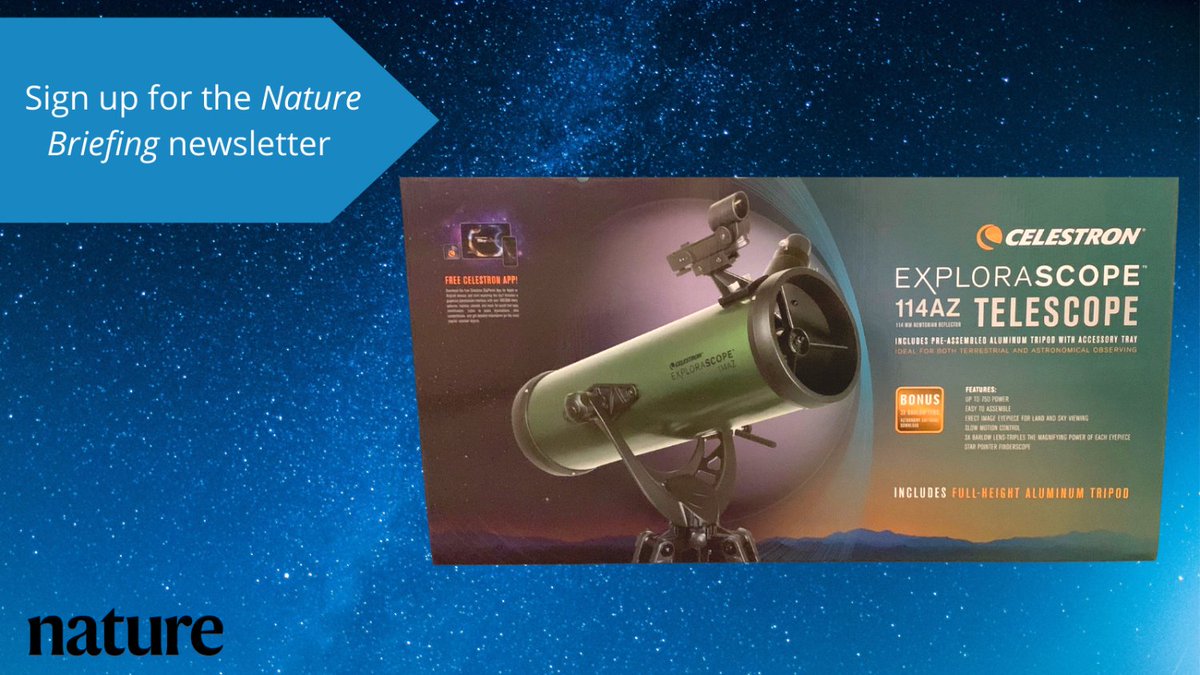
📢 📢 Competition time! 📢 📢
Be in with a chance to win a CELESTRON® Telescope by signing up for the Nature Briefing, a daily round-up of science news, opinion and analysis, delivered to your inbox every weekday. Enter now: https://t.co/wzCwA38Cjj
Super excited to share this project we've been working on for the past few years, in collaboration with the Chichilnisky Lab and @bel_ethz.
Please stop by my presentation (SB03.07.02, 1:45pm, Wed 11/30).
Would love to hear your feedback! #F22MRS#MRSFall2022
Who would have thought you just need a bit of alcohol to connect flexible devices to electronics? Check out this paper first-authored by my lab mate @erictzhao
Excited to share my 1st PhD preprint from the Melosh lab in collaboration with @bel_ethz and @HuguenardLab: https://t.co/oUBixLBBGh. We solved a key bottleneck limiting the scalability of flexible neural interfaces, enabling a 2200-channel ECoG array in a 3.5 mm x 2.1 mm area.
Happy #YearOfThePig! Sign up for Nature Briefing for a chance to win this pleasingly plush Nature-branded pig, tucked into its own canvas tote bag.
https://t.co/Zn9ulXsLVy