Options are becoming the next onchain battlefield.
Onchain options just had the biggest month on record.
$170.1M in premium over 30 days, $1.99B in open interest, and $1B in all-time premium.
@DeriveXYZ leads with 87% of 30-day premium and 91% of open interest. @paradex is second at 9.0%.
@dreaming: $847K of premium in 30 days, up 1,403% month over month.
@SynapseProtocol: $1.47M since launch on Hyperliquid.
On Solana, @leaps_finance just launched in beta. You can sell covered calls or cash-secured puts on SOL and cbBTC and get the premium paid upfront in USDC.
Hyperliquid HIP-4 is useful for prediction markets and bounded options-like instruments.
But 92% of markets are sports. So the options layer looks more like a prediction market.
@Outcomexyz: 97% of 7-day HIP-4 volume. Mostly sports.
The vanilla options on Hyperliquid are Rysk and Hypercall.
@ryskfinance: $23.6M TVL and $103.6M of 30-day notional
@SynapseProtocol Hypercall, $1.47M since launch
Onchain options are just 5.3% of Deribit.
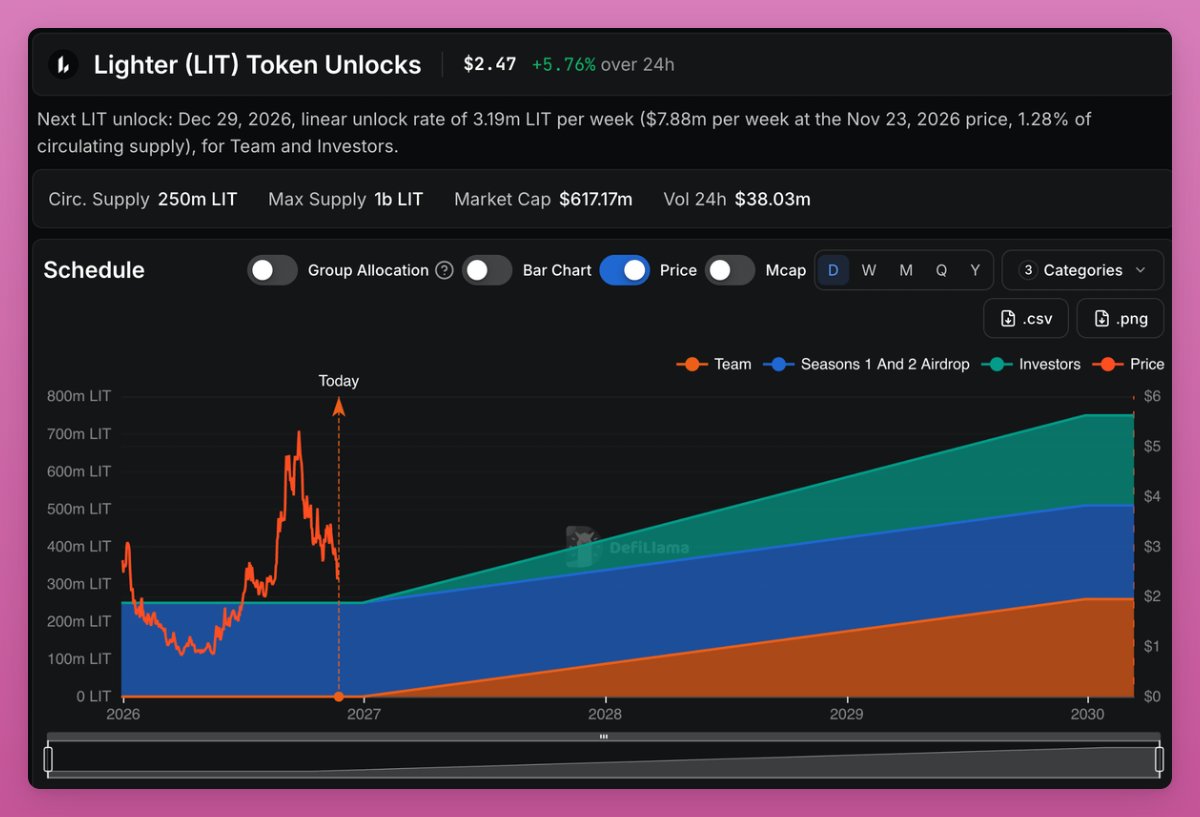
$VAR TGE is coming just as $LIT unlocks gonna start.
VAR has more open interest than Lighter:
$653M vs Lighter $552M
Of course, people are farming the VAR airdrop. Although Lighter has points farming on Robinhood Chain too.
So we don't know how much activity stays when rewards stop.
But Lighter's OI only fell 14% in the month after TGE. HL's actually grew 41%.
So I'm optimistic users are mostly gonna stick
If we match LIT's FDV/OI we get $VAR at ~$2.85B FDV (let me dream).
Currently $VAR pre market trades at $1.4B on ... Lighter :)
Cherry on top for the comparison is LIT unlocks starting in Dec.
We'll have ~$34M/month unlocks vs $4.7M in buybacks but if HYPE FUDed unlocks are a lesson, this could be a non-event.
Top DeFi news to pay attention to this week 🧠👇
1. @okx and ICE launch the OKXICE venue Nov 23: tokenized US stocks trading 24/7 against $USDC in permissioned Uniswap v4 pools on X Layer.
2. @Polymarket starts moving new markets to Protocol V2 on Nov 23. BTC and ETH Up/Down, commodities and finance markets follow Nov 24.
3. @SuiNetwork US Samsung Wallet users can send $USDC on Sui from Nov 23 with no gas needed, across 82M compatible Galaxy devices.
4. @LayerZero_Core opens pre-genesis $ZRO staking Nov 23, ahead of Zero's mainnet. Staked ZRO locks until March 31, 2027.
5. @LidoFinance's Vote #207 closes Nov 23, adopting the framework for Lido Lend, its new lending product. The first planned market is WETH/wstETH.
6. @citrea_xyz's Pomelo mainnet upgrade rolls out Nov 23-25, adopting @SuccinctLabs's SP1 zkVM for proving.
7. @StellarOrg validators vote Nov 24 on Protocol 30 "Bell," adding post-quantum signature checks for smart contracts and millisecond ledger close times.
8. @injective's Veyra upgrade goes live Nov 24, adding RWA infrastructure, institutional RFQ trading and wider IBC connectivity.
9. @ether_fi holds its ETHFI investor call Nov 24 and is teasing a new product announcement.
10. @PropbaseApp Lend launches Nov 26, letting users lend $USDC or borrow it against staked tokenized real estate.
11. @KaiaChain opens withdraw-and-restake on Nov 26, moving stakers onto new contracts as the network goes permissionless.
12. @ethereum core devs meet Nov 26 to decide next steps for Glamsterdam's testnets. The upgrade has slipped into 2027.
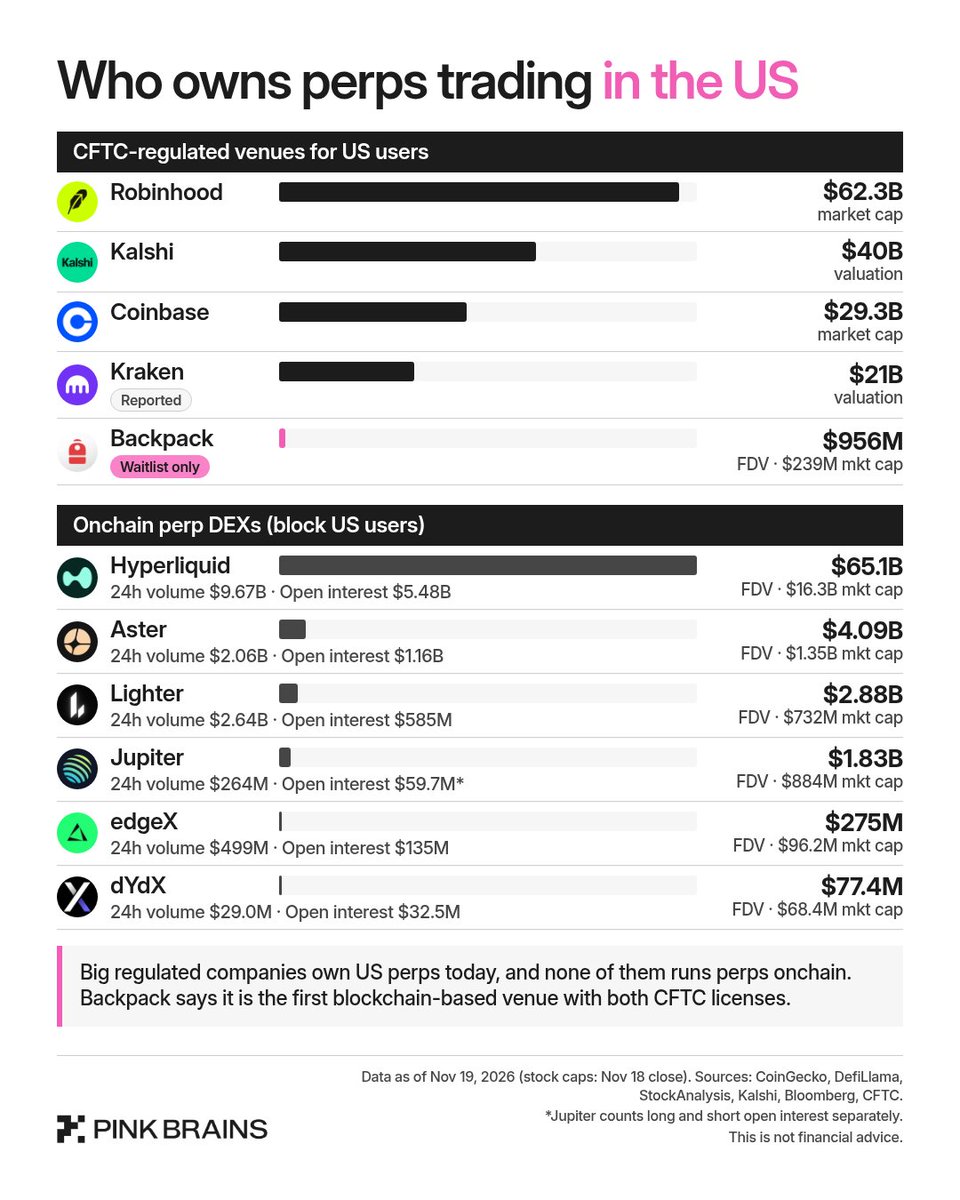
US perps still belong to regulated giants, not onchain venues.
Four regulated firms hold the US market today, while two onchain players are lining up to compete 🧠👇
1. @RobinhoodApp offers US perps on $BTC and $ETH. Its market cap is $62.3B.
2. @Kalshi lists US perps on crypto, metals and the US500. It was valued at $40B, with Bloomberg reporting $65B talks.
3. @coinbase offers US 5-year "perpetual-style" futures. Its market cap is $29.3B.
4. @krakenfx lists 16 US perps on @Bitnomial. Its September round was reported at $21B.
5. @Backpack holds all three US licenses from the CFTC and NFA, with a waitlist open and no launch date yet. $BP has a $956M FDV and a $239M market cap.
6. @HyperliquidX leads onchain perps with $9.7B in 24-hour volume, while $HYPE has a $65.1B FDV and a $16.3B market cap. Its main interface still blocks US users, and a Hyperliquid Strategies subsidiary awaits US broker approval.
4 giants total about $153B across market caps and private valuations, though licenses alone dont guarantee users or liquidity.
Who brings onchain perps to US traders first?
Humans have no chance when agentic trading platforms build and combine Jev-like decision models with prediction markets.
Prediction markets move the second a headline lands, so the edge is who reads it first.
Decision models like Jev don't generate text, they just return probabilities in milliseconds.
While Jev is a general-purpose System One model, @dmind_ai's Kairos is tuned for news and event trading and connected to @minara.
It can answer whether a market resolves YES, and whether buying at the current price is worth it.
You compare its number with the market price, and your own code decides the trade.
Trading agents are becoming crypto x AI's next data customer.
https://t.co/gcMGMZC3A7
Privacy could bring more capital into DeFi.
@zama's confidential vaults are providing enterprise-grade privacy for onchain deposits
The first vault launched on @Morpho in June, and confidential vault TVL hit an ATH of more than $110M.
5 more available:
- Brazilian receivables on @plumenetwork
- US residential mortgages through @NUVAFinance's HOME vault
- @Ondo tokenized stock markets curated by @Re7Labs
- Digital credit from @saturn_credit and @hyperithm
- Diversified @YuzuMoneyX USDC vault.
-> You deposit confidential USDC. Deposits, balances, and withdrawals stay encrypted onchain.
-> It runs on fully homomorphic encryption, so the chain computes on data without decrypting it.
Privacy is what institutions require before going onchain, and this could be how private credit gets there.
https://t.co/qoSJvoivNH
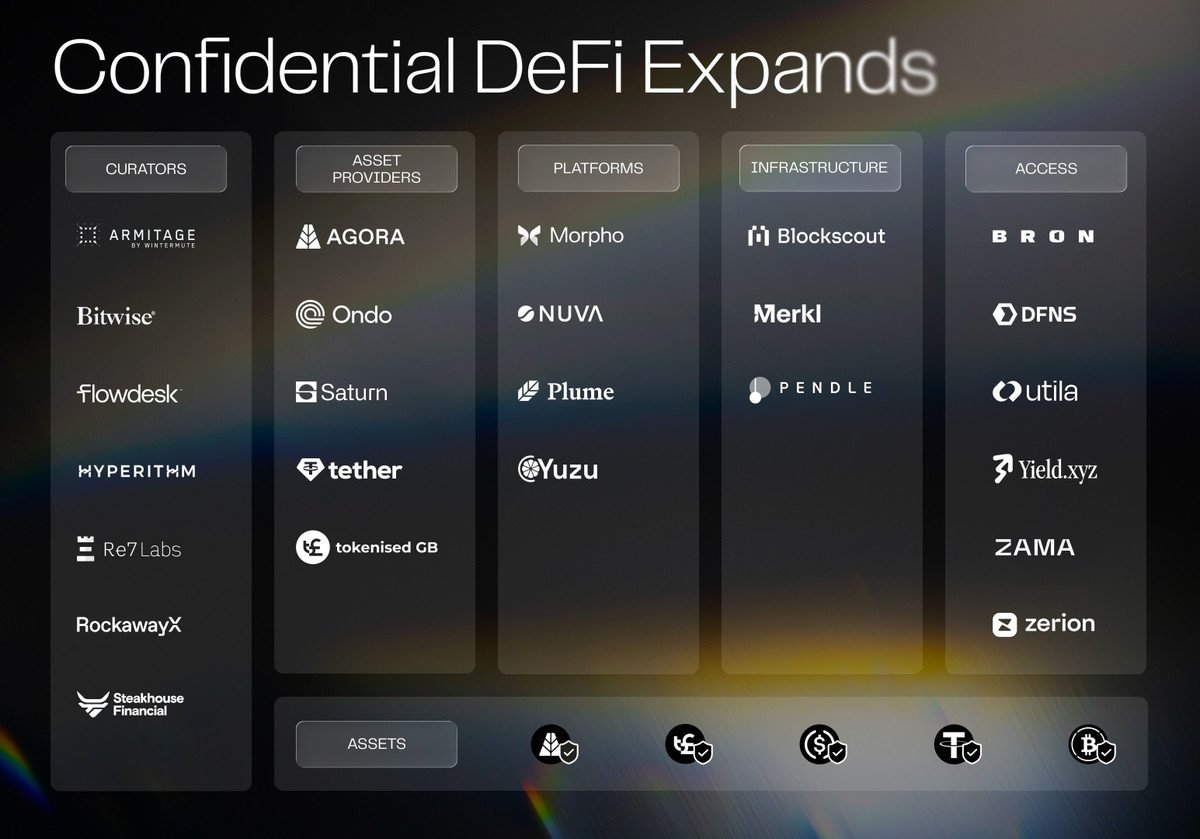
Confidential DeFi is expanding.
Today, we're launching 5 new confidential vaults across 4 platforms, each with a new strategy.
The first confidential vault was launched in June. By September, there were 16 vaults, with TVL reaching an all-time high of over $110M in October. Now Confidential DeFi goes beyond a single platform and into a growing ecosystem.
What's live:
- Re7 Confidential Ondo USDC: RWAs on @Ondo tokenized equities, curated by @Re7Labs on @Morpho
- BlackOpal LiquidStone II: private credit backed by Brazilian receivables, on @plumenetwork
- Saturn Confidential USDC: digital credit and Ondo Stocks, by @saturn_credit and @hyperithm, live on @Morpho
- HOME: private credit in U.S. residential housing loans, on @NUVAFinance
- Yuzu Confidential USDC: diversified USDC yield, on @YuzuMoneyX
All 5 vaults take Confidential USDC (cUSDC) deposits, and every depositor's position stays confidential onchain.
Beyond the vaults, a full stack of wallets, custody providers, and DeFi infrastructure now supports confidential tokens.
Powered by the Zama Protocol. Shield, send, deposit, earn, and swap confidentially at https://t.co/u8HcSVa8dH
Full announcement: https://t.co/G0hcJwVJ3j
Stablecoin supply is down ~9% since May's ATH.
$USDT: -$14.4B (-7.6%)
$USDC: -$7.6B (-9.9%)
Binance lost the most: $17.2B or - 28.5% of their total balance.
So binance is responsible for ~64% of the global supply decline.
At first I thought it's due to the hack, but 51% of Binance's decline happened BEFORE the hack.
Bybit lost $1.9B (-27.6%) and Bitfinex lost 68% (On Bitfinex in the comments).
Crypto com lost 83% of all stablecoin deposits (mostly USDC) and sits at all time lows
Worth mentioning $USD1 that lost 31% of the supply:
Binance raised USD1 rewards on Nov 10 and extended the campaign to Dec 4 (up to 10% APR).
Still, USD1 supply dropped another ~11% in the past week. I'd guess 1)hack plus 2) democrats winning has something to do with it.
Overall, stablecoins leaving CEXs reduces buying power on the dips. Not bullish.
*** All data is from defillama so if there are any discrepancy, tag them.
Why did @NYSE pick @avax?
@RasterlyRock of @Bitwise: it comes down to customizability, with built-in compliance controls and surveillance while still using the public blockchain.
@Matt_Hougan: Avalanche feels like a McKinsey office. This business culture is why.
$AVAX