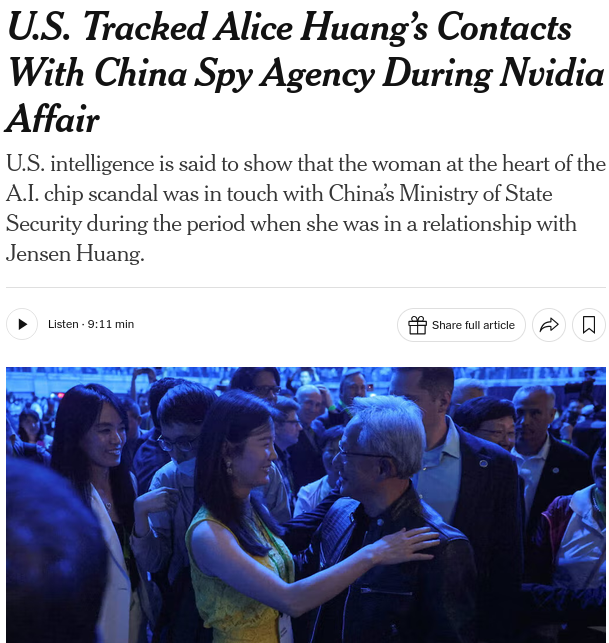
The @NYTimes' coordinated assault on Jensen Huang is astonishing. Three to five hit pieces a day. Front page. Thinly sourced. Every day for two weeks. If the NY Times spent even 1% of that energy going after Epstein's clients or Big Pharma, the world would be a better place.
I've been non stop thinking about what this Huang case means for China, America relationship and I really think it's a symptom of a far bigger problem.
China is not a normal competitor for the chips that power military AI. It is a hostile force that treats U.S. technology restrictions as a problem to be worked around.
The Jensen Huang case was only the latest example. Beijing has spent years building intermediaries, shell companies, and overseas data centers to keep restricted Nvidia hardware flowing to Chinese users. Those chips train the models that improve targeting, autonomous systems, and battlefield decision tools. China does not need to match American design if it can keep buying the output.
Export controls exist because advanced compute is dual-use. Every successful diversion is a step toward closing the gap on capabilities the United States has explicitly tried to deny.
If war with Taiwan breaks out tomorrow we will look back on this scandal as a major step on the ladder towards escalation.
In a turn of events that will surprise no one, there was limited demand for ING’s $500 million portfolio of a dozen different data center loans.
In other words, ‘no bid’ - which means it’s time to sweeten those yields and drop the dollar price.
Stephen Miller nailed it:
The Democrat Party, through the Biden-Harris administration, ran a deliberate scheme to fly in and parole millions of illegal aliens — handing them work permits, Social Security numbers, and a path to the voting booth while hooking them on welfare.
The goal? Permanent Democratic voters and the erosion of the Constitutional Republic.
Not a conspiracy. Their own words and policies.
#ElectionIntegrity #BorderCrisis #StephenMiller
No one should be surprised by reports that Jensen Huang was a target of espionage
Every individual, and institution in China must assist with espionage. Which means they are able to constantly put pressure on American elites.
Any relationship can be exploited. Chinese controlled supply chains are weaponized to manipulate western corporations. We need to radically rethink our relationship to the PRC.
@CrudeCO77@ScottPresler You’re missing the point none of what you said matters and yes I am well aware of market structure and all the dynamics. China pushed up prices right into the elections. You’d be a fool to think otherwise.
Her parents ruined her life. In Shanghai in 2016, a rich family could send their kids to the US for middle school or high school through legal procedures. But they needed to attend private schools in the US. It was popular among these rich Shanghainese. Her parents orchestrated her study plan and abused the US immigration system. I bet the training she got in Shanghai before she came to the US was not cheap. She could change her immigration status to legal when she became an adult. Why did she insist her family was persecuted in China? If her family was really persecuted in China, there was barely a chance they could leave China. Chinese government doesn't allow political prisoners to have passports or leave China. In 10 years, USCIS has denied her family's political asylum application, which has proven the application was baseless. She used her so-called persecution as a selling point in her academic application, which just indicated her dishonesty.
Aujourd'hui, à Shenzhen, je rendais visite à des sous-traitants en usinage.
Les ouvriers y travaillent cinq jours par semaine, à raison d'environ dix heures par jour, ils ont la possibilité de travailler le samedi en supplément, payé sans majoration. Tous le font, systématiquement.
À lire les commentaires sous mes posts d'hier, beaucoup d'entre vous y verraient l'enfer sur Terre.
Et pourtant, ces ouvriers chinois, payés 25-30 yuans de l'heure à 60 heures par semaine, disposent, malgré un salaire nominal bien inférieur au SMIC français, d'un pouvoir d'achat souvent supérieur en matière d'alimentation, de sorties, de transports et de services du quotidien. Leur capacité d'épargne peut également être supérieure.
Pourquoi ? Parce qu'ils ne sont pas les seuls à travailler davantage.
Le restaurateur, le commerçant, l'artisan, l'industriel travaillent eux aussi davantage. Les machines tournent plus longtemps, les investissements sont mieux amortis, les biens et services sont plus abondants, les coûts unitaires diminuent, pour tous.
C'est cela, la véritable solidarité économique : que chacun contribue davantage pour que tous puissent vivre mieux.
En France, nous avons inventé une conception assez singulière de la solidarité : travailler toujours moins, redistribuer toujours plus et exiger des autres qu'ils nous fournissent toujours davantage pour toujours moins cher. Et lorsqu'à la fin tout devient trop cher, on accuse le capitalisme.
Une fois de plus, je pense qu'on gagnerait non pas à copier la Chine, mais à s'inspirer un peu plus de la ténacité et du bon sens des Chinois.
this is going to be turning into another 8 page in depth analysis. Europe looks so scary i could not stop writing. probably deserves a pdf rather than a whatsapp message.
I haven’t seen this many wrenches in the gears ⚙️ that drive the global economy ever.
1. housing markets over the years created a massive bubble that’s now running into higher rates and fuel costs - the air is coming out
2.) Russia/Ukraine war flipped the narrative on wheat 🌾 potentially gas much more so(therefore also fertilizer) AND oil but more decisively so in refining/diesel
3. Record diesel prices suggest a shortage is here.
4. Tariffs slow global economic demand outside and in the USA but overtime a net positive. Still a wrench as we view it here.
5. Shortages of critical infrastructure needed to build AI results in shortage commodity type pricing for things like memory, semiconductors, and Nvidia’s products and know how.
6. Shortages are developing in key critical minerals like copper and in oil and refining capacity for diesel. Wheat has the potential to go bonkers. Cattle already have. This is a setup that’s asking for a recession if not alleviated soon.
7. These interest rates are too damn high. So is the debt. Inflate it away or bombs 💣 away.
8. China feels global tariffs, more than we do. They were the big driver of growth for many things.