$PIPE is live on @ponsdotfamily
CA: 0xD87b957171751980eF2b62fE1Fc3daE5d4D408E9
Pipeshift is the settlement layer that venues on @RobinhoodApp Chain share, built so that a trade is not done until both legs have moved in the same transaction.
Where a venue settles a whole session at once, the engine collapses those trades into one net position per desk, and every venue reads the same canonical registry, so one pAAPL means the same instrument wherever it trades.
Developer resources:
Website: https://t.co/37DSUc2693
Contracts: https://t.co/fg2xwqqrHT
SDK: https://t.co/97gmEPv2hP
Docs: https://t.co/BEeVnGwsIc
Venues match. Pipeshift settles.
We are not connected to Ethy. Not the same team, not the same chain, not the same product, no shared code, no shared token, no shared investors.
They build a trading assistant on Base. We build settlement contracts on Robinhood Chain. The two things do not overlap at any point except that both have a website.
Our landing was built from a third party source that is not Ethy's site. The demo art inside it is not ours, we have said so plainly, and it is coming down.
What is ours is on chain and has been since yesterday. Three verified contracts, six tokenized equities in a canonical registry, and a desk where two parties settle a trade with no venue in the middle. That is the part nobody can screenshot away.
https://t.co/GCT9DEkq42
Another 3,740,047 PIPE burned. That takes the total past a hundred million.
100,052,112 tokens now sit at the dead address, 10.01 percent of supply, across six burns since the token launched yesterday. None of it comes back, and none of it is a figure we type in anywhere. The dashboard asks the chain for that address balance every time you load it, and adds the six burns up in front of you.
Holders are at 414, up from 252 yesterday.
https://t.co/WjPK3Ow6gw
https://t.co/gGk0nY9wsr
Fair. The landing runs on a bought template and the demo art in it came with it. It is not ours and we are not going to pretend otherwise. It gets replaced this week with screens from our own product.
What is not a template: three contracts deployed to Robinhood Chain today and verified on the explorer, a registry with six tokenized equities listed, and a settlement desk where two parties trade with no venue and no permission from anyone.
Registry 0x6c60e54A2F8f0573d8830BE3cB09384738f37120
Settlement 0xDa10c25Ba40ac6904976cDae742AE3A609b6dB19
Netting 0x28527BddAbf078aB0BCEd3A5f6DA0B7795978C17
Copy a landing page in an afternoon. Copy that and I will be impressed.
https://t.co/GCT9DEkq42
No affiliation with Ethy. Different team, different chain, different product, no shared code and no shared token.
The demo art on our landing came with an off the shelf template and was never ours to claim. It is being replaced this week with screenshots of the thing we actually built, which is settlement infrastructure on Robinhood Chain, not a trading assistant.
That part is on chain and checkable rather than arguable.
Registry
0x6c60e54A2F8f0573d8830BE3cB09384738f37120,
settlement engine 0xDa10c25Ba40ac6904976cDae742AE3A609b6dB19,
netting engine 0x28527BddAbf078aB0BCEd3A5f6DA0B7795978C17
all verified, deployed today, plus a two party settlement desk that needs no venue and no permission.
Judge us on that.
Pipeshift is live on Robinhood Chain mainnet.
Three contracts, all verified: the asset registry, the settlement engine and the netting engine. Six tokenized equities are listed, USDG is accepted for the cash leg, and the dashboard reads every bit of it off the chain instead of asking anyone to paste a hash.
Registry 0x6c60e54A2F8f0573d8830BE3cB09384738f37120
Settlement
0xDa10c25Ba40ac6904976cDae742AE3A609b6dB19
Netting 0x28527BddAbf078aB0BCEd3A5f6DA0B7795978C17
We deployed twice today. The first set carried a registry that could list a token exactly once, forever, which means a wrong identifier could never be corrected. A registry that cannot be corrected is not canonical, so we fixed it, wrote the tests for it and paid for the second deploy.
https://t.co/GCT9DEkq42
Mainnet in three hours.
The registry, the settlement engine and the netting engine go up on @RobinhoodApp Chain. After that the button on the dashboard that has been sitting inert stops being inert: a session you build out of live transfers becomes a call you can actually send.
The addresses go up here the moment they are confirmed, and the dashboard reads them, so you will be checking what went live rather than taking our word for it.
https://t.co/GCT9DEkq42
Any security on the dashboard now has its own link.
https://t.co/PtKBMxDmaF opens with Tesla already picked and its netting session already built. Same for the other forty nine, and #pipe still goes to the token. The address bar updates itself as you click, so sharing what you are looking at is a copy and a paste.
The page also refreshes itself once a minute, and stops doing that while you are picking transfers apart, because nobody should lose a selection to a background timer.
https://t.co/GCT9DEkq42
Burned another 3,181,763 PIPE.
That puts 96,312,065 tokens at the dead address, 9.63 percent of supply, and none of it is coming back. The number only moves one way, and you can read it off the chain yourself instead of taking a thread's word for it.
Today the large wallets left and the holder count went up anyway, from 252 this morning to 281 now. The dashboard shows both, live, on every load.
https://t.co/tqI4PqFSqF
https://t.co/gGk0nY9wsr
Mainnet is next. Not today.
The contracts are written and tested, and the dashboard already folds live chain data into a session and encodes the exact call that would settle it. What is not finished is the part that has to run with nobody watching: reading the chain continuously, holding state that survives a restart, and proposing sessions that are right every time rather than most of the time.
Deploying before that is how you end up with a contract on mainnet that nobody can operate. We would rather be late than explain a stuck session to someone holding real shares.
The engines go up when the backend behind them is boring.
https://t.co/37DSUc2693
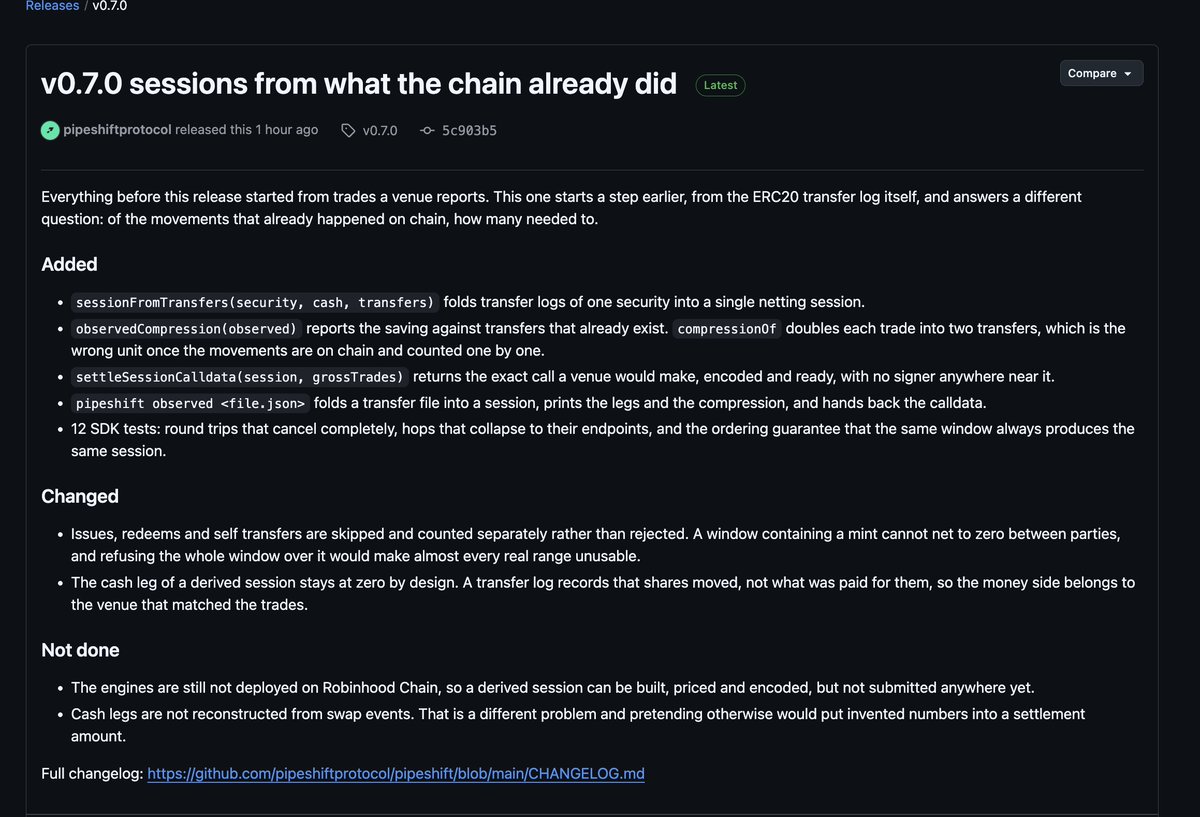
v0.7.0 is out.
Until now the SDK started from trades a venue reports. This release starts from the ERC20 transfer log itself and answers a different question: of the movements that already happened, how many needed to. One call folds a window of transfers into a session, another prices what that removes, and a third returns the exact calldata a venue would send.
The cash leg stays empty on purpose. A transfer log records that shares moved, not what was paid for them, and inventing that number is the easiest way to make a demo look better and the software worse.
38 tests, and the encoding is checked byte for byte against cast.
https://t.co/whQrRnRiuu
https://t.co/37DSUc2693
@RAIZ_75 Yes. The contracts and the SDK have been public from the start, the dashboard shipped today and reads the chain live, and the next step is deploying the engines so it settles instead of only calculating.
Holders come and go. The commits land either way.
Some of the larger wallets sold today. It is on the chain and there is nothing to spin: the pool holds 615 million tokens against 273 million this morning, the holder count went from 252 to 225, and the price is down about three quarters.
None of that changes the work. The session builder shipped today and it reads Robinhood Chain live. The 93,130,302 tokens at the dead address have not moved and cannot. Next is deploying the engines so the dashboard settles instead of only calculating.
We are building a settlement layer. That takes longer than a chart does.
https://t.co/GCT9DEkXTA
A short walk through the dashboard.
Pick a security and a few hundred real transfers of it collapse into a handful of legs. In the clip 597 movements of SPCX become 41, and 29 accounts turn out to have ended exactly where they started. Untick a trade and the numbers move with you.
None of it is a mockup. The page is reading Robinhood Chain while the recording runs.
https://t.co/GCT9DEkq42
The dashboard does something now instead of only showing you things.
Pick any tokenized equity and every real transfer of it from the last ten minutes folds into one netting session in front of you. Untick a trade and the numbers move with you. What comes out is the exact call a venue would make to settle the whole lot in one go, and you can copy it.
Netting is easier to believe when you can take it apart yourself.
https://t.co/GCT9DEkq42
Fair ask, and it deserves an answer instead of silence.
Nothing has been sold and nothing is going to be. Everything we have put out so far has gone into the settlement layer rather than into the chart, because that is the only thing that makes a token worth holding a year from now. 9.31% of supply is already sitting at the dead address, and you do not have to take our word for that, the holder list is live on the dashboard with the pool contract labelled so the largest line does not read like somebody's wallet.
On the wallet you are asking about, the honest move is to label it on that page rather than describe it in a reply, so that is what we will do and you can check it against the chain yourself.
https://t.co/gGk0nYa4hZ
The dashboard now has a tab for $PIPE itself.
It reads the token the same way it reads everything else on the page, which is to say from the chain rather than from a file we keep updated by hand. The burn figure is simply the balance of the dead address, fetched again on every load, currently 93,130,302 tokens or 9.31 percent of supply. Price and depth come from the pools actually quoting the token, and the holder list arrives with each share worked out, including the largest one, which is the PIPE/WETH pool contract and is labelled as such instead of being left to look like somebody's wallet.
Connect a wallet and it puts your own balance at the top and marks your rows in the transfer log.
We would rather publish the awkward version of these numbers than a screenshot of the flattering ones.
https://t.co/gGk0nYa4hZ