Over 1M views on @GoogleDeepMind's new Gemini Decision 1 announcement today, and almost nobody has read the actual billing rules and caching limits in the docs.
Here is the real engineering math—where it saves you 16.2x, and the hidden trap where it costs 5.2x MORE:
1. The Win: Single-Pass Shared Input (16.2x Cheaper)
Google's pricing rule states: "Each request bills shared input tokens once, regardless of question count" (up to 1,000 yes/no, choice, or rubric checks in one 150–250ms forward pass).
• Evaluate a 4,000-token multimodal record against 20 checks (50 tokens each) in 1 pass = 5,000 tokens billed ($0.50 per 1,000 records, $0 output).
• Running 20 separate calls resends the 4K record 20 times = 81,000 tokens ($8.10 per 1,000 records).
• Batching your checks into one request cuts routing bills by 93.8%.
2. The Catch: Zero Context Caching & No Batch API
Look at the fine print on the pricing table: Gemini Decision 1 does NOT support Context Caching, Batch API, or Flex tiers.
• If an agent loop evaluates the same 20,000-token document across 10 separate steps over time, Decision 1 re-bills the full 20K tokens every single call ($20.10 per 1,000 docs).
• By contrast, OpenAI's GPT-6 Luna Decisions API discounts cached inputs to $0.01/1M—costing just $3.90 for the exact same 10-step loop (5.2x cheaper than unbatched Decision 1).
3. The Data Privacy Split
Google AI Studio's Free Tier (200 RPM) uses your requests to train models. Only the Paid Tier excludes customer data from training.
Rule of thumb: Use Gemini Decision 1 when you can pack 10–1,000 checks into ONE single-pass call. Use cached endpoints if your agent steps fire sequentially over time.
Introducing Gemini Decision 1, our new frontier decision model in the Gemini API.
It is $0.10 per 1M input tokens with no additional cost. With support for image, audio, video, and PDF natively, 256K context window, & 1K questions.
You can try it for free in the API!
Primary source docs (Verified):
• Google AI Studio Pricing Table & Data Terms (confirming shared-input billing, no context caching / Batch API, and Free vs. Paid tier training terms):
https://t.co/SsLXJtecoY
• Google DeepMind Gemini Decisions API Technical Guide:
https://t.co/bgYYSOdWNl
Over 1M views on @GoogleDeepMind's new Gemini Decision 1 announcement today, and almost nobody has read the actual billing rules and caching limits in the docs.
Here is the real engineering math—where it saves you 16.2x, and the hidden trap where it costs 5.2x MORE:
1. The Win: Single-Pass Shared Input (16.2x Cheaper)
Google's pricing rule states: "Each request bills shared input tokens once, regardless of question count" (up to 1,000 yes/no, choice, or rubric checks in one 150–250ms forward pass).
• Evaluate a 4,000-token multimodal record against 20 checks (50 tokens each) in 1 pass = 5,000 tokens billed ($0.50 per 1,000 records, $0 output).
• Running 20 separate calls resends the 4K record 20 times = 81,000 tokens ($8.10 per 1,000 records).
• Batching your checks into one request cuts routing bills by 93.8%.
2. The Catch: Zero Context Caching & No Batch API
Look at the fine print on the pricing table: Gemini Decision 1 does NOT support Context Caching, Batch API, or Flex tiers.
• If an agent loop evaluates the same 20,000-token document across 10 separate steps over time, Decision 1 re-bills the full 20K tokens every single call ($20.10 per 1,000 docs).
• By contrast, OpenAI's GPT-6 Luna Decisions API discounts cached inputs to $0.01/1M—costing just $3.90 for the exact same 10-step loop (5.2x cheaper than unbatched Decision 1).
3. The Data Privacy Split
Google AI Studio's Free Tier (200 RPM) uses your requests to train models. Only the Paid Tier excludes customer data from training.
Rule of thumb: Use Gemini Decision 1 when you can pack 10–1,000 checks into ONE single-pass call. Use cached endpoints if your agent steps fire sequentially over time.
Introducing Gemini Decision 1, our new frontier decision model in the Gemini API.
It is $0.10 per 1M input tokens with no additional cost. With support for image, audio, video, and PDF natively, 256K context window, & 1K questions.
You can try it for free in the API!
@themuscleai@AnthropicAI Spot on—that version string in the roadshow footnote ("Claude Mythos Preview" vs. the public 5.2 release) is the entire smoking gun. Using an uncapped internal checkpoint to pitch automated GPU bring-up while shipping training-capped weights to API users is a wild split.
Everyone celebrating "Claude ported itself to AMD MI355X in 3 days—the Nvidia CUDA moat is dead" missed two huge footnotes in @AnthropicAI's own documentation this week:
1. The GPU Kernel Cap Paradox
In the Fable 5.2 & Mythos 5.2 release notes, Anthropic explicitly states they intervened during training to cap "accelerator kernel optimization" so it performs no better than Opus 5.5.
Why did the AMD port work? Because the roadshow slide footnote cites "Claude Mythos Preview"—NOT the newly capped 5.2 release. Anthropic used an uncapped internal preview model to pitch automated GPU bring-up to IPO investors during the exact same week they nerfed GPU kernel optimization in the weights shipped to developers.
2. Prefill ≠ Full Inference Bring-Up
Look closely at the slide footnote:
"Bring up prompt processing for one Anthropic model on AMD MI355X GPUs at a useful level of performance."
"Prompt processing" is PREFILL ONLY—compute-bound matrix multiplication (GEMMs) where AMD ROCm/hipBLASlt is already strong.
It says nothing about DECODE, which is memory-bandwidth bound and requires custom paged-attention, KV-cache kernels, and collective communication tuning to beat H100/B200 TCO in production.
Agent-written kernels are a massive milestone, but prefill bring-up on an uncapped internal model isn't the death of CUDA yet.
That aligns with two big changes in the Fable 5.2 rollout this week: outputs are running up to 30% faster and Anthropic cut false-positive safeguard blocks by 55% compared to 5.1, so fewer sessions get wasted on retries.
Are you noticing the looser rate limits on Opus 5.5 too, or mainly when running Fable 5.2 on medium/high effort?
DeepSeek V4.1 Flash alongside GLM 5.3 Flash is a super fast routing pair—and an abliterated Kimi K3.1 Pro is going to be wild for red-teaming and uncensored coding benchmarks where standard refusal filters false-positive on security code.
Are you seeing any noticeable degradation on tool-calling / SWE evals from the abliteration pass on K3.1 Pro, or do the coding weights hold up cleanly?
Animated SVG generation is honestly one of the best visual proxies for spatial reasoning + long-output coordinate consistency.
Did you run Fable 5.2 on High or Max effort here? In my testing, jumping from High to Max on Fable 5.2 nearly 3x's the token bill ($9.08 -> $26.54 on AA v5) for a small lift, while Carbon spends more verification tokens upfront.
Scraping and search dominating the top of @MonidHQ's endpoint ranking makes total sense—retrieval and live state verification are still the primary bottleneck before an agent can execute any downstream write action.
Curious when we see low-latency decision/routing endpoints (like the new $0.10/1M Gemini Decision 1 API) overtake raw LLM calls as the #2 volume layer right behind search.
Built-in agentic browser use inside Antigravity solves the biggest friction loop in frontend + full-stack agent runs: verifying DOM state and console/network regressions without context-switching out of the IDE.
Does the browser agent share the same workspace session cookies/local-storage across multi-step test runs, or spin up an isolated context per task?
Appreciate the quote on this Robin! The crazy follow-up is what happens on Dec 1 when Gemini 4 Carbon's intro API pricing jumps 2x ($2/$10 -> $4/$20) while Google still locks paying AI Pro users out of the app tier.
Are you testing Carbon via API in your workflow right now, or sticking with Opus 5.5 / Fable 5.2?
$0.10/1M input with $0 output tokens and 150–250ms single-pass scoring across up to 1,000 closed-set choices turns agent routing and guardrails from a generative bottleneck into a deterministic primitive.
Two technical questions on the implementation:
1. When scoring 1,000 questions against a single multimodal input in one pass, are input tokens billed strictly once for the shared context?
2. Does confidence calibration hold up if you shuffle the option order (like Artificial Analysis's AA-Symmetry test)? If log-probs stay invariant under choice permutation, this replaces 90% of LLM-as-a-judge calls overnight.
Primary sources (Verified):
1. Anthropic Fable 5.2 & Mythos 5.2 launch post (disclosing training-time cap on accelerator kernel optimization at Opus 5.5 level):
https://t.co/84R3UxPapR
2. Anthropic IPO Roadshow transcript & slide footnote ("prompt processing for one Anthropic model on AMD MI355X" via Claude Mythos Preview):
https://t.co/udaU4f8Snp
@OpenAI@AnthropicAI@GoogleDeepMind: AI leadership is also about access.
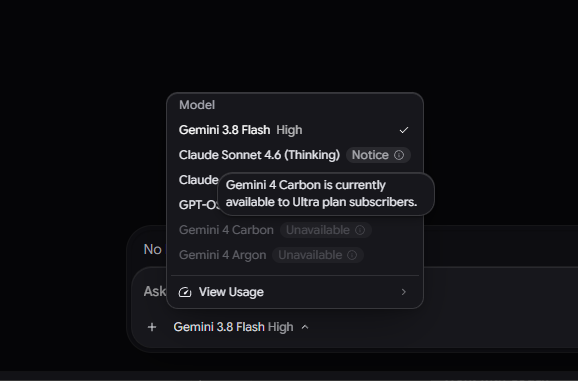
Anthropic gave Pro users a launch week window for Fable 5.2. Google put Carbon behind Ultra not AI Pro. Paid API access exists; Gemini Pro users remain locked out.
Smart strategy or trust problem? Fuck!
Fuck you, @GoogleDeepMind and @OfficialLoganK.
You have users’ data to train your models, yet give those same users practically no access. What the fuck is this?
Even OpenAI’s free tier offers more usable access. And Google's answer is just “Unavailable”?
Seriously?
Fuck you, @GoogleDeepMind and @OfficialLoganK.
You have users’ data to train your models, yet give those same users practically no access. What the fuck is this?
Even OpenAI’s free tier offers more usable access. And Google's answer is just “Unavailable”?
Seriously?
🚨Gemini 4 Carbon is Live! is only available with a Google AI Ultra plan, or pay per request with an API key.
No Carbon for Pro User's @OfficialLoganK@GoogleDeepMind WTF! no Pro user's. I paid you guys.
@CryWoozieMu@GoogleDeepMind@OfficialLoganK Without free users and clients there is no fucking business for Google
Mate I’m not said I want everything free I want what is paid for I have paid for Pro plan cost me rupees nearly 2K/monthly for it and I can’t get the Pro models!? WTF! I fucking paid it.
@CryWoozieMu@GoogleDeepMind@OfficialLoganK Google says India is its largest global user base for voice and visual Search, and leads the world in daily Gemini use for learning. Criticise Google’s decisions—but don’t dismiss the users and talent helping power its ecosystem.
@CryWoozieMu@GoogleDeepMind@OfficialLoganK South Asia is not a footnote—and India alone shows why. Google Research’s India lab works on foundational ML, multilingual NLP, computer vision and healthcare AI for products used worldwide. This is technical contribution, not just consumption.