The innovation has existed for years.
The difference now is that regulation, infrastructure and distribution are beginning to catch up.
That's when financial products move beyond early adopters and into mainstream markets.
Capital is flowing into Robinhood Chain, but liquidity alone isn’t enough. The real challenge is giving people a simple way to interact with it every day.
That’s why I’m paying attention to @NockFi. By making swaps, yield, vaults, and more feel like one seamless experience, they’re building the kind of user experience that keeps people engaged long after the hype fades.
$NOCK is the utility powering that vision.
Most crypto traders don't want AI to trade for them--63.6% won't allow full autonomy.
What they want is convenience without the black box.
That's the actual gap $NOCK fills: one chat, five DeFi venues, Robin previews every move, you confirm.
Convenience ≠ control--On @NockFi
Agentic trading has early adopters: everyone.
We surveyed 1,400 US crypto traders and found that most are ready to hand AI control, half already use AI tools weekly, and nearly 80% would switch platforms to get more.
Read our blog for the full breakdown ⤵Agentic trading has early adopters: everyone.
We surveyed 1,400 US crypto traders and found that most are ready to hand AI control, half already use AI tools weekly, and nearly 80% would switch platforms to get more.
Read our blog for the full breakdown ⤵Agentic trading has early adopters: everyone.
We surveyed 1,400 US crypto traders and found that most are ready to hand AI control, half already use AI tools weekly, and nearly 80% would switch platforms to get more.
Read our blog for the full breakdown ⤵️
July 27 - 31.
Five days.
Every reveal sharpens the thesis.
Every milestone reinforces the vision.
Every step strengthens the foundation.
And the flywheel that makes it all tick.
Started the month with around 20. I'm currently sitting at 90.
That is proof of value right there.
70+ people looked at my content and saw that it was nice, ad they decided to follow.
It's 4 days till the end of the month. Can I push a 100 by then?
There's only 1 way to find out.
How to make money from the worldcup games?
It's simple--apply my framework, and bet away.
But it's not that simple tho.
I've been kinda looking at ways to print from this world cup, and I thought...it would be best to predict my way to thousands of naira.
Yh. You heard me.
But am I really that good at predicting? No.
Would I be able to predict with much accuracy? Yes.
How? With the help of AI.
I hopped on my Claude and brainstormed an idea--why not I build a system around 3 of my favorite market options?
Instead of me manually checking stats and picking bets, why don't AI speed up the whole process, while I spend time on other important things?
Exactly.
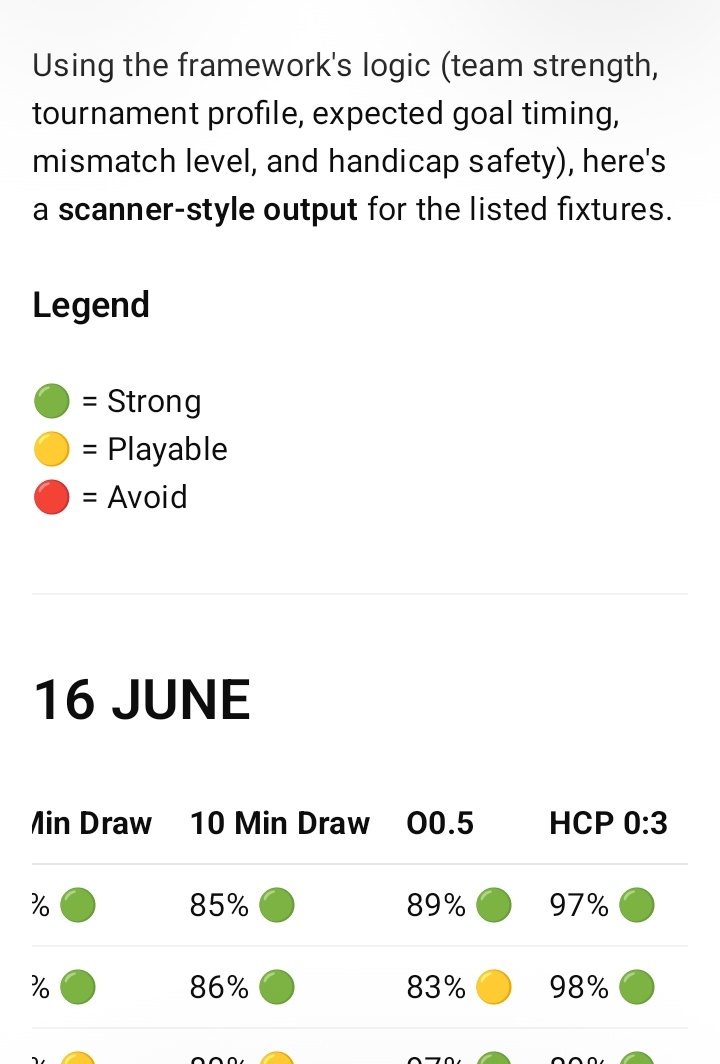
I built an AI analyzer that gives me conditions and percentages for success of my 3 favourite match picks:
- first 5/10 minutes draw
- handicap 0:2/0:3
- overall match goals >0.5
Since I can't really get access to the API's I need, I drew data from:
- last 5 matches
- last 5 H2H b/w teams in play
- current standings
- overall team standings
I burned all my Claude tokens in the process 😭 😂
That aside, I ran 2 weeks worth of #worldcup matches on chatgpt.
How well do I trust my framework? I'd be actively testing it out with #500 every time I play.
Let's see how successful & accurate it can be.
11 slips. 6 wins, 5 losses. 3 sole market options.
That's a 54.5% win rate.
3× my deposit, +₦15,000—With AI.
All done in 4 days.
I just wanted to test how accurate AI could be, not knowing I would take a lil something home for testing.
Was AI entirely giving me predictions? Partially No. Was I doing the whole work? Partially No.
Here's what I did;
I had 3 picks which were my favourites:
- handicap 0:3
- first 5 min draw
- Team goals >0.5
I noticed that it took me time to check team stats and find what particular market was favourites to play out in a particular match.
That's where I went to Claude & chat and wrote a framework. I put my favourite markets, and told AI to create a framework giving me the percentage probabilities/likely occurrence of these markets playing.
For data, I just told Chatgpt to pull data from that particular teams last 5/10 matches.
That's all. 🙂
The roadmap was like this:
- Pull data
- give me the percentage probabilities of each individual market
- rank the probabilities on a scale of most sure to least sure
- give me a least of teams with the highest possible chance of market playing out
- I write out these games, and proceed to my odds provider(😂) and stake accordingly
- then, I come on X and type "probably nothing"
🙂
AI does 4 out of these 6 things—that's 66.66%.
Would you like to see how next week's performance would be?
Had a lotta conversations with all my friends
They are all depressed
And I dunno what to do anymore
Financials, mentally and everything
Tryna hang out with them
Get them to go out and all
Maybe a lil dopamine rush
Today is @SuperteamNG anniversary, I will be attending.
Maybe I will tell people about @amuletslabs.
I have my funds ready in my wallet, what should I do with it ?
𝗪𝗵𝗮𝘁 𝗜𝗳 𝗬𝗼𝘂𝗿 𝗪𝗼𝗿𝗸 𝗖𝗼𝘂𝗹𝗱 𝗦𝗽𝗲𝗮𝗸 𝗙𝗼𝗿 𝗜𝘁𝘀𝗲𝗹𝗳?
Imagine you're new in town.
No references. No connections. No one who can vouch for you.
You walk into a restaurant looking for a job. The manager asks: "What's your experience?"
You say: "Trust me, I'm good."
He says: "Next, please."
Now imagine a different world.
Same restaurant. Same manager.
But this time, you hand him a glass box.
Inside that box — every meal you've ever cooked. Every customer you've ever served. Every tip you ever earned. Every review anyone ever left you. All of it. Sealed. Timestamped. Impossible to fake.
The manager doesn't need to trust you anymore.
He can see you.
𝗧𝗵𝗮𝘁 𝗴𝗹𝗮𝘀𝘀 𝗯𝗼𝘅 𝗶𝘀 𝘄𝗵𝗮𝘁 @zeroauthdao 𝗶𝘀 𝗯𝘂𝗶𝗹𝗱𝗶𝗻𝗴.
The internet is full of people saying they can do things.
Designers with portfolios they may have stolen. Developers with credentials they bought. Writers who list clients that can't be verified. Everyone is claiming. Nobody can prove.
This problem gets worse in Web3 — a space full of anonymous usernames and Discord handles. A project needs a writer. Ten people say they're great. Who do you trust?
@zeroauthdao's answer: don't trust anyone. Verify everything.
Every piece of work you submit on the platform becomes a permanent record.
Think of it like a scoreboard that never resets — and nobody can edit it but the work itself.
𝗛𝗼𝘄 𝗜𝘁 𝗔𝗰𝘁𝘂𝗮𝗹𝗹𝘆 𝗪𝗼𝗿𝗸𝘀
Here's the simplest version:
Organizations — startups, communities, crypto projects — post tasks. They could be anything. Write a thread. Design a graphic. Research a protocol. Build a feature.
Contributors — writers, designers, developers, anyone really — pick up those tasks and submit work.
The platform records everything. Who submitted. What they delivered. How well. What they earned.
Over time, your profile stops looking like a resume and starts looking like a report card that graded itself.
🚨 𝗕𝗥𝗘𝗔𝗞𝗜𝗡𝗚: 𝗠𝗬𝗦𝗧𝗘𝗥𝗜𝗢𝗨𝗦 𝗗𝗥𝗢𝗡𝗘𝗦 𝗢𝗩𝗘𝗥 𝗡𝗘𝗪 𝗝𝗘𝗥𝗦𝗘𝗬
In November 2024, residents across New Jersey began reporting unusual aerial objects appearing at night.
Witnesses described:
• Multiple lights moving together
• Objects hovering for long periods
• Aircraft-sized silhouettes
• Repeated appearances after sunset
The reports started locally.
Then they spread.
Fast.
At this point, nobody really knew what they were.
And that's important.
Because uncertainty creates a vacuum.
And vacuums get filled.
Not with facts.
With stories.
Fr this mindset creeps in low-key for me, but how I solve it is to look at "what I'm doing", not "how I'm doing it" .
"What you are doing"—you can give this a definition of your choice, but I choose to take this as my niche, or what you are creating content about
"How in doing it"—i can be really flexible here. This is where style comes in.
How do you want to show people what you are doing? That's a question I answer, then I get to work.
For me, this is via a lil art here and there, really short mograph videos, my PoH vids & written content.
These then become my content pillars.
One last ingredient to make things easier is having a schedule. A schedule allows you to plan ahead, and also helps you up the consistency with which you stick to your pillars.
This includes the time of posting and what pillars to use for content per day.
This is just how I make things a lil easier for myself.
You are doing very well ser—with ur alpha's & content contests here and there.
Keep it up ser!
𝗧𝗵𝗲 𝗛𝗼𝘂𝘀𝗲 𝗔𝗹𝘄𝗮𝘆𝘀 𝗪𝗶𝗻𝘀 — 𝗕𝘂𝘁 𝗡𝗼𝘁 𝗙𝗼𝗿 𝗧𝗵𝗲 𝗥𝗲𝗮𝘀𝗼𝗻𝘀 𝗬𝗼𝘂 𝗧𝗵𝗶𝗻𝗸
Every casino has one rule that never changes: the house wins.
But here's what most players don't know — the house doesn't win because it's lucky.
It wins because the entire system is engineered against you before you even place your first bet.
Rigged outcomes you can't audit.
Withdrawal conditions buried in fine print.
Bonus schemes that sound generous until you read the 40x wagering requirement.
These aren't accidents. They're features.
Web3 was supposed to fix this.
Put the game logic on-chain, make everything verifiable, give players back control.
The vision was right.
The execution? Not so much.
Most Web3 casinos today are transparent about nothing, painful to use, and charge you gas fees just to lose your money faster.
You need to confirm a transaction for every single bet.
The UI looks like a fever dream.
And the "decentralization" is mostly marketing.
@AptCasinofun is built on a different premise: fairness isn't a feature you advertise.
It's the foundation everything else is built on.
On-chain randomness.
Gasless gameplay.
Clean UI.
No hidden traps.
The #casino should win sometimes. That's fine.
But you should always be able to prove how.
I put money into a Bitcoin yield protocol on Stacks. Before I did — I ran it through 11 questions.
Here's every answer I found, including the one that's still a problem
Two types of people see "earn BTC on your crypto."
Type 1 apes in blind. Type 2 scrolls past.
Both are reacting to the same thing: no framework for knowing what's real.
This thread is for a third type.
The ones who want to go in — but only after they understand what they're going into.
Bitcoin yield sounds like a trap.
Usually because it is.
Token emissions dressed as yield. Inflation mechanics rebranded as rewards. Synthetic BTC that depegs the moment you need it.
The skepticism is correct. The question is whether it applies here.
That's what the 11 questions are for.
Fast Pool is a stacking pool on Stacks — a Bitcoin Layer 2.
The yield comes from Bitcoin miners. Real BTC committed by miners competing to produce Stacks blocks. That BTC flows to stackers.
No token emissions. No inflation mechanics. No Ponzi.
Variable yield — but the source is legitimate.
That's the claim. Here's how I verified it.
Q1: Who controls the money?
Not a person. A smart contract. Rules enforced in code, not promises.
One human assumption exists: the reward administrator distributes your share correctly. Eyes open on that role.
Q2: Has it been audited?
No. This is the biggest unresolved question mark on Fast Pool.
Open source and audited are not the same thing.
The code is readable. It has not been formally reviewed. That gap is real.
Q3: How old is it?
Friedger has been building on Stacks since 2018. Fast Pool is on v3.
The previous deposit address still holds 5.32 BTC from earlier operations — visible on-chain, right now.
This isn't a new project testing ideas. It has traceable history.
Q4: What does exit look like?
Clean. STX locks one cycle at a time — roughly 2 weeks.
Revoke delegation, sit out the current cycle, walk away.
No cliff. No penalty. Rewards earned before exit stay yours.
Q5: Where exactly does your money go?
Full traceable path:
Your STX stays in your wallet — you sign a delegation, not a transfer
Miners send BTC each cycle → Fast Pool BTC addresses
BTC consolidates at a proxy address
Proxy bridges to sBTC via taproot deposit
Stacks distributor contract pays you in sBTC
Every address in that chain is publicly listed.
You can verify every hop on a block explorer right now.
Q6: Is the yield source real?
Bitcoin miners. Real BTC.
Not emissions. Not inflation. Miners competing to produce blocks.
The source is legitimate. The amount is variable.
Q7: Is the code readable?
Yes. Both GitHub repos are public.
Every line of logic governing your funds is visible on mainnet.
Q8: What's the liquidity risk?
Real. Fast Pool gives you no liquid token mid-cycle.
No stSTX. No tradeable position.
~2 weeks illiquid. That's the price of the simplicity.
Q9: What breaks this?
Four realistic failure modes:
— sBTC depegs → rewards arrive devalued
— Reward administrator misbehaves
— Stacks network failure post-Nakamoto upgrade
— Miner participation drops → yield shrinks, no floor
Q10: Who built this?
Friedger. Stacks contributor since 2018. Publicly reachable on Discord.
His own documentation says: "He will never DM you first. Beware of scammers."
That's the behavior of someone who has watched this ecosystem get exploited long enough to know how it works.
Q11: Is the BTC peg verifiable?
Yes. Every transaction from reward addresses → proxy → taproot deposit is traceable on any Bitcoin block explorer.
The transparency is real. Not claimed.
Here's what I can't tell you:
Whether the reward administrator will always behave correctly. Whether a future Stacks upgrade introduces something unexpected. Whether sBTC holds peg during a severe market event.
And the audit gap is real. No formal third-party review on record. For a protocol this transparent in every other dimension — that absence is loud.
I went in anyway. Sized the position accordingly.
👇