// Agent memory is a data system now //
Great paper on long-term memory for LLM agents.
(bookmark it)
Agent memory has grown from simple retrieval into a full data-management layer with storage, retrieval, update, consolidation, and lifecycle governance. Yet most evaluations still score it as a black box through end-to-end task success like F1 and BLEU, which hides the costs and failure modes underneath.
The authors decompose agent memory into four core modules and measure each one for operational cost, architectural trade-offs, and robustness under dynamic knowledge updates.
Why does it matter?
If you design an agent memory layer, this gives you the module breakdown and the system-level metrics to evaluate it honestly, instead of trusting a single downstream score.
Paper: https://t.co/4RZNRQG1ac
Learn to build effective AI agents in our academy: https://t.co/LRnpZN7L4c
NVIDIA just open-sourced a high-throughput, low-latency inference framework for serving reasoning models like DeepSeek-R1!
Introducing Dynamo, a framework designed for serving generative AI and reasoning models in multi-node distributed environments.
100% Open Source
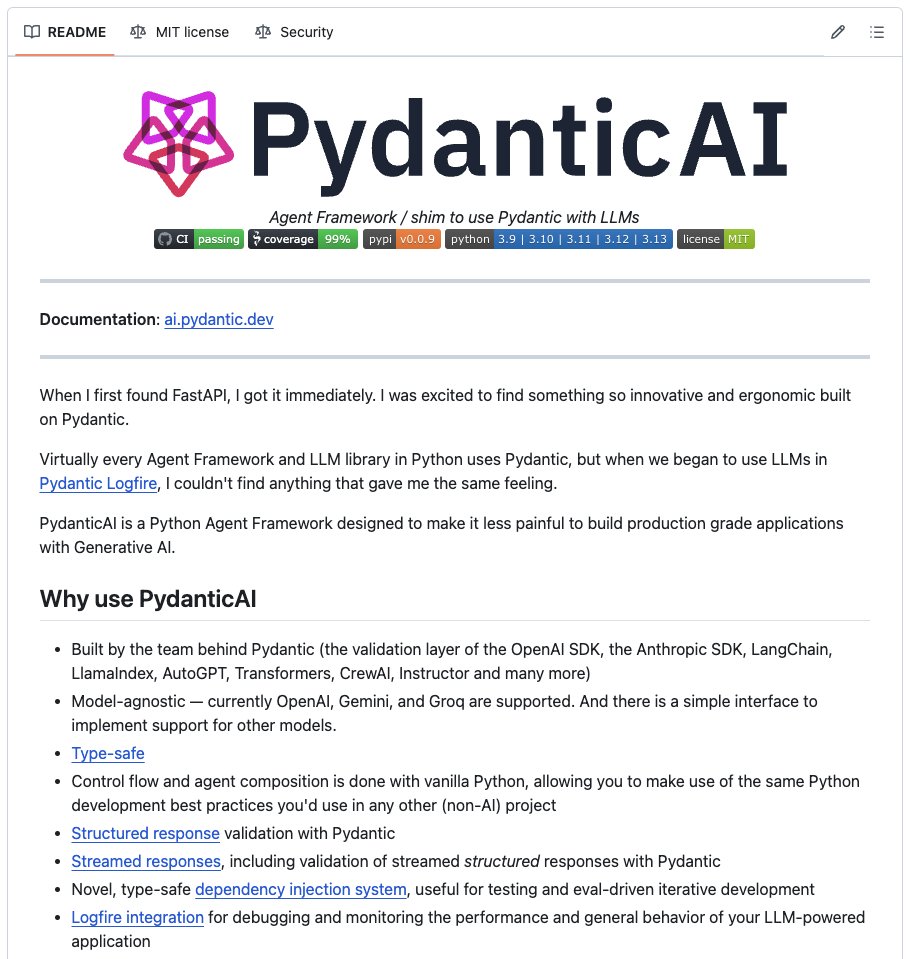
PydanticAI: Build production-grade Agentic AI apps in pure Python!
PydanticAI offers the same elegance and ease of use as FastAPI, now extending that experience to building production-grade LLM applications.
Why PydanticAI?
🔌 Model-agnostic
✅ Type-safe & production-ready
🔄 Pure Python control & composition
🧱 Pydantic-based structured validation
💻 Streamed responses & dynamic prompts
🔧 Dependency injection for iterative testing
📊 Logfire integration for monitoring & debugging
🤖 Built by the team behind Pydantic, it's completely open-source!
Link to GitHub repo in next tweet!
____
Find me → @akshay_pachaar ✔️
For more insights & tutorials on AI and Machine Learning.
Pandas is getting outdated.
5 reasons you should move to FireDucks 👇
1. Requires changing ONLY ONE line of code:
↳ Replace "𝗶𝗺𝗽𝗼𝗿𝘁 𝗽𝗮𝗻𝗱𝗮𝘀 𝗮𝘀 𝗽𝗱" with "𝗶𝗺𝗽𝗼𝗿𝗲 𝗳𝗶𝗿𝗲𝗱𝘂𝗰𝗸𝘀.𝗽𝗮𝗻𝗱𝗮𝘀 𝗮𝘀 𝗽𝗱"
↳ The rest of the entire code remains the same.
↳ So, if you know Pandas, you already know how to use FireDucks.
↳ Done!
2. Ridiculously faster as per official benchmarks:
↳ Modin had an average speed-up of 0.9x over Pandas.
↳ Polars had an average speed-up of 39x over Pandas.
↳ But FireDucks had an average speed-up of 50x over Pandas.
3. Pandas is single-core; FireDucks is multi-core.
4. Pandas follows eager execution; FireDucks is based on lazy execution. This way, FireDucks can build a logical execution plan and apply possible optimizations.
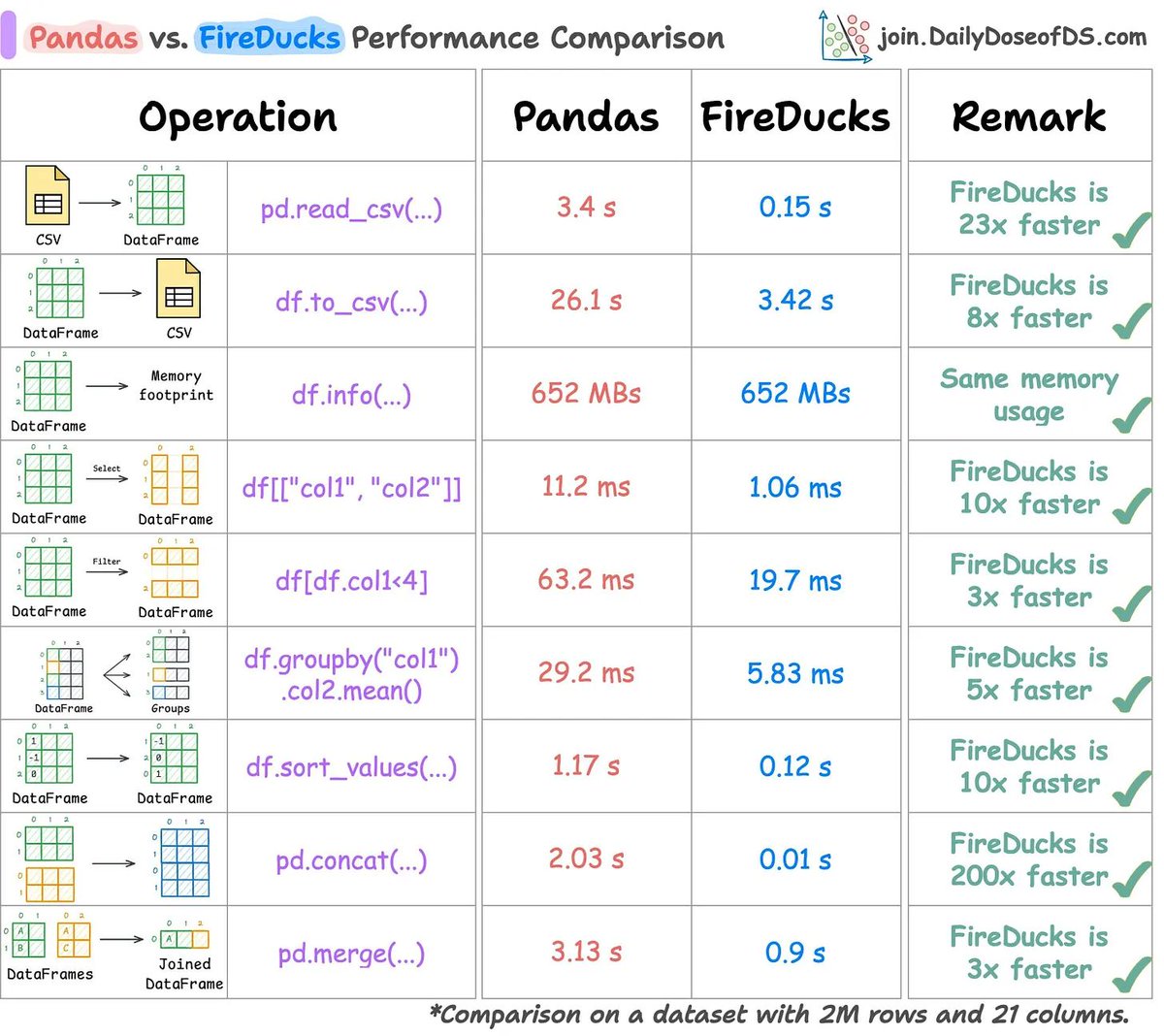
5. That said, even under eager execution, FireDucks is way faster than Pandas, as depicted in the image below.
Learn how to use FireDucks here: https://t.co/fWi3V9bvuu
👉 Over to you: What are some other ways to accelerate Pandas operations?
_____
Find me → @akshay_pachaar ✔️
For more insights and tutorials on AI and Machine Learning!
We live on a thin crust of solid rock, beneath which is vast ball of molten rock.
Earth’s core, which generates most of our magnetic field is ~85% iron and moves independently from the surface plates, which is why the magnetic pole changes position.