A few months ago, a high profile paper in Science claimed to find that researchers' ideology produced biased results in favour of immigration.
A reanalysis of the data finds that result came from a coding error, which once corrected, shows no effect.
Will people who shared that original finding update their views?
https://t.co/pSuAZ26pqe
Forthcoming in the AER: "Corporate Tax Cuts, Firm Growth, and Workers’ Earnings" by Patrick J. Kennedy, Christine L. Dobridge, Paul Landefeld, and Jacob Mortenson. https://t.co/IQPO8zgNp7
Forthcoming in the AER: "Taxing Top Wealth: Migration Responses and their Aggregate Economic Implications" by Katrine Jakobsen, Henrik Kleven, Jonas Kolsrud, Camille Landais, and Mathilde Munoz. https://t.co/d9yoTeOwlI
Vean 'Los desaparecidos de Ecuador', un documental del programa investigativo @ajfaultlines de @aljazeeraenglish, en el que colaboré como productora en 🇪🇨.
Es un trabajo que visibiliza la exigencia de las familias que buscan a, al menos, 51 personas desaparecidas forzosamente en 2024, el primer año de conflicto armado interno impuesto por el presidente Daniel Noboa y que sigue trabajos que publicamos a nivel local como Operación Sin Rumbo.
Varias familias nos permitieron acompañarlas y entrar a sus casas para conocerlas a ellas y a sus seres queridos.
Gracias a @jyoun06 que lideró un equipazo para seguir narrando la lucha de las familias buscadoras en este país que duele, pero que nos impulsa a nombrar. A esperanzarnos. A no callar. A hacerlo con corazón.
Pueden verlo completo aquí: https://t.co/QhZLb061NO.
Do elite colleges help talented students from modest backgrounds join the social elite or help incumbent elites retain their positions?
NEW in the American Economic Review, by Andrés Barrios-Fernández, Christopher Neilson, and Seth Zimmerman: https://t.co/KvjCwvYlWN
Recently accepted by #QJE: “Why Doesn't the United States Have National Health Insurance? The Political Role of the American Medical Association,” by Alsan and Neberai: https://t.co/9a1xXkLlKV
Our paper “Difference-in-Differences Designs: A Practitioner’s Guide” is now published in the Journal of Economic Literature. It took us a while but we are happy!
We put together a lot of material to make the paper useful in practice: https://t.co/30TbAgihlz
Hope you like!
Ya que @teleamazonasec borró el tuit, lo borró de su web y no lo puso en su segunda emisión, toca compartir el reportaje de Fausto Yépez sobre los vínculos de #RobertoEntuque con el contrato con ATM, otra de las empresas que nos goleó con millones en la emergencia eléctrica.
La infancia en Santo Domingo enfrenta una crisis silenciosa. El reclutamiento forzado por grupos criminales convirtió a las aulas en zonas de captación. Los menores que se niegan a cooperar terminan desaparecidos, extorsionados o forzados al exilio. https://t.co/me9Prr492k
New working paper with @AmolRaswan and Chris Udry: "The Sisyphean Pursuit of Evidence for Poverty Traps."
A central idea in development economics is that poverty can trap people. We went looking for the cleanest evidence. Here's what we found – and didn't.
As more and more students begin using A.I. to complete assignments, professors across the country are changing their approach—and losing their hope.
https://t.co/v1bG1JlWjI
After childbirth, mothers take off 7 weeks on average, while fathers take off 3 days
by Rebecca Jack, Daniel Tannenbaum, and Brenden Timpe
https://t.co/UbYZwrQcrd
Replacement fertility in one chart: Even if 90% of women have children and average 2.2 each, we still fall short.
Why? The fertility rate of a population equals the product of the proportion of women who have children and the average number of children per mother.
That is, if 90% of women have children and the average number of children per mother is 2.2, the fertility rate of this population is 1.98.
This simple formula gives us the relationship between the proportion of mothers in a population and the average number of children per mother required to reach the replacement rate. As I explained two days ago (check my feed if you missed it), this replacement rate is 2.1 in Western countries, where sex selection and infant mortality are low.
The figure plots the result (if you are technical, this is called the iso-replacement curve). Obviously, if 100% of women become mothers, the average number of children per mother required to reach replacement is 2.1. If we move to 90%, this average rises to 2.33.
Notice that if we fall to 80%, the average increases substantially to 2.6. I selected 80% because it implies that one in five women never becomes a mother, close to what we now see in Japan and parts of Southern Europe. The current young cohorts in advanced economies seem to be on track to be well below 80%, but we will not know for sure for another 20 years or so.
Having an average of 2.6 children per mother requires many very large families. And modern societies are not organized for this to happen.
Smartphones are not the explanation for the recent decline in fertility. Instead, they are an accelerator of deeper forces already at work.
Let’s start with the facts. Fertility is falling almost everywhere: in rich, middle-income, and poor countries; in secular and religious countries; and in countries with high and low levels of gender equality.
The decline accelerated around 2014. So, no country-specific explanation will work unless you are willing to believe that 200 distinct country-specific explanations arrived at roughly the same time.
Smartphones look like the obvious candidate: the first iPhone was released in 2007, and global adoption has been astonishingly fast.
Economists understand the first major decline in fertility in advanced economies, from 6 or 7 children per woman throughout most of human history to about 1.8, that occurred between the early 1800s and roughly 1970, well before smartphones. The main drivers were a sharp fall in child mortality (effective fertility was rarely above 3 and often close to 2) and the shift from a low-skill, rural agrarian economy to a high-skill, urban industrial one. We have quantitative models that fit these facts well.
Country-specific factors mattered too, of course. Proximity to low-fertility neighbors accelerated Hungary’s decline, while fragmented landowning structures accelerated France’s. But these were second-order mechanisms.
This is also why most economists long considered Paul Ehrlich’s doom scenarios implausible. We forecast that fertility in middle- and low-income economies would follow the same path as in the rich, probably faster, because reductions in child mortality reached India or Africa at lower income levels (medical technology is nearly universal, and most gains come from handwashing and cheap antibiotics, not Mayo Clinic-level care). Much of what we see in Africa or parts of Latin America today is still that old story.
But in the 1980s, a new pattern appeared. Japan and Italy fell below 1.8, the level we had thought was the new floor. By 1990, Japan was at 1.54 and Italy at 1.36.
This second fertility decline began in Japan and Italy earlier than elsewhere, driven by country-specific factors, but the underlying dynamics were widespread: secularization, an education arms race, expensive housing, the dissolution of old social networks, and the shift to a service economy in which women’s bargaining power within the household is higher. The U.S. lagged because secularization came later, suburban housing remained relatively cheap, and African American fertility was still high. U.S. demographic patterns are exceptional and skew how academics (most of whom are in the U.S.) and the New York Times see the world.
My best guess is that, without smartphones, Italy’s 2025 fertility rate would be about 1.24 rather than 1.14. I doubt anyone will document an effect larger than 0.1-0.2. Italy was at 1.19 in 1995, not far from today’s 1.14. The TFR is cyclical due to tempo effects, so I do not read too much into the rise between 1995 and 2007 or the decline from 1.27 in 2019 to 1.14 today. The direct effect of smartphones is not zero, but it is not, by itself, that large.
Where social media, in general, and smartphones, in particular, matter is in the diffusion of social norms. What would have taken 25 years now happens in 10. Social media are not the cause of fertility decline; modernity is. But they are a very fast accelerator.
That is why social media are a major part of the story behind Guatemala (yes, Guatemala) going from 3.8 children per woman in 2005 to 1.9 in 2025. Without them, Guatemala would also have reached 1.9, just 20 years later.
Modernity, in its current form, is incompatible with replacement-level fertility. By modernity, I do not mean capitalism: fertility fell earlier and faster in socialist economies than in market economies. Socialist Hungary fell below replacement in 1960, and socialist Czechoslovakia in 1966 (both experienced small, short-lived baby booms in the mid-1970s). By modernity, I mean a society organized around rational, large-scale systems and formalized knowledge.
Countries will not converge to the same fertility rate. East Asia is likely stuck near 1, possibly below, given its unbalanced gender norms and toxic education systems. Latin America faces the same gender problem plus weak growth prospects, so I expect something around 1.2. Northern Europe has more egalitarian family structures and might hold near 1.5. The very religious societies are probably the only ones that will sustain 1.8.
All of this could change with AI or changes in population composition. We will see. But on the current evidence, deep sub-replacement fertility is the “new new normal.” Unless we reorganize our societies, better learn to handle it as best we can.
"Sátrapas, miseria humana, incapaces, mala fe, porquería, patrañas”. Con esos términos se refirió Rafael Correa a la prensa el 15 de septiembre de 2012, durante una lujosa cena organizada en respaldo al primo porque los medios ya habían expuesto su título falso.
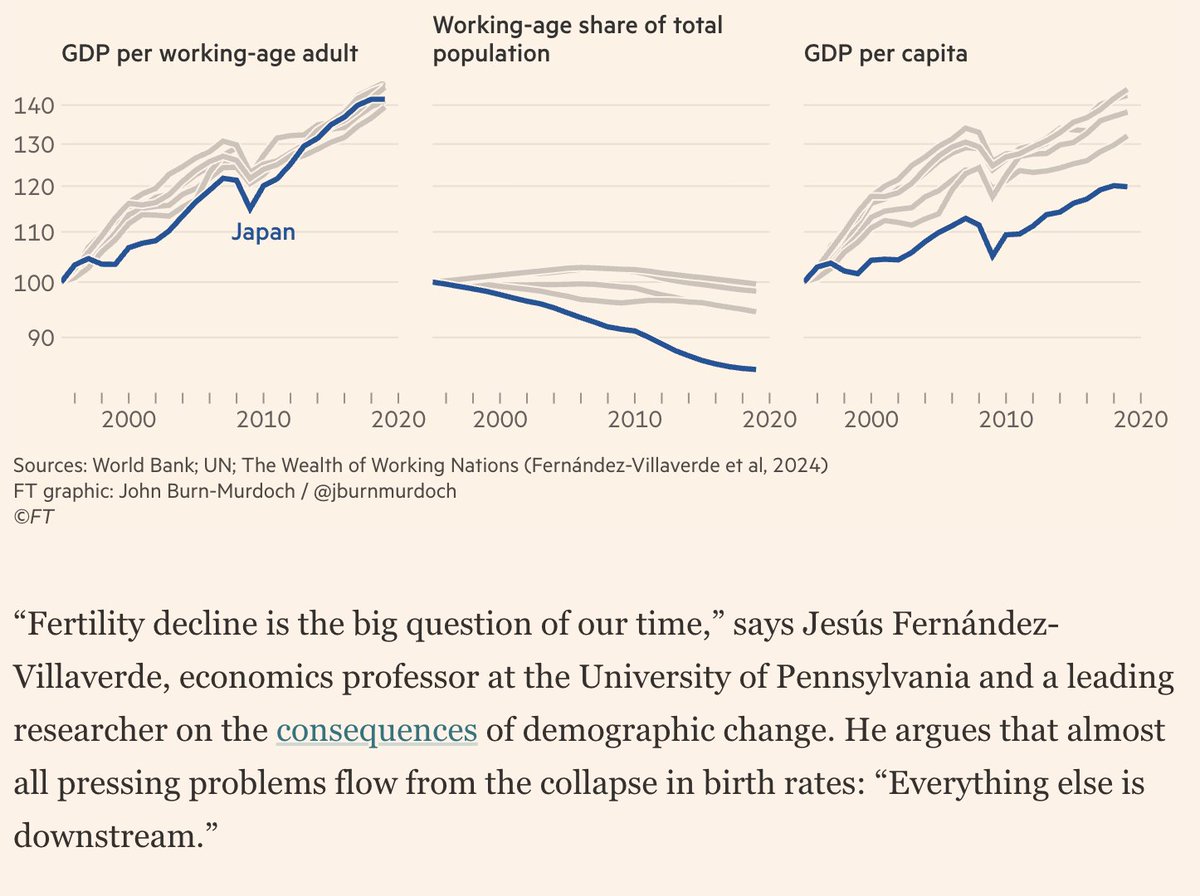
At the FT today, John Burn-Murdoch (@jburnmurdoch) has an excellent article describing how fertility is declining everywhere at the same time:
https://t.co/Ad0LpN25Dl
He quotes me and, even better, draws the reader’s attention to my work with Gustavo Ventura, @King_ofSweden, and Wen Yao on “The Wealth of Working Nations.”
If I may suggest, reading the article alongside the podcast I did with Derek Thompson, @DKThomp, will give you a good overview of the issue.
BTW, I have decided to write something longer about all this over the summer with Nezih Guner, @NezihGuner. Hopefully, the gods of productivity smile on us, and we can have a draft by early fall.