Trick or treat? 🎃 The market asks this every morning, and it never tells you which door you’re opening.
Trick 🔴: you nail the analysis, enter at the perfect level, and price does the exact opposite.
Treat 🟢: you almost skipped the trade, and it runs straight to target.
Neither one says much about how good you are. What matters is that the trick didn’t cost you the whole night.
So size like it could be a trick. Then let the treats come to you. 🍬
💬 Trick or treat this week? Be honest 👇
Pivex provides simulated trading accounts.
The market is open 24/5. You don't have to be.
Set your session hours, and when they end, close the platform. Don't just minimize it.
A lot of bad trades happen in the hours that were never part of your plan.
20 pips isn't the same risk on every pair.
Pip value depends on the quote currency. On EUR/USD, one standard lot is about $10 per pip. On USD/JPY it's 1,000 yen per pip, so the dollar value moves with the exchange rate.
Same stop in pips can mean different risk in dollars. Do the math per pair.
👻 Ghost your stress, not your trades.
Pivex challenge comes with a 4% daily loss limit. Think of it less as a rule to fear and more as a built-in stop for your whole day.
How to make it work for you:
🕯 Know your number before you trade: 4% of your account is your max loss for the day
🕯 Size so one bad trade can’t eat the whole limit
🕯 Hit your own stop first: many traders end the day well before 4%
🕯 Bad day? Log off. Tomorrow is a fresh session 🎃
A clear limit means you always know how much is on the line. That’s what lets you trade calmly.
Every strategy is built for some market condition: trending or ranging.
A trend strategy in a range gets chopped up. A range strategy in a trend keeps fading the move.
Before the setup, ask what kind of market you're in today.
Every trader starts from a different place. The path should fit yours. 🧭
📏 Want a smaller first step? Four account sizes, starting from $10,000 size.
🚩 Want fewer steps? One evaluation phase, with clear rules from day one.
⏳ Want no deadline? No time limit. Pass at your own pace.
📚 Want to learn first? Pivex Academy covers the trading basics and is included with every membership.
Pick the setup that matches how you trade, then let your process do the work. 🎯
💬 Which of these mattered most when you chose your first challenge? 👇
Pivex provides simulated trading accounts.
Watching your P&L tick up and down trade by trade is a fast way to make emotional decisions.
Try thinking in R instead: how many units of your planned risk is this trade up or down?
-1R is a planned loss. -$340 feels like a disaster.
Market order vs limit order, the short version:
A market order fills right now at the best available price. You get in, but the price can be worse than you saw.
A limit order fills only at your price or better. Better price, but it might never fill.
Speed or price. Know which one you're choosing.
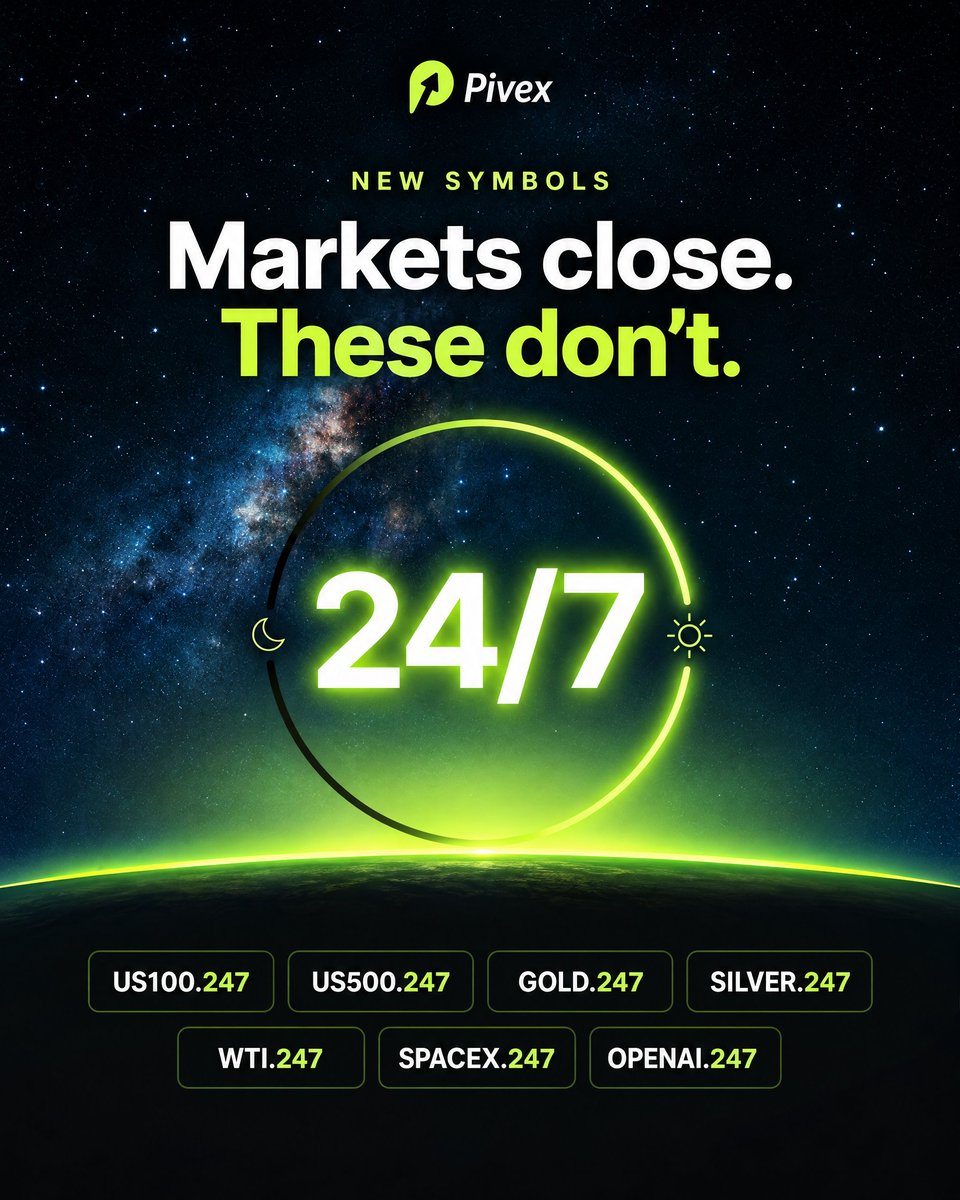
🎉 Something new just landed on Pivex: markets that never sleep!
7 new symbols you can trade 24/7, live now on both Challenge and Funded accounts:
📈 US100.247: Nasdaq 100
📈 US500.247: S&P 500
🥇 GOLD.247: Gold
🥈 SILVER.247: Silver
🛢 WTI.247: Oil
🚀 SPACEX.247: SpaceX (pre-IPO)
🤖 OPENAI.247: OpenAI (pre-IPO)
🔍 How to find them: search .247 on Match-Trader. These are separate from the regular symbols: GOLD.247 tracks gold perpetual futures (contracts with no expiry date), which is why it keeps trading when regular markets close. GOLD and GOLD.247 are two different instruments, and prices can differ slightly.
Saturday morning setup? Sunday night session? The charts are open whenever you are. 🌙☀️
💬 Which one are you trying first? 👇
Pivex provides simulated trading accounts. Rewards are based on trading performance.
Your analysis is only as good as the platform you execute it on. 💻
Every Pivex account runs on Match-Trader:
🌐 Trade anywhere: in your browser or on mobile, no heavy installs
📊 5 asset classes in one place: forex, commodities, indices, crypto and stocks
⚡ Clean execution: a fast, distraction-free workspace that keeps the focus on your plan
Good tools don’t replace a good strategy. They just stop getting in its way. 🎯
💬 What’s the one feature you can’t trade without on any platform? 👇
Dropping to a lower timeframe to find a reason to stay in a losing trade isn't analysis.
Pick your timeframe before you enter and judge the trade on that chart.
If the setup is broken there, it's broken.
If you can't say where your trade idea is wrong, you don't have a trade yet.
Before you enter, name the exact level that proves you wrong. That's your stop.
No level, no trade.
After you review your trades, what actually changes the next day?
Not what you write in the journal — what you do differently. That gap is where most traders stall out.
The trades you don’t write down are the lessons you’ll repeat. 📓
Disciplined traders log every trade, wins and losses. Keep it simple:
📍 Setup: why did you enter?
📍 Execution: did you follow your plan?
📍 Confidence: how did you feel before, during, after?
📍 Lesson: one thing to keep or change
After 20 entries, your patterns show up on their own. 🎯
💬 Do you journal your trades? Pen and paper, spreadsheet, or an app? 👇