Underrated life advice: Keep more evidence of your progress. Journal entries. Photos. Notes. Old goals. We spend so much time focused on how far we have left to go that we forget how far we've already come. Sometimes perspective is the only motivation you need.
Full podcast episode with @rauchg, @maxhodak_, and @bscholl.
40 minutes of unreleased material.
The AI Industrial Revolution
Part 1: Waste Tokens, Save Time
0:00 Three Frontier Founders
1:27 AI Software Factories
4:15 Waste Tokens, Save Time
5:47 Models Instructing Humans
9:29 Is Pure Software Dead?
12:03 You Don't Get Stuck Anymore
Part 2: Vibe Coding Hardware
14:39 Vibe Coding a Turbine Blade
18:07 Open Source Compounds China's Advantage
20:15 You Always Want the Smartest Model
22:44 Software Still Needs Hands
24:43 Humans Are Becoming Verifiers
Part 3: The Regulatory Frontier
27:53 The Regulatory Red Queen Race
32:32 Why There's No Innovation in Healthcare
36:49 We Need a True 50-State Experiment
40:31 China's FDA Is Beating Ours
43:37 Healthcare Is a Communist Society Inside Capitalism
45:57 Sid's Story: N-of-1 Medicine
Part 4: The Autonomous Company
47:49 Autonomous Infrastructure
51:25 Your Job Is to Train the Agent
54:54 The Next Lord of the Rings
59:08 What's Your Definition of Art?
1:05:00 Can AI Have New Ideas?
1:07:03 A Large Number of Small Teams
NEW:
Spiral 4.0—a writing partner for you and your agent by @every
-> Stylometry: we built a new Style Engine based on the principles of stylometry to extract you and your brand's voice and produce great writing every time, based on examples of your past work
-> MCP and CLI: Spiral is now built to be used by your agent like Codex, Claude Code, OpenClaw and more so you can get great writing automatically
we use it every day internally to write landing pages, tweets, podcasts, marketing emails and more and to make sure it's ALL on-brand across our entire 30 person team @every
we landed on a pretty good workflow for doing parallel work in OpenCode
this demo is with git worktrees but i also preview an alternative we're working on at the end
this will be in 1.6.0
Preview of an AI Coding Dictionary I'm shipping later this month
AI coding sounds complex (harness, model, agent, tool etc) but it's really not. You just need to understand the terms of engagement.
More of the iOS app loop, now inside Codex.
The Build iOS Apps plugin lets Codex view and test your iOS app in the in-app browser, open SwiftUI previews, and hot reload edits without leaving Codex.
Elixir v1.20 released! Now officially a gradually typed language: Elixir type checks every single line of code, finding bugs and dead code, without developer overhead (no typing signatures) and extremely low false positives rate. Plus a faster compiler! Links and reports below.
Most people think being wealthy is having a fancy car, expensive watch, or a big home.
It's really about having the ability to have coffee with your wife, gym in the afternoon, lunch with friends, and being able to see your family for dinner.
You need to be slowmaxxing. You need to be reading long, fat books. You need to be making 48-hour chocolate chip cookies. You need to spend hours watching wildlife, you need to spend 15+ min making your coffee. You need to breathe in and breathe out. You need to be slowwwwwwwwww.
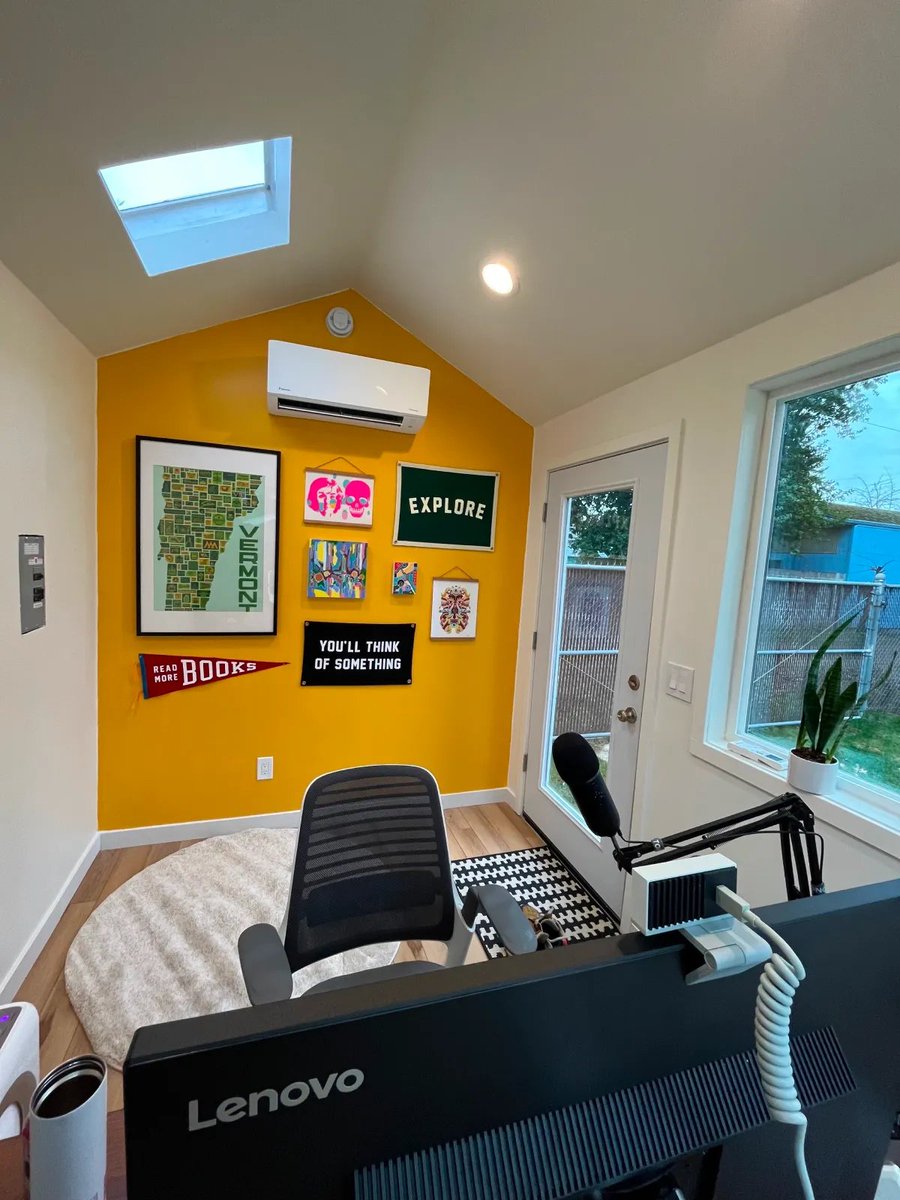
if you work from home and have the yard space, I can't recommend a backyard office enough. Built mine 3 years ago for under $20k all-in. best work-life upgrade I've ever made.
A harnessed LLM agent, clearly explained!
Most people picture this as a model with tools bolted on. The real architecture inverts that relationship.
The model itself is deliberately thin. Intelligence gets pushed outward, and the harness composes it at runtime.
Three dimensions orbit the harness core:
- 𝗠𝗲𝗺𝗼𝗿𝘆 holds the state a model shouldn't carry in weights or context. Working context, semantic knowledge, episodic experience, and personalized memory each have their own lifecycle.
- 𝗦𝗸𝗶𝗹𝗹𝘀 hold procedural knowledge. This can cover operational procedures, decision heuristics, and normative constraints that specialize the general model per task.
- 𝗣𝗿𝗼𝘁𝗼𝗰𝗼𝗹𝘀 hold the interaction contracts. Agent-to-user, agent-to-agent, and agent-to-tools are three distinct surfaces with their own failure modes.
Between the core and these modules sit the mediators, like sandboxing, observability, compression, evaluation, approval loops, and sub-agent orchestration.
They govern how the harness reaches out and how state flows back in.
The useful question this framing unlocks is: for any new capability, where should it live?
- Stable knowledge goes to memory
- Learned playbooks go to skills
- Communication contracts go to protocols
- Loop governance goes to the mediators
Harness design becomes a question of what to externalize, and how to mediate it.
I'm building a minimal agent harness from scratch and will open-source it soon.
In the meantime, my co-founder wrote an article about the anatomy of Agent Harness, covering the orchestration loop, tools, memory, context management, and everything else that transforms a stateless LLM into a capable agent.
Read it below.
#BREAKING MP Kevin Hogan blasts PM
Anthony Albanese in Parliament for destroying Australia's risk reward economic model.
Hogan's critique is razor sharp, the government has systematically inverted incentives for private enterprise.
Historically, risking capital meant keeping the return.
Now, the framework forces a parasitic transfer of wealth “You take the risk and the Albanese Government gets the reward” Hogan argued.
Hogan then rages that this isn't just failed policy, it's a calculated “unforgivable" deception of the Australian electorate.
Hard to argue.
🚀 Gemma 4 12B is here!
We partnered with @GoogleDeepMind to bring and optimize their new dense and unifed multimodal model for Apple Silicon.
◈ 12B dense · 256K context
◈ Thinking mode (built-in reasoning)
◈ Vision: dynamic res, OCR, UI + charts
◈ Native audio: ASR + speech translation
◈ Function calling for agents
◈ Text + image + audio, interleaved
Runs local. Get started now ⚡
> uv pip install -U mlx-vlm
https://t.co/7BvnEuzKvj
luckily bookmark rot is an easy problem to fix now
here's how to turn every X bookmark you've ever saved into a second brain your agent has full context on:
1. export your bookmarks. i use twitter-web-exporter (free userscript) or the BookmarkSave extension. you get one file with every bookmark + the full text + the author + the link
2. drop that file into a folder. if you already run an llm wiki / obsidian vault, drop it straight in so your bookmarks join the rest of your knowledge
3. point your agent at the folder (claude code, codex, hermes, whatever you run) and tell it: "read this export and turn every bookmark into its own markdown note with the original link and a couple of topic tags"
that's it, your agent has read all of it.
now you can ask "what have i saved about pricing" or "pull everything i bookmarked on claude code" and it answers across the whole pile
takes maybe 10 minutes
after that they actually get used, and every new bookmark folds into the same brain instead of rotting in a tab you never open again
How do we automate business analytics with Claude?
New blog post covering our best practices for skills, data foundations, and evaluations when building agents to perform data analysis:
https://t.co/mfEJMAQFBU