Procrastination is an identity management problem. As long as you haven't started, you are still potentially great and potential is infinite. But actuality is finite and specific and mediocre at first.
Think of it as Schrödinger's talent: the box stays closed and you stay a genius.
It takes zero energy to stay certain of your current thesis. Meanwhile curiosity takes a lot of energy and discomfort. It requires constantly disassembling and rebuilding your world model.
That's what makes certainty so dangerous: it's the bottom of the potential well and it's hard to get out.
The answer doesn't have to be in your head; you can look outside yourself. If you're truly looking at things objectively, you must recognize that the probability of you always having the best answer is small and that, even if you have it, you can't be confident that you do before others test you. So it is invaluable to know what you don't know. Ask yourself: Am I seeing this just through my own eyes? If so, then you should know that you're terribly handicapped. #principleoftheday
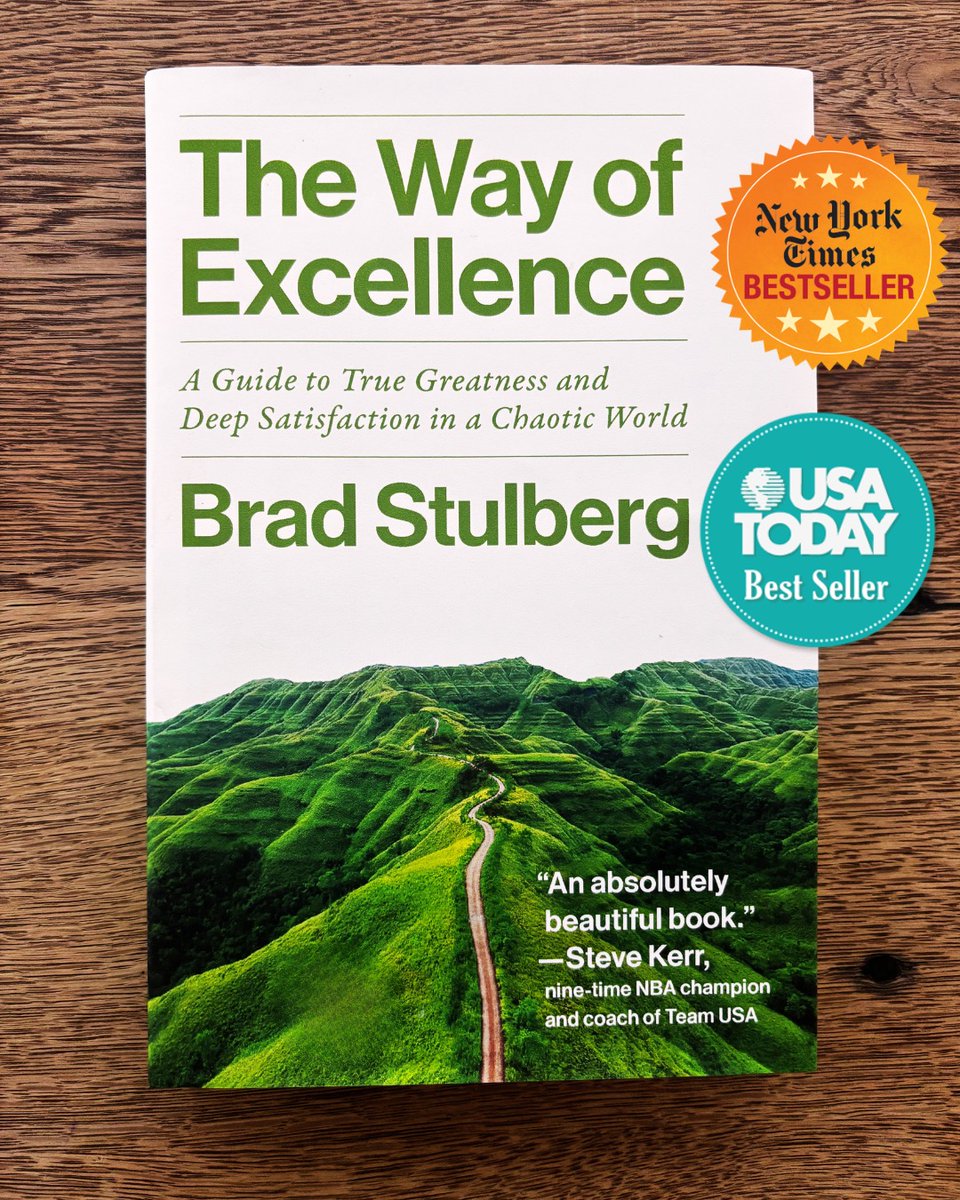
Hi y’all—a little update: "The Way of Excellence" has been out for a month. I just heard from my publisher and the numbers are incredible. So many of you have ordered the book! Thank you. I am beyond grateful.
The mission of the book is to reclaim excellence—not the hustle-culture, gimmicky, optimizer version; but the real thing—and to outline the core habits, mindsets, and practices that help you get there. I wrote the book as an antidote to the numbness, burnout, overwhelm, alienation, and nonchalance that plague modern society. I'm thrilled how much it's resonating.
If you haven’t yet, get a copy. It's a great investment in yourself. It’s also the best way to support my work, support this page, and to join a growing movement of people who want to reclaim and aspire toward actual excellence in a world that needs it more than ever.
“The East reveres Buddha, the West reveres Christ. Both taught love as the secret of wisdom. The earthly life of Christ was contemporary with that of the Roman Emperor Tiberius, who spent his life in cruelty and disgusting debauchery and perversion. Tiberius had pomp and power; in his day millions trembled at his nod. But he is forgotten.
Those who live nobly, even if in their day they live obscurely, need not fear that they will have lived in vain. Something radiates from their lives, some light that shows the way to their friends, their neighbours perhaps to long future ages. I find many people nowadays oppressed with a sense of impotence, with the feeling that in the vastness of modern societies there is nothing of importance that the individual can do. This is a mistake.
The individual, if he is filled with love of mankind, with breadth of vision, with courage and with endurance, can do a great deal. Every one of us can enlarge our mind, release our imagination, and spread wide our affection and benevolence. And it is those who do this whom ultimately humankind reveres.”
— Bertrand Russell
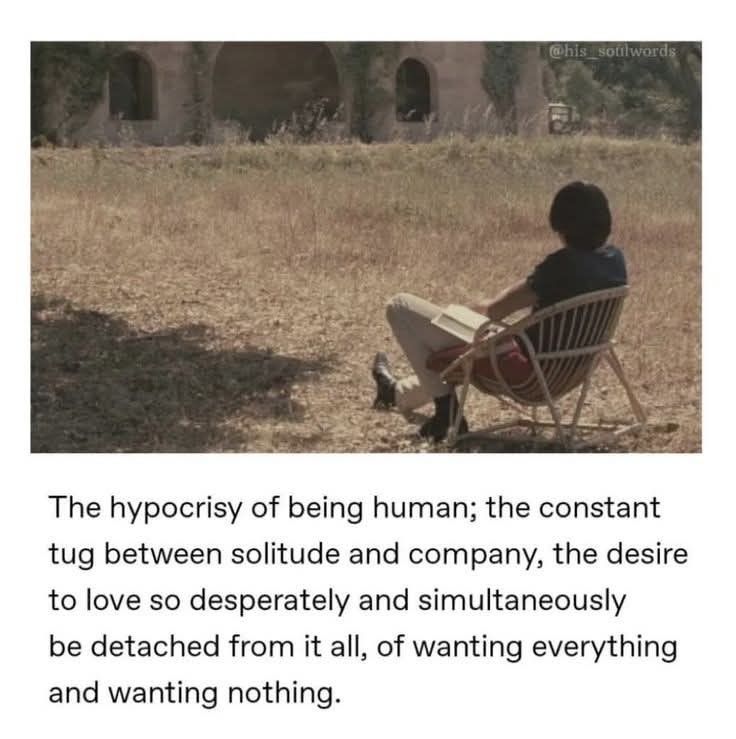
I want a slow life. A life filled with meaning. No rush. No anxiety. No overthinking about the future. Just quiet calm. Doing my thing. Quiet morning coffee watching the sunrise. Going for long walks in nature. Cooking healthy meals listening to some lo-fi. Reading thick books that take weeks to finish. Spending time with people who match my vibe. And the time to pursue mastery to get better at something slowly, patiently. A simple calm low-key life.
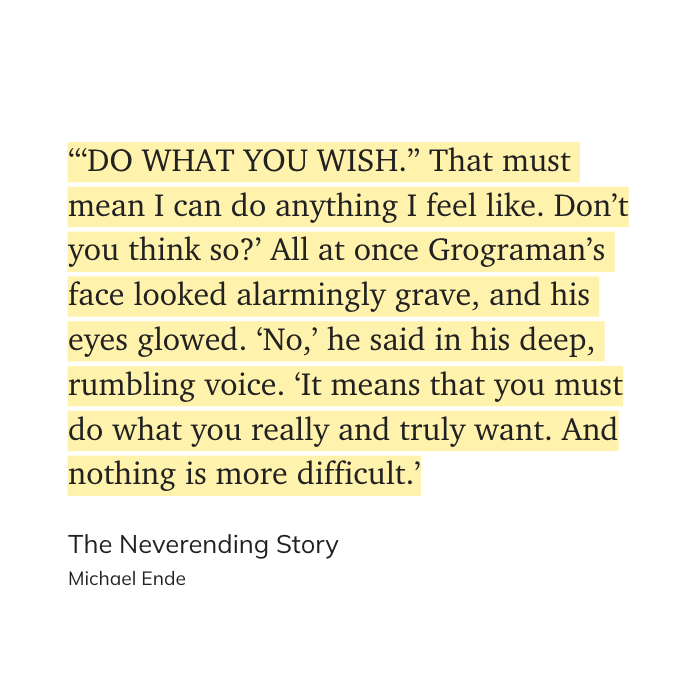
I often work with people who are confused between "should I just do what I feel like?" vs "should I force myself to do the hard thing?"
and I believe this is a false dichotomy. just doing what feels good will produce a life that's pleasurable but empty. doing what's difficult will produce a life that's impressive but hollow
the third path, which is also the most difficult, is to allow yourself to be pulled by your deepest desires, by what wants to be expressed through you
calling, vocation, devotion... these all point to the same thing: to surrender yourself to something larger, and to follow it where it takes you, because it feels true to you
The most important quality for a smart person is courage because without it their intellect will be leveraged to rationalize their fears and concoct the most convincing excuses not to act.
I started programming decades ago when I was 12 years old. At first, it was just a game to me. Over time, as I acquired more skills, it became part of my identity. While others played basketball or the violin, I wrote code.
It is so deeply ingrained in my identity that when I once stopped programming regularly, I became depressed. Shamefully, it took me years to realize that I need to program weekly to stay happy.
Today, the best AI models can write C++ code better than most computer science professors. They are certainly better programmers than my teenage self, who learned without access to the internet.
Why play the violin when anyone can find a recording of a great violinist with little effort?
This is not a new problem for human beings. What happened to bowmen when the musket became standard military issue?
Do you keep showing up on the battlefield with your bow? A bow has advantages over a musket—and bows continued to improve even after the musket’s invention. Yet the writing was on the wall: the future of the battlefield did not belong to the bow.
I could also recount the story of portrait painters who struggled with the rise of photography.
Programmers are not alone in facing a transformation of their craft. Graphic designers, lawyers, writers, and nearly everyone in the laptop class are impacted. Some do not mind, because their craft was always primarily about achieving professional success. Others are more troubled.
Let us be fair. For the last 30 years, the West pursued globalist policies that continually moved industrial jobs elsewhere, leaving many young men without much-needed opportunities. We told them not to worry—their economic losses were more than offset by government checks.
And this gets to the core of the issue. Getting the job done is only part of what we care about. Perhaps more importantly, we want meaningful lives, which often come through skill development and its fruitful application. Money alone is not enough—it never was. We also crave status, recognition, and a sense of empowerment.
As I look at software programming today, I can accomplish in five hours what would once have taken me three days. Sometimes I can do in 15 minutes what used to take three hours. Other times—especially when tackling something difficult that plays to my strengths—I do like Luke Skywalker: I turn off the targeting computer and code without AI for the best results.
At the same time, I see many people (including some of my students) trapped in an illusion of competence. They prompt an AI and generate low-quality code—not because the models are bad, but because a tool is only as good as the person wielding it.
What is coming? I cannot predict the future with certainty, but the following seems possible:
1. We may end up with the equivalent of a laptop-class rust belt. People who used to write reports and PowerPoint decks for a living could become obsolete. Teachers might find students turning to AI instead, reducing them to little more than relatively useless bureaucrats. IT specialists might see their entire purpose wiped out by a new AI model. They may still earn a decent living, but their social status could crater—just as it did for factory workers in the West from 1980 to today. What goes around comes around.
2. During the globalization era, the financial industry boomed in the West, and to this day some of the most prestigious and highly paid jobs are in finance. A similar phenomenon is likely unfolding in this AI era. Many of those benefiting will have a background in programming. The people who can build in a month what once took a year will be able to automate tasks that previously weren’t worth automating.
What about the sense of purpose and competence? Speaking for myself, it is not gone. If anything, I feel I can leverage my hard-earned skills even more effectively than before. More importantly: I am still having a lot of fun programming.