so i wanted to understand how containers actually work, so i built one from scratch in go
meet forge, my own small container runtime
it uses linux primitives for process isolation, filesystems, cgroups, networking, oci images, and the container lifecycle
heres a quick demo
Go's popularity is going to grow exponentially with the rise of AI agents.
Agents are long-running processes -- seconds, minutes, hours -- which means that they benefit dramatically from good concurrency primitives. There's arguably no language with better simplicity + performance (when it comes to concurrency) than Go.
Also, the model of "share memory by communicating" works really well with the actor pattern, which I'm seeing in more and more agent stacks.
My favorite trick to reduce memory overhead in a Go app is to replace all time.Time references with int64. time.Time is 24 bytes versus 8 bytes, so a 3x improvement. There's also a GC improvement since time.Time contains a *Location pointer.
We maintain a few indexes in our engine which are ordered by priority and timestamp (these are queue-related indexes). We'd like to do everything possible to ensure this index fits in memory (and only fall back to disk with enormous backlogs).
In our first implementation, we'd read these rows out of the database to construct the index and convert pgtype.Timestamptz -> time.Time. But this strategy only let us fit a few million entries in memory on a 2GB machine. After a light refactor and partially due to this fix, we're nearing hundreds of millions of slots.
This is nowhere near Cloudflare's level of optimization but was very leveraged in our case.
The answer boils down to one thing, which is: proper “DECOUPLING”.
So, decouple non-critical work from the critical path.
Speaking of that charging the card and recording the ledger entry are the parts that must succeed together for financial correctness.
Emailing a receipt is best-effort notification; it must never block or fail the money movement.
Let’s continue reading I’d explain in detail below
If I had to relearn backend development from zero,
I'd learn these in this order:
1. How a request actually travels
DNS → TCP → TLS → HTTP → Load Balancer → Server
2. What happens when two requests hit the same data
Concurrency → Locks → Transactions → Race conditions
3. Why an API becomes slow
Connection pools → N+1 queries → Indexes → Network latency → p95/p99
4. How systems communicate
REST → gRPC → WebSockets → Webhooks → Queues → Event streams
5. What happens when things fail
Timeouts → Retries → Backoff → Circuit breakers → Idempotency
6. How one server becomes 100
Stateless services → Load balancing → Caching → Replication → Sharding
7. How to know what's actually happening
Logs → Metrics → Traces → Profiling → Alerting
Don't learn backend as a list of technologies.
Learn what happens to your code after you press "Send".
This is why "forex gurus" sell you a course instead of encouraging you to study institutional finance and understand how interbank liquidity actually works.
If the students of Habby Forex and Jeffrey Benson truly understood capital dynamics, they would never believe the ridiculous claim that Jeffrey withdrew $9 million from an offshore retail broker like Assex Markets or Kwakol. The only way such a massive withdrawal could legitimately happen is if these brokers possessed active clearing contracts and institutional settlement lines with Tier-1 liquidity providers like JPMorgan Chase, which they simply do not have.
The primary purpose of selling courses is to control the narrative and keep students in the dark. The irony is that, strictly speaking, these influencers are not even real forex traders, and their audience fails to realize this due to a complete misunderstanding of market microstructure and broker execution models.
A retail broker like the ones Habby Forex promotes is no different from a Bet9ja shop. When you walk into Bet9ja and place a bet that Real Madrid will beat Barcelona, you are simply entering into a private wager with the betting house.
Real Madrid, Barcelona, and La Liga have no idea your bet exists, and neither the players nor the league earn anything whether you win or lose. Your win is an outright loss for the betting house, and your loss is their direct profit. The betting house remains profitable because they know that over 90% of gamblers will eventually lose all their money, and even the rare few who win substantial sums usually gamble it all back.
This is precisely how the brokers used by Habby Forex and Jeffrey Benson operate. When you open their trading app, you see live charts of forex price movements, much like watching live scores on a sports betting app. But when you place an order, that trade is logged solely on the broker's private server. The broker makes zero attempt to route or execute your order in the real interbank market. Routing orders to real global liquidity providers requires massive upfront capital, bridge fees, and transaction costs. Because statistics show that roughly 90% of retail traders wipe out their account balance within 90 days, the broker has no financial incentive to incur costs by sending your order to the real market. They simply wait for you to blow your account so they can pocket 100% of your deposit.
This is also why these brokers offer absurd leverage like 1:2000, as it ensures you lose your money as quickly as possible. In the real financial world, leverage consists of strictly collateralized credit lines. In the United States, retail leverage is legally capped at 1:50; in the UK and EU, it is capped at 1:30; and in many emerging markets, it is even lower to prevent systemic risk due to lack of liquidity.
Ultimately, these brokers partner with forex influencers like Habby and Jeffrey Benson to funnel inexperienced traders onto their platforms. They pay these influencers massive commissions for every referral, and under certain affiliate deals, they even pay them a percentage of their followers' trading losses, because client losses are where the broker makes the most money.
This is a much better explanation than the oversimplification by people who just come out to shout “this is a scam.”
There’s a difference between something being a “scam”, and understanding the business model behind the profit.
There are people who make money from “music” without being musicians; they could be backstage producers, show operators etc, but they still make their money from music.
There’s people making money from “crypto”, but they don’t trade; they create software.
You could spend decades in an industry, but if you don’t understand the model that people in your market are really using to make money, you’ll join the bandwagon to keep shouting scam.
The harsh reality is that nobody is under any moral obligation to show you how their business model completely works when it is their competitive edge; it’s your own job as a participant in said industry to ask questions, do research, find where the money is flowing and decide if you want to participate or not.
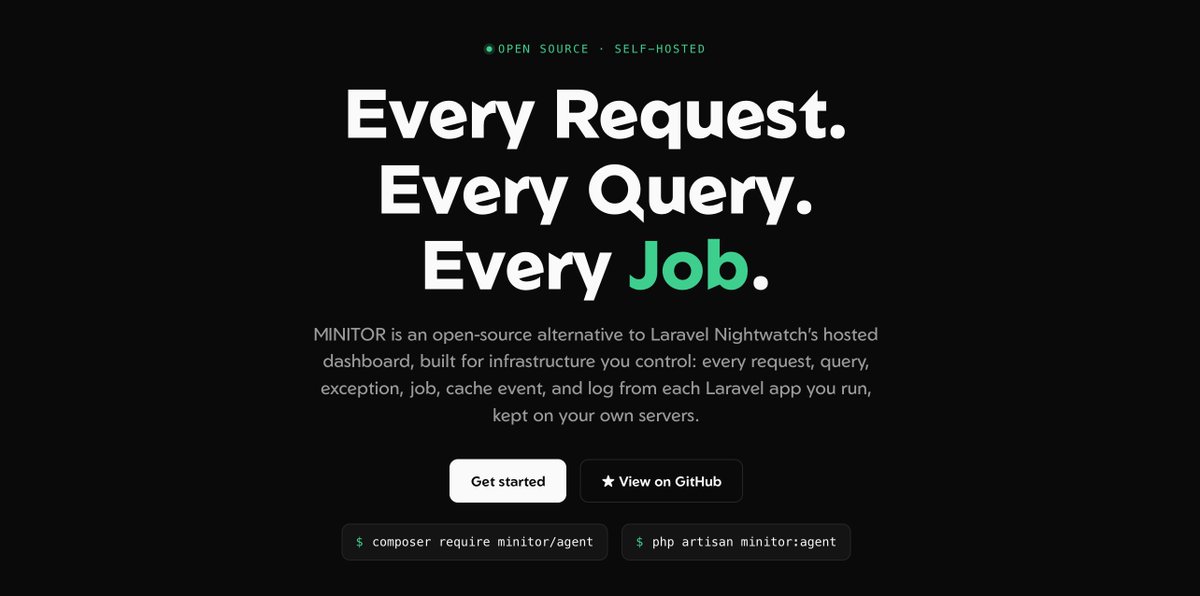
Introducing MINITOR, a self-hostable Laravel Nightwatch alternative for observing every request, query, and job on your own server.
100% opensource and free to use.
https://t.co/tbsj6w7sjO
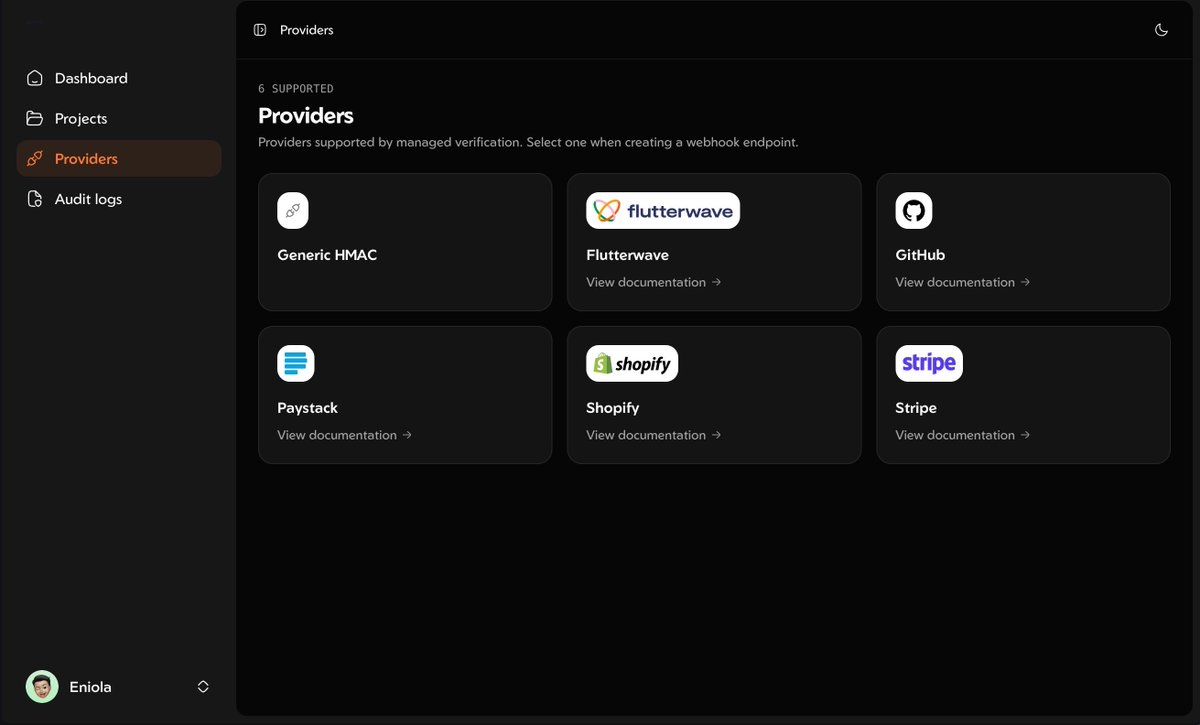
The webhook gateway has
Transparent relay - This means it forwards the webhook to your application exactly as it arrives. Your application then handles the signature verification logic.
Managed Verification - This means the gateway verifies the webhook signature for you before sending it to your application.
The gateway has some predefined providers, and it uses their signature verification pattern to verify your webhook before sending it to your application.
I will be adding more providers as we go.
A lot of bad arguments, bad analogies and bad decisions are really just bad mathematical thinking. I think everyone should learn these basic concepts
Fractions & percentages - for making proper comparisons
Averages - understanding whether a a number is representative and identifying outliers
Ratios & proportions - to compare things fairly
Statistics - to avoid being fooled by random fluctuations or misleading numbers
Growth & Compounding - so you can see why debt, investments, inflation and bad or good habits can become huge over time
Correlation and causation - to stop assuming that because two things happened together, one caused the other
I am happy to announce Hookdrop
This is for every developer and team who's ever debugged a Stripe or Paystack webhook by squinting at logs and praying.
Debugging webhooks shouldn't mean babysitting a provider dashboard.
hookdrop gives you a permanent URL, so every webhook that hits it shows up instantly, live.
Click it, see the full payload data, and verify their signature is actually real (most tools don't even do this part).
Then replay it straight to your localhost. No need to trigger from the provider again every time you fix a bug.
Get started at:
[https://t.co/DpQGXJOTdE]
"Building in public" doesn't mean screenshotting every feature or class you write in your IDE and pasting on X, looking for validation.
It means making people aware of the general idea of what you're building and collecting user feedback in terms of suggested workflows. It's a product roadmap walkthrough across a time period.
Fora on HackerNews, Reddit, etc., work with this perspective.
The bottleneck was never access to information or knowledge, but the desire, discipline and commitment required to learn something new.
Just as google search did not produce geniuses, AI won’t automatically do same; instead, it will further widen the gap between the average person and outliers.