NEW NFT ON THE BLOCK!
We are in the extremely pleasant position to announce that the first NFT of contemporary music composition is reality. The NFT is especially composed, performed, recorded and produced to be the first NFT of its category.
https://t.co/mHs3raQyfV
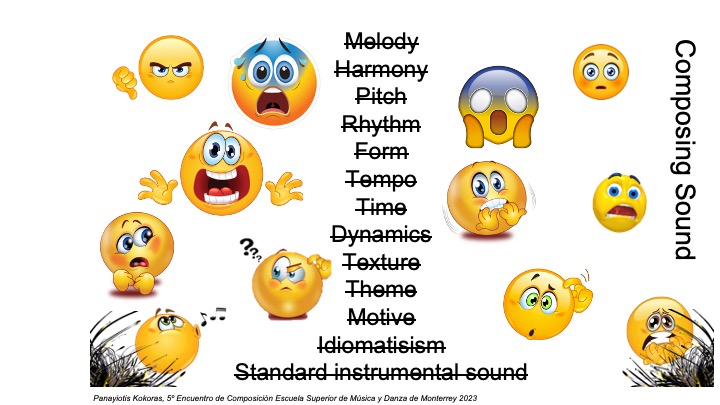
A slide from my presentation today at 5º Encuentro de Composición Escuela Superior de Música y Danza de Monterrey - La Superior ESMDM in Mexico. https://t.co/VpfGYM8NIV
“Earlier on, music was thought to come about because of a need for humans to do something together in a peaceful fashion—call to a mate, speak with the gods, communicate over long distances, work together effectively.” (Bruno Nettl, 2015:64)
"Fully professional performances" are those in which all the performers are regular professional performers (not teachers etc.), and are being paid a full fee for the performance, in a public context with a royalty payable to the composer.
https://t.co/AX90VH2LZs
A non-dualistic approach to sound would suggest that sound is a construct of our mind; there is no inherent separation between sound and the auditory system that perceives it.
In my creative process I like to map out my own creative pathways and allow for chance and unpredictability to shape my work. Rather than following a predetermined plan or structure, I embrace uncertainty and the potential for unexpected connections, interactions and synergies.
…musical sound-making could be considered to be a subcategory of dance. Iain Morley ( 2013) The Prehistory of Music, Human Evolution, Archaeology, and the Origins of Musicality. p.317
sound composition does that: “it can turn anything into anything else; it can make sounds which remind you vaguely of something but which are not exactly that thing. Well known instruments can be made ambiguous, made to be both themselves and something else” Harvey J, Hcmf 2009
The future of keyboard.? — ”Timbre is fixed; pitches are incapable of any sort of inflection, …one single point of contact with the sound-object, at the initiation of the note, …no impact on the internal morphology of the sound.“ On Sonic Art (1996) T. Wishart
in 1640… ”the performers must bow, pluck, and hit the strings; hold the instruments on their laps; and play from offstage. The instruments echo, drone, mewl, bark, and crow.” Curious and Modern Inventions, Instrumental Music as Discovery in Galileo's Italy, R. Cypess, 2016:176
On the origins of music. “The herd was initially enticed towards the drive area by a young man singing a spiritually potent song in the manner of a bleating calf.”
Kehoe, A. (1999) Blackfoot and other hunters of the North American Plains. The Cambridge Encyclopaedia, p.16.
Brandt et al. define music as “creative play with sound.” Brandt, A., Gebrian, M., and Slevc, L. (2012) Music and early language acquisition. Frontiers in Psychology: Auditory Cognitive Neuroscience 3 (Article 327), 1–17.