While the dust may have settled and you may be sick of hearing about #lk99, it is worth highlighting the central irony of #lk99: a completely different "super" property masqueraded as a signature of superconductivity: superionicity. So, this is short thread about superionicity
Happy to share our recent work on single-particle plasmon coupled circular dichroism (PCCD) in Nano Letters. Congrats to @OjasviV19 and the whole team @ Stephan Link and Prashant Jain @plasmon .
https://t.co/an9yVj8T1T
It almost reads like science fiction: pulling CO₂ right out of the atmosphere to create new hydrocarbon fuel, eliminating the need for extraction and new carbon emissions. A @ChemistryUIUC team has discovered that lasers could make it a reality. https://t.co/3S0AWG3NCf
Combining visible light & electrochemistry, a team led by Prashant Jain @plasmon has enhanced the conversion of carbon dioxide into valuable products & stumbled upon a discovery that opens new avenues for CO2 conversion & other chemical reactions. https://t.co/qFu3HAjcW9
🤯A fantastic review in @acsnano with 50 global leaders discussing the impact of SERS in catalysis and energy 🌍📈⛽️💡 Very honored to lead! 🙏In commemoration of the 50th anniversary of SERS🎂 Check it here 🔓: https://t.co/6EfdY1vNBc
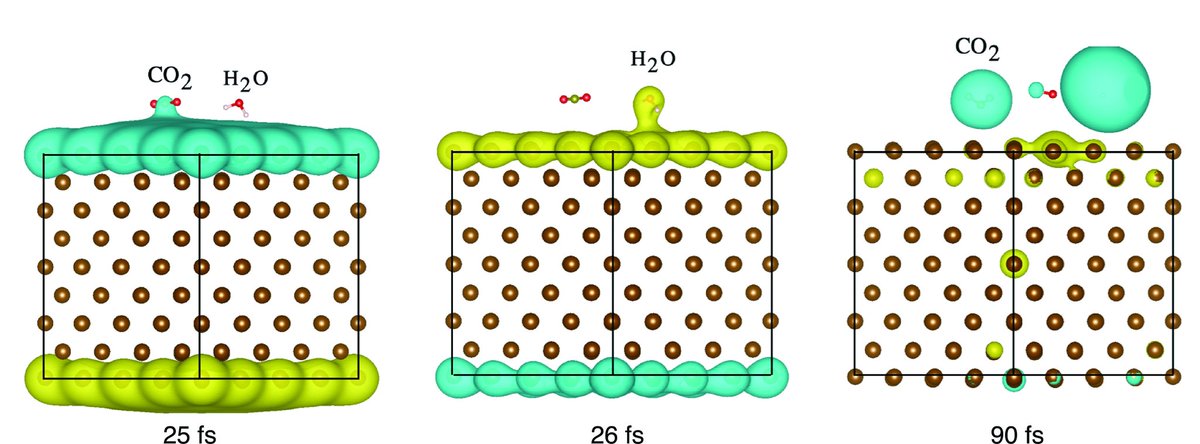
In PNAS we report how electromagnetic fields direct charge flow, reaction pathways, & selectivity in CO2 reduction https://t.co/qECb0NlE0P Phenomenal teamwork with @AlcornFrank @NorthwesternU collaborator @GCSchatz with Sajal Kumar Giri, @mayachatt_ & Rachel Nixon @ChemistryUIUC
✏️You can already apply to join us and I'm listing here some of the speakers and discussion leaders to help us spreading the word about this fabulous event: 8-13 June 2025 in Ventura, US 🇺🇸
🚦🚦🚦B R E A K I N G N E W S 🚦🚦🚦
We've just published the preliminary program for the next @GordonConf on Plasmonically Powered Processes 2025! I cannot be happier and prouder for such a diverse & groundbreaking line-up! 🙏Thanks all! https://t.co/754KhGxdji
@zhigangsuo Not commenting on the ChatGPT explanation but the statement is indeed false. E.g. 20+ known phases of pure H2O. At the most 3 phases can coexist for a pure substance as per Gibb's rule, but I am not aware of a theorem limiting the number of possible phases over full T-p space.
Congratulations @progna_physics on the start of your research laboratory @LoyolaChicago. Excited for you and your new research group. Glad to have been a small part of your scientific journey.
Shoutout to my PhD advisor @plasmon at the @UofIllinois who helped me transform from a physics student into a chemistry researcher. Many attributes that I will be carrying forward as a researcher & mentor, will be influenced by the formative years spent with his group.
Excited for group alumna @progna_physics who starts a tenure-track position and her new research group @LoyolaChicago. Congratulations and looking forward to many exciting things to come from the Banerjee Lab.
I'm excited to start my impendent laboratory as a tenure-track professor at @LoyolaChicago this month! My "PBEnergyLab", will be working on designing batteries to be non-combustible, cost-effective, efficient: and built with elements sustainably sourced within the US.
Looking forward to building my independent lab as an empathetic leader! I have multiple openings for PhD advisees, postdoctoral scholars & undergraduates in my group, drop me an email if interested! See a compiled list of instructions here https://t.co/XnIswu41bY
@rjoliveir@UofIllinois@LASillinois@ChemistryUIUC No assigned textbook. I post course notes, which draw from multiple sources: Callen, Chandler, McQuarrie, Pathria&Beale, Dill, and some classic papers.
An honor to be recognized by the Campus Teaching Excellence Award from @UofIllinois Provost. Immensely grateful to the students who wrote letters & @LASillinois@ChemistryUIUC for nominating. I've had a ball teaching (and learning) Thermodynamics/StatMech for over a decade.
Check the source of H2 in your photo/electro catalysis experiment. (Cracked stirrer bar can be the culprit!)
Viewpoint by @plasmon
Hydrogen Evolution from a Spurious Source | ACS Energy Letters https://t.co/FCGiTRN3Dx