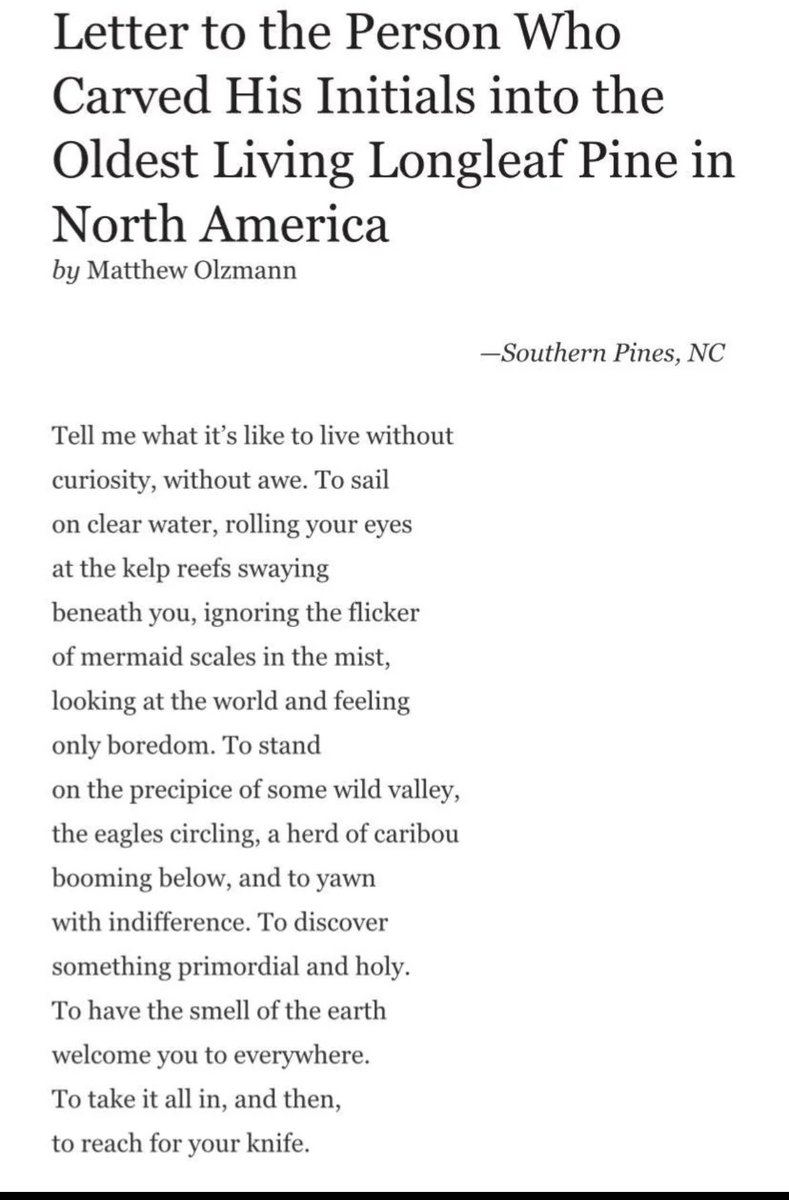
A lot of poetry simply cannot imagine life outside the author’s point of view. One could easily imagine a more interesting poem about someone knifing the tree in an attempt to leave his mark on the world….
and thereby sacrificing some beauty in nature. In his attempt to interact with and become master of sublime nature, he cheapens it. This idea both takes the knifer seriously and maintains the idea that carving a tree harms something good.
@OrinKerr Though, of course, alarmism about the majority could play a similar role to the public: Look at a radical majority opinion that won’t own up to its own scope. Clearly, then, it is not a really good or honest opinion and should actually be cabined.
@OrinKerr I wonder if this strategy makes the most sense when circulating draft opinions, perhaps to pick off a few agnostic members of the majority who might threaten to leave the majority if the opinion is not moderated.
It makes less sense, though, upon publication to the public.
@ItsJorny@MerriamWebster I tend to pronounce them differently. I would say “BYE-uh-graphical” instead of “BYE-oh-graphical.” That is generally how I hear it, too.
Perhaps I am in the minority on that tho!
Any visual depiction of Helen—or for that matter any person said to be the most beautiful alive—will necessarily disappoint. The thought of her will always be much more powerful.
What’s so interesting is that—given the key role her beauty played in the Troy myth—there is no detailed description of what Helen of Troy looks like anywhere in Homer (or even in extant Gk tragedy, apart from —if memory serves—something about her hair in Euripides’ “Orestes”).
Also, I don’t think the OP is blind to these concerns. I have just heard other people talk like that, and this post was a good opportunity to rather quickly address what I see as an inconsistency!
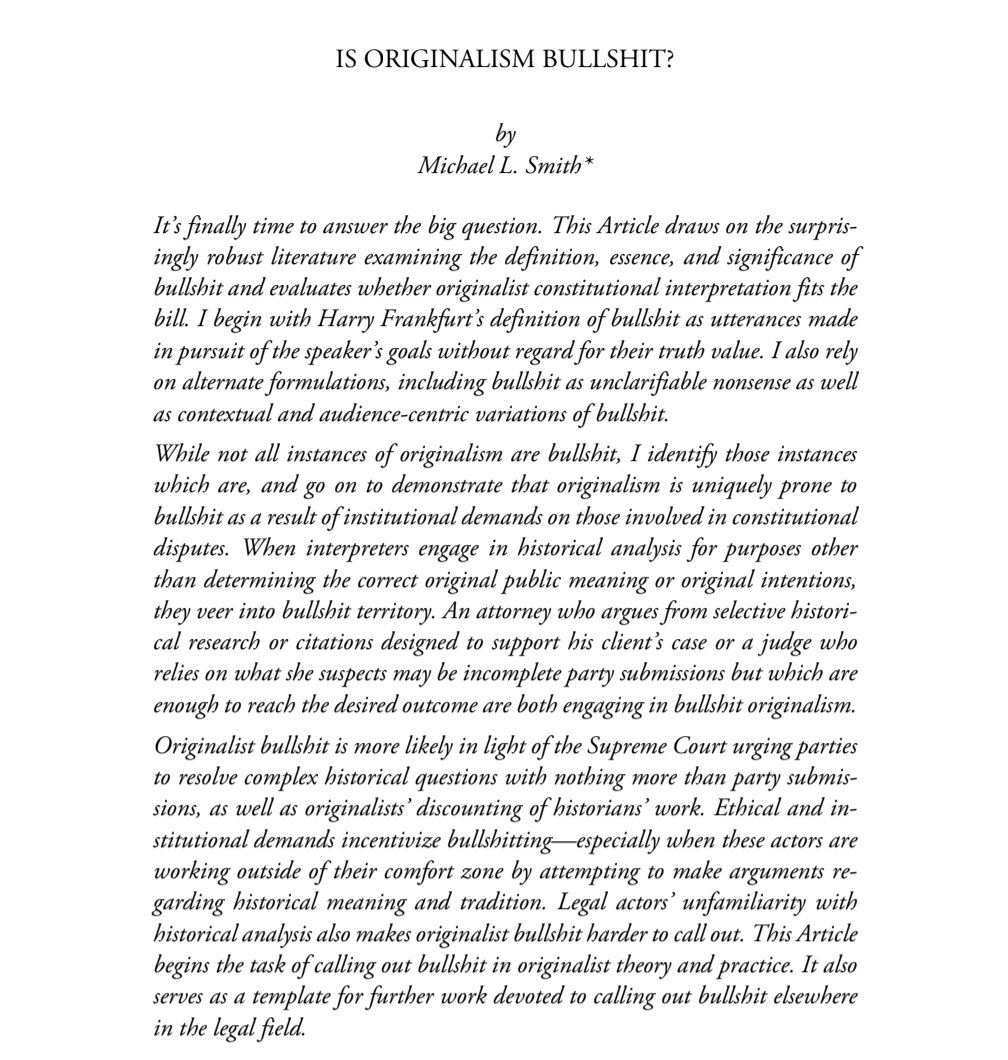
I’m not saying that originalist scholarship or originalist lawyering is particularly good. But the critique that “lawyers aren’t historians” has always felt odd to me. The critique reads to me as a complaint that originalists simply aren’t originalist enough!
Lawyers are not trained historians. Originalism is largely and remains largely bullshit. The hubris that backs it leads to nonsense arguments that ignore the plain, unambiguous language of a statue. These professors want to will more bullshit in furtherance of their careers.
After all, that last statement argues for a “living” view of language by reference to the views of those who set that language down. Thus, if those people had set down a “dead” view of that language, that would then be the meaning of that phrase.
So the theist claims that the atheist has no incentive to follow a set morality. Which is hard to argue: if the atheist can act morally only with reference to changeable incentives, then the particulars of morality can change.
I think people are talking past each other: Most frame this debate as about incentives. “The atheist lacks incentives outside personal preference to be moral,” the theist says. True. But the same may be said of the theist—his personal fear of divine retribution guides his belief.
The real debate, to me, is whether the content of morality actually can change. The atheist does have incentives—social pressure and personal tastes—to act morally. But the theist likely finds this an insufficient morality because social pressure and personal taste are fleeting.