Playbit is a pursuit of personal-scale software. Today we’re launching a beta version of a brand-new Playbit. It’s macOS only for now (more platforms soon.) Playbit is infrastructure for a new era of personal-scale, local-first software.
Ever since I started working on Playbit in 2020, have I had this nagging feeling that making software is just too damn complicated. For anything practical, you end up having to do so much “grunt work” that isn’t about the essence of what you’re actually trying to build: maintain servers, week-long waits on Apple bureaucracy, writing your own data sync or just accept that your software will be unavailable when someone uses it on a train that goes through a tunnel.
Playbit is a cultural platform for doing things differently.
You own your data. A Playbit Volume is like a fancy Dropbox that can contain not only files, but also structured data that can be edited offline and syncs whenever you are online. The data is encrypted and uses public-key cryptography to allow sharing volumes with other people or service accounts.
Apps are written in any programming language you’d like. Playbit is like an operating system kernel, a syscall-style C ABI with forwards version compatibility. Apps store their state in Volumes, so when you use an app you have complete visibility into the data stored by the app.
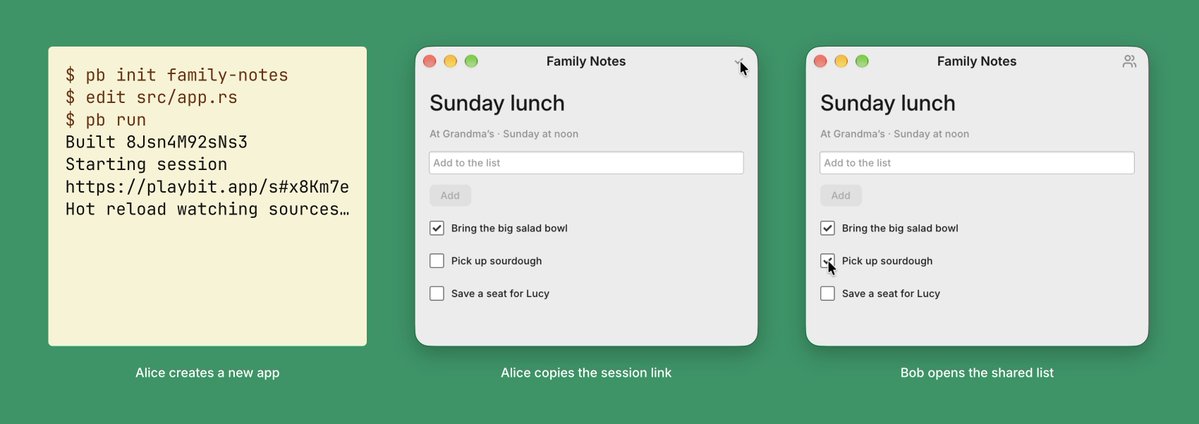
Sessions are like “private spaces” where an app runs. You can invite someone to join a session with a single click — Playbit is fully multiplayer. Session data is of course fully encrypted; a session invitation link holds the encryption key to the session.
We’d love to hear what you think and what you make!
This week we did a three day "App Jam" at @Playbit_ .
Lots of cool things were built, like a multiplayer math art app and a MIDI composer.
My own project was a flow-based programming app for graphics. As if Quartz Composer was multiplayer.
Pure C & WGSL, no libs, 1.5M wasm file.
Today we at Playbit are sharing our first iteration of the Playbit runtime, our vision for building playful personal-scale software.
https://t.co/kIhrQoVnJL
Personal-scale software means programs by you, for you and for the people in your life. An app for your friends isn't very useful if only some of them can run it, so usually these projects have only one option: the web, an abstraction which many apps don't fit well into.
We wanted a better solution, so that's what we're building. A runtime designed for highly dynamic graphical apps that are collaborative, with a really good set of developer tools.
The Playbit runtime is a bit like an OS, but lives inside a host environment and gives guest code a small system layer to interface with. In practice it’s a minimal ABI-stable syscall interface with well-defined semantics.
While we only support macOS in this initial release, our vision is for a powerful multimedia and collaborative platform which you can write your app for once, and run it on any platform.
Learn more and grab the macOS app at https://t.co/kIhrQoVnJL
With love and a bit of code,
– Edward, Nick, Julia and Rasmus
Rasmus Andersson @rsms gave an awesome key note introducing @playbit_ - a new operating system & development environment which encourages playful learning, building & sharing of local-first software on a personal scale.
Getting time zone synced between host system and playbit was more work than I expected.
On the plus side, I walked away with deeper knowledge about IANA time zone data and how libc & the Linux kernel keeps track of time zone independently.
@rsnous@abanduk@navaneethmn Here's a screen recording of a quick demo.
(I'm running a debug build in an emulator here which is why it's in a macOS window.)
We're about to send out the first early-access invitations to Playbit, starting with 100 randomly selected email addresses from the early-access signup form on our website.
If you have the curiosity, feel brave and are comfortable with computer programming, let me know if you'd like to get access.
This first release *only works if you have an arm Mac.* We essentially give you a mac app that is a virtual machine which runs Playbit (think: a video game in full-screen mode.) This makes it easy try. In future early-access releases we will increase compatibility to other architectures and platforms.
It will be a *very* early release where most of the exciting and interesting features are promised for the future are absent.
You can sign up for early access here: https://t.co/qY157R7IHY
playbit workspaces are like entire virtual machines and can be shared with other people, which means that we have to handle displays of varying size and aspect ratio. For this, we are moving away from a stacking window system to a tiling one, with a "rail"
For the past few months we have been able to develop playbit inside playbit [inception.gif]
Although the road ahead is still long, we'd like to share a very first peek of playbit in action.
• Please keep in mind that this is a _very_ early version.
• Sign up for early access at https://t.co/nSPC48Srkl
• Video source: https://t.co/aIHHfwZWWp
• Desktop wallpaper by @maitrishahhhh
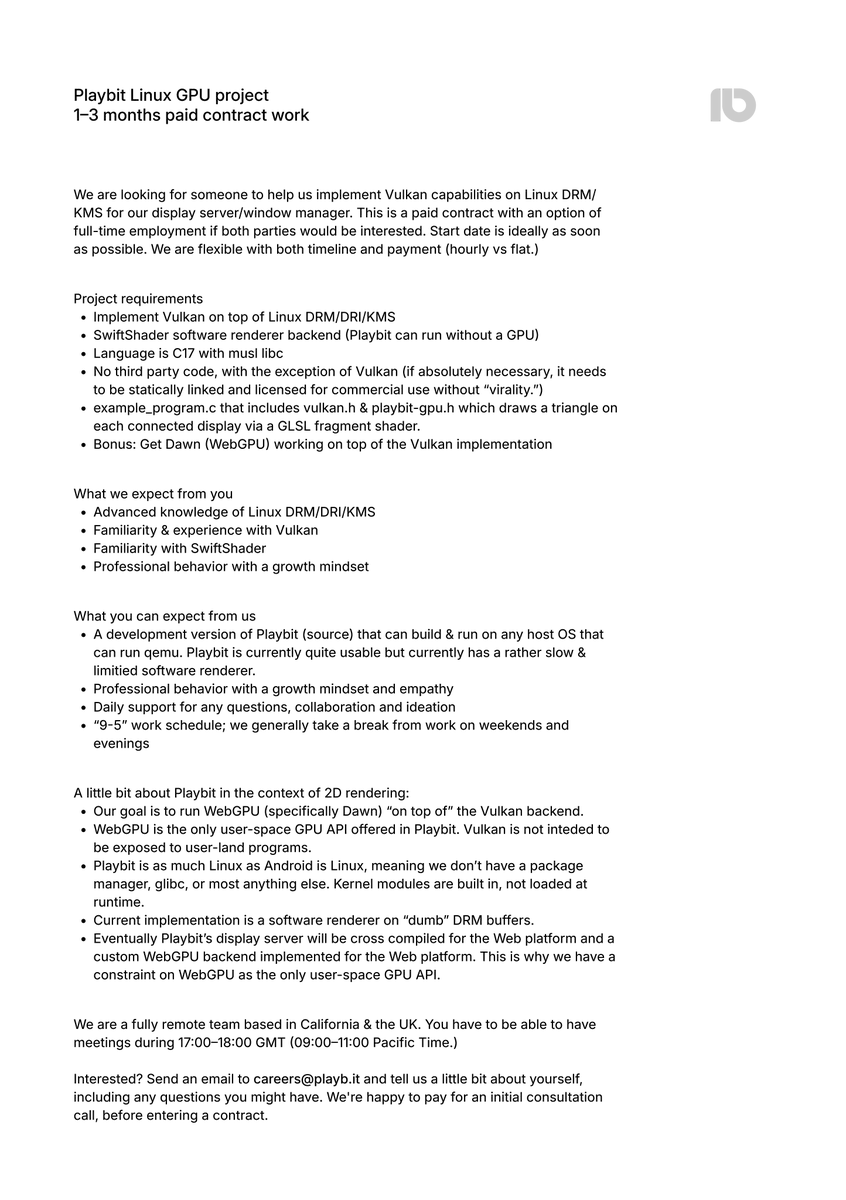
• We are hiring linux-kernel & GPU hackers
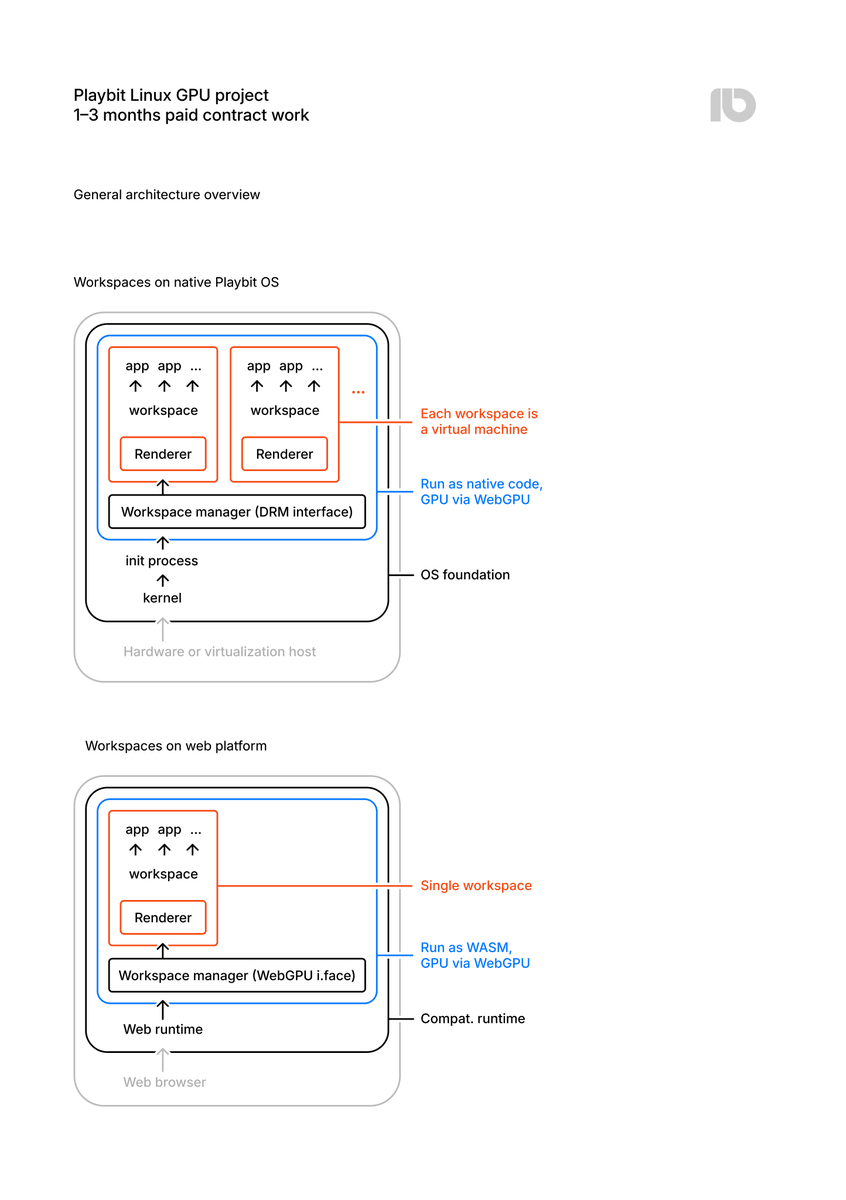
The second "embedded page" in the tweet contains a confusing illustration; here is a newer version that should have been in the tweet. (The website is up to date though.)
Apologies to all the "I'll read it in an image" people out there.
Playbit is an endeavor to build a new operating system for software creatives. After over two years of research, Playbit is now a real company and we are hiring our founding engineers.
Are you up for the challenge?
https://t.co/A8B1xFwBxe
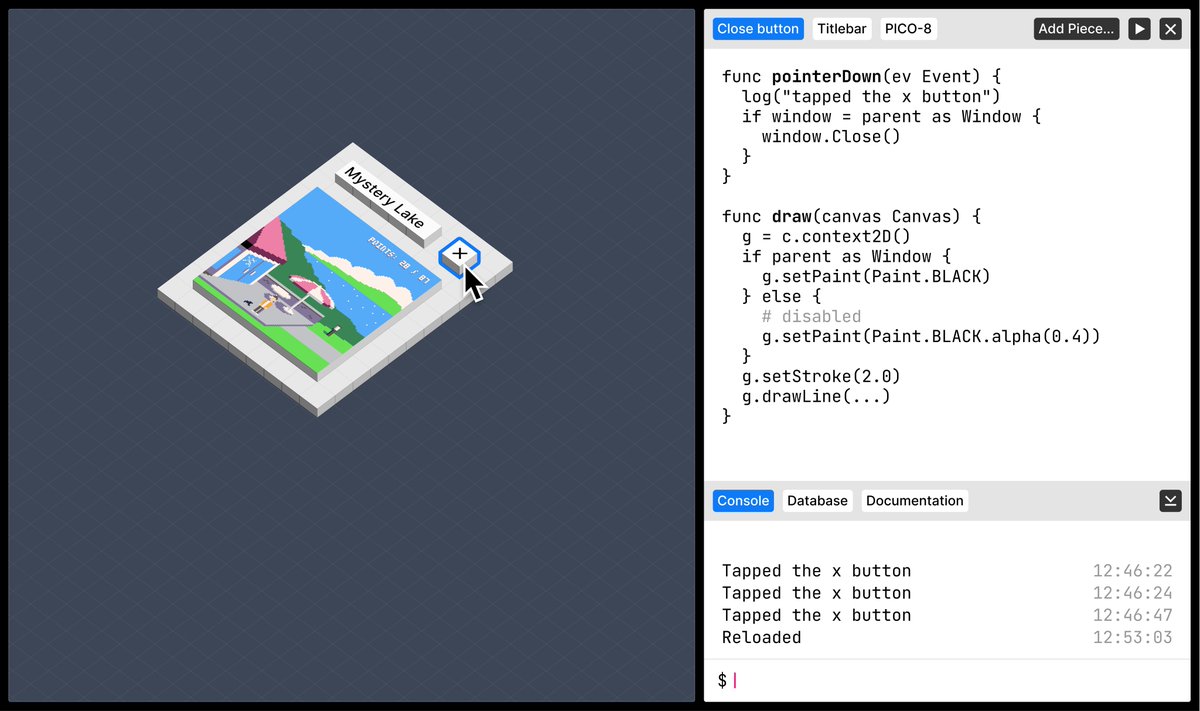
Built a super basic GUI for testing the Playbit CRDT "DOM" implementation (v2 in C) and it immediately helped me find bugs. Playing and experimenting is important not only for getting a feeling for things but also to lower the friction to trying stuff.
Doesn't look like much but celebrating a small win with the Playbit display server: Multiple textures, multiple render pipelines, camera & view transforms, depth stencils, etc. over partitioned WebGPU 🥳