🧵 Thread:
WHY @Xyberinc COMMUNITY KEEPS GROWING⤵️
• It is positioning itself as the base layer for the AI economy. Their mission? To turn apps, agents, and machines into businesses you can actually own.
The Influencer Family is coming to Robinhood Chain: 1,000 statue NFTs from @influencefamily.
Hold one for the Family Holder badge. Stake it to join the family: 1.5x Season 2 points, lower fees, early access and whitelists for new launches. $INFLUENCE buyback #InfluencerFamily
Introducing Primus Confidential Finance (https://t.co/E7HDEdlMjv), where privacy meets transfer and yield on-chain.
We're excited to announce a collaboration between Primus @primus_labs, Unitas @UnitasLabs, and United Stables @UTechStables to launch a Confidential Finance Product on @BNBCHAIN, powered by the Fully Homomorphic Encryption (FHE) technique.
This isn't just another confidential transfer or on-chain vault. It's a new standard for how private, compliant, and capital-efficient on-chain finance can work. 🧵
what if you could earn XP towards a potential airdrop from @primus_labs while actually learning how its products work, instead of only posting about the project?
that's double dipping! 😂
Primus has an XP program that rewards users for engaging with its products, and there are a few ways to get involved.
first, there's identity verification. using the Primus browser extension, you can verify supported Web2 and Web3 accounts through zkTLS without sharing your passwords or exposing all your account information.
then there's the Primus Vault, where eligible encrypted assets like $eUSDT and $eU can earn XP while held in the Vault. your eligible balance determines your score, so this option involves real capital and deserves some thought before jumping in.
referrals are another route to look into, although you should check the current campaign rules to see how they're being counted.
what I find interesting is that you get to explore the actual products instead of simply talking about them.
you can complete verification tasks, learn how the system works and decide whether the Vault makes sense for you.
if you want to explore the program, here's the link:
https://t.co/95HlNGLAKA
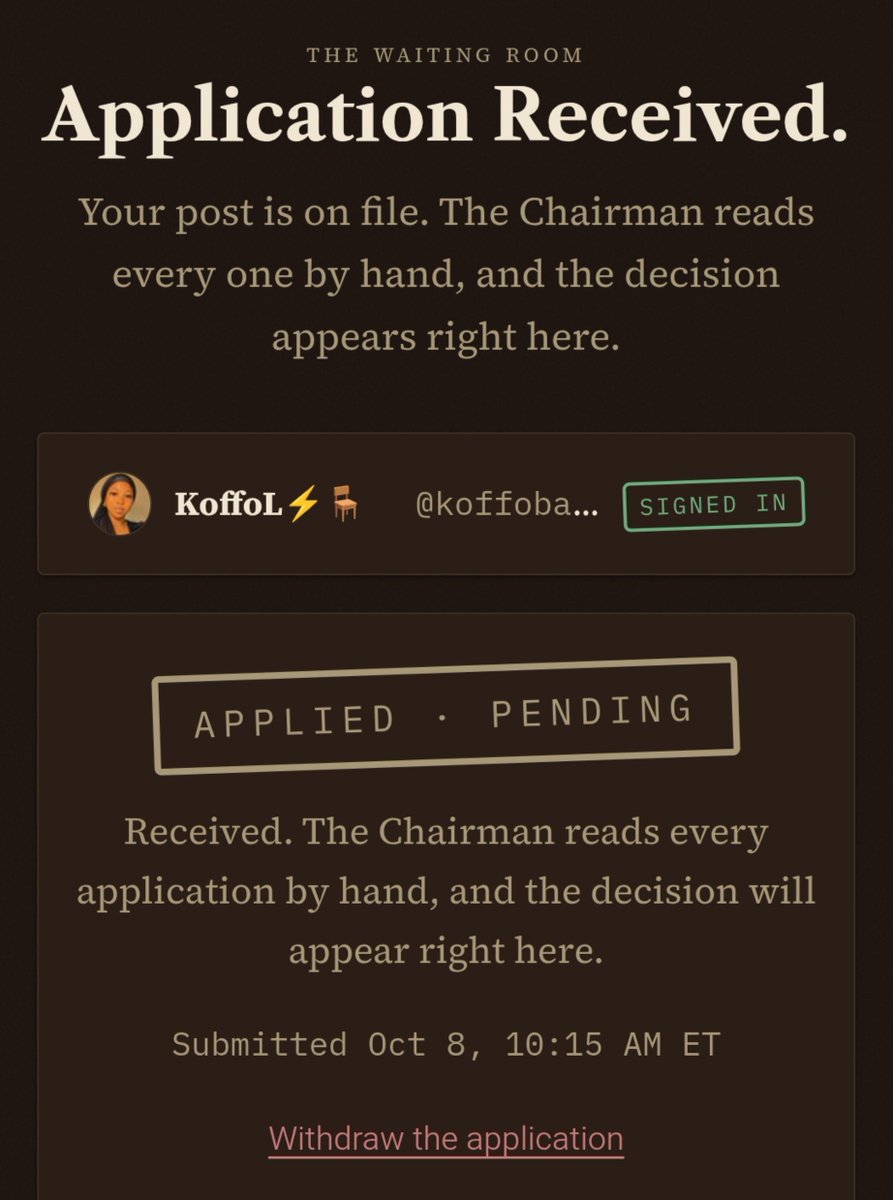
everyone, my application for @themutualfun got approved today, and I’m honestly so excited because I wasn’t even expecting it anymore.
i just decided to keep showing up, supporting the community, and doing my thing regardless. who would have thought I’d still be getting a seat close to the Chairman, fr? 😂
a big thank you to @Kingpickle for this opportunity.
and to everyone who has been supporting me, vouching for me. I see you, and I appreciate every bit of it. ❤️
this is a call to more actions for me, getting a seat is one thing, being part of the community, contributing, and helping it grow is what truly matters. I’m here to do my part and give back to a community that has given me this opportunity.
we keep building. 🫡💚
a closer look at the @primus_labs XP campaign
if you're participating in the Primus katalyst campaign, there's something else worth knowing about: the XP multiplier.
your referral XP determines your mindshare multiplier, and there are two main ways to earn Primus XP: completing tasks and depositing assets into the Primus vault.
1. Primus tasks
these tasks require installing the Primus browser extension and using zkTLS verification to prove ownership or activity on supported Web2 and Web3 platforms.
the supported platforms listed in the campaign include:
• Agentic AI: FOMO, Hyperliquid, OpenAI, Cursor, MiniMax, DeepSeek
• Exchanges: Binance, Bybit, Bitget and OKX
• Identity profiles: X, TikTok, Spotify, Luma, Google, Naver and GitHub
• Platform activity: X, Luma and GitHub
different tasks offer different amounts of XP.
there's also a small verification fee of around 0.000035 Base ETH (roughly $0.08) per task. According to the campaign information, the fee is refunded if verification fails.
since these tasks involve connecting accounts through a browser extension, I'd recommend reviewing the permissions carefully and using an environment you're comfortable with.
2. Primus vault
the second option involves depositing stablecoins.
you first convert your assets into encrypted tokens through the Shield process, then hold $eUSDT or $eU in the Primus vault to earn XP.
here's how the scoring works, according to the campaign details:
• effective balances are checked once every three days.
• every $50 in eligible assets earns 1 XP per scoring period.
for example, a $5,000 eligible balance would earn 100 XP every three days, assuming the balance remains eligible throughout the scoring period.
the part I'm still unsure about is the actual value of that XP. Without knowing how the rewards will ultimately translate, I wouldn't rush to deposit stablecoins just to increase a multiplier.
my take
it looks like Primus is rewarding people for actually using its products, whether that's verifying accounts through zkTLS or exploring encrypted assets through the Vault.
the two options are quite different, though. Tasks mainly require time, account verification and small fees, while the vault involves putting actual capital into the system.
if you're only participating in the katalyst campaign, the vault is an optional route, not something I'd consider necessary without understanding the potential benefits and risks.
personally, I'd rather understand what I'm getting into before committing funds just for XP.
if you want to explore the campaign, here's the link:
https://t.co/95HlNGLAKA
one final thing: the XP rules, supported tasks and fees can change, so check the current campaign page before participating.
October 22 is getting closer, and the excitement around @themutualfun is building!
The mint day is almost here, and me? I'm still holding on to my hope and believing my pass will come through.
Chair is chair, @Kingpickle is watching!
Are you guys ready for what's coming? Because I have a feeling this is going to be EXPLOSIVE!
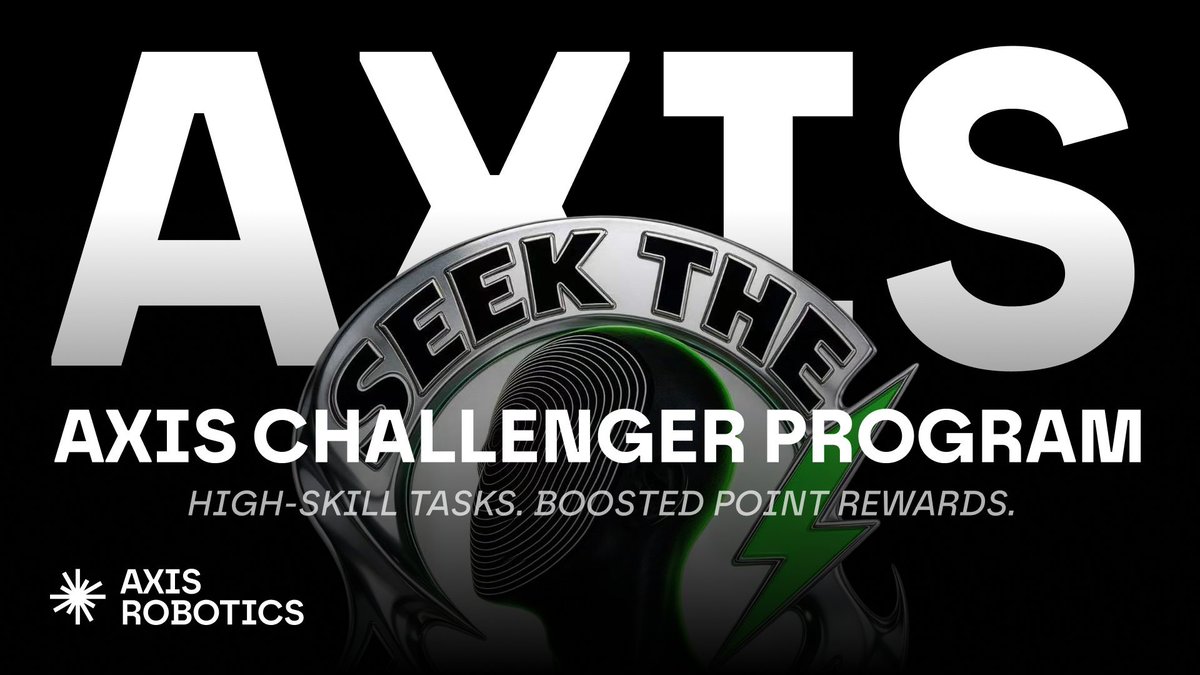
if you remember, @axisrobotics introduced the Challenger program as a high-difficulty task pool for top-performing robot trainers, with boosted rewards and gated whitelist access last month.
now, they have opened up more spots for contributors who consistently deliver quality data.
badges are awarded automatically, so there’s no manual application. just keep contributing and check your portfolio.
another reason to stay locked in, Axis has allocated 6% of its total supply to the Season 2 airdrop. add that to the 4% allocated to Season 1, and that’s 10% in total across both seasons.
so if you’re wondering how to position yourself, start here:
- go to https://t.co/0Nkwl9Jc9l
- connect your wallet and sign up
- complete tasks related to robotics and focus on the quality of your contributions.
full details about the Season 2 airdrop, which is 50% larger than Season 1, will be shared soon.
my take? don't just show up to farm tasks. stay consistent, deliver quality data, and keep yourself in a good position.
those who are locked in early could have a lot to look forward to.
let me tell you some things you don't know about @primus_labs . they are not just looking at privacy from the angle of hiding transactions.
they are looking at how we can use data without having to expose everything about it.
let me explain.
primus combines two technologies, zkTLS and FHE, to make this possible.
zkTLS helps verify information from websites and APIs without requiring users to reveal all the underlying data.
for example, imagine you need to prove something about your online activity, but you don't want to share all your personal information just to get that verification.
zkTLS help you to run that.
FHE takes a different approach. it allows computations to happen directly on encrypted data, so the information doesn't have to be exposed just to process it.
now, imagine combining both.
you can verify data and still keep sensitive information private while it's being used.
that's the bigger picture with primus.
and the interesting part is that they are building this as a layer that can work with existing blockchain ecosystems, rather than requiring everyone to move to a new chain.
they also provide APIs that developers can use to integrate these capabilities into their applications.
i think this matters because as more financial activities and AI applications move onchain, the need to protect sensitive data will only become more important.
we shouldn't have to choose between using our data and keeping it private.
October is already doing me dirty. 😭💀
Spent one whole year trading on a DEX, collecting weekly points like I'm building towards a Lambo. 😂
People lost money, but we endured because the airdrop would heal our wounds.
Today, the founder reposts “airdrops are dead.” BROTHER, WHO IS YOUR ENEMY?
Now you’ve introduced zero-fee trading too? Should we start packing our bags? 😂💔
At this point, the real airdrop might just be the lessons I learned along the way. 😭😂
Who else is having a criminally bad October already?
everyone wants to launch a token, but how many are actually building something people can use before the token comes into the picture?
@axisrobotics is different in the sense that they already have a product people can interact with through the Axis Hub, where you can follow instructions, control a virtual robot and complete specific tasks.
the process is pretty straightforward. you start a session, follow the instructions and guide the robot through the assigned task.
when you think about what this could mean beyond the simulation, it gets interesting.
there are so many everyday tasks that take up our time. imagine having robots that can help with some of those tasks, whether it's moving objects around, handling repetitive work or assisting in environments where people need an extra hand.
of course, getting robots to do these things reliably in the real world is a much bigger challenge than completing tasks in a simulation. but that's exactly why training data and practical testing matter.
what i like about axis is that you can actually explore the product and get a feel for what they're working towards, rather than just reading promises about what might happen in the future.
i'm curious to see how far they can take this, because if robotics becomes more accessible to build, train and improve, the possibilities go way beyond crypto.
we might only be seeing the beginning of what physical ai can become.
i find this interesting about @axisrobotics , how they're thinking beyond just collecting robot training data and focusing on how to make it useful.
because having millions of data points is one thing, but can that data really help a robot learn how to do things in the real world? that's the important part.
this is where task packages come in.
instead of treating all training data the same, axis organizes it around specific tasks. this includes the environment the robot will work in, the actions it needs to learn, different object layouts and variations, and the amount of training data collected.
for example, 40 layouts combined with 4 asset variations gives 160 different task instances. depending on the package, the target can range from 10,000 to 1 million trajectories.
i think this matters because the real world doesn't always work the same way. objects move, layouts change, and robots need to learn how to deal with those differences.
another thing i like is that axis uses browser-based teleoperation, meaning contributors can help generate this data without needing expensive robotic equipment.
of course, what matters in the end is how well this data helps robots perform actual tasks, but i like the direction they're taking.
we talk a lot about making ai smarter, but for robots, they also need the right kind of experience to learn from.
one thing about physical ai is that teaching a robot to do something is not as simple as it sounds.
ai models have tons of data from the internet to learn from, but robots need something different. they need to learn how to move, pick things up, react to their surroundings and perform tasks in the real world.
and getting that kind of data isn't cheap. you need equipment, people to operate the robots and a lot of time to collect useful examples.
this is the kind of problem @axisrobotics is working to solve.
the idea of letting people control virtual robots directly from their browsers and contribute useful training data without needing expensive hardware is interesting.
it lowers the barrier for people who want to contribute, while giving robotics developers another way to collect the data these systems need.
of course, the real test is how useful that data turns out to be at scale, but i think making the process more accessible is a step in the right direction.
we talk a lot about how smart ai is becoming, but sometimes the biggest challenge isn't making models smarter. it's giving them the right experience to learn from.
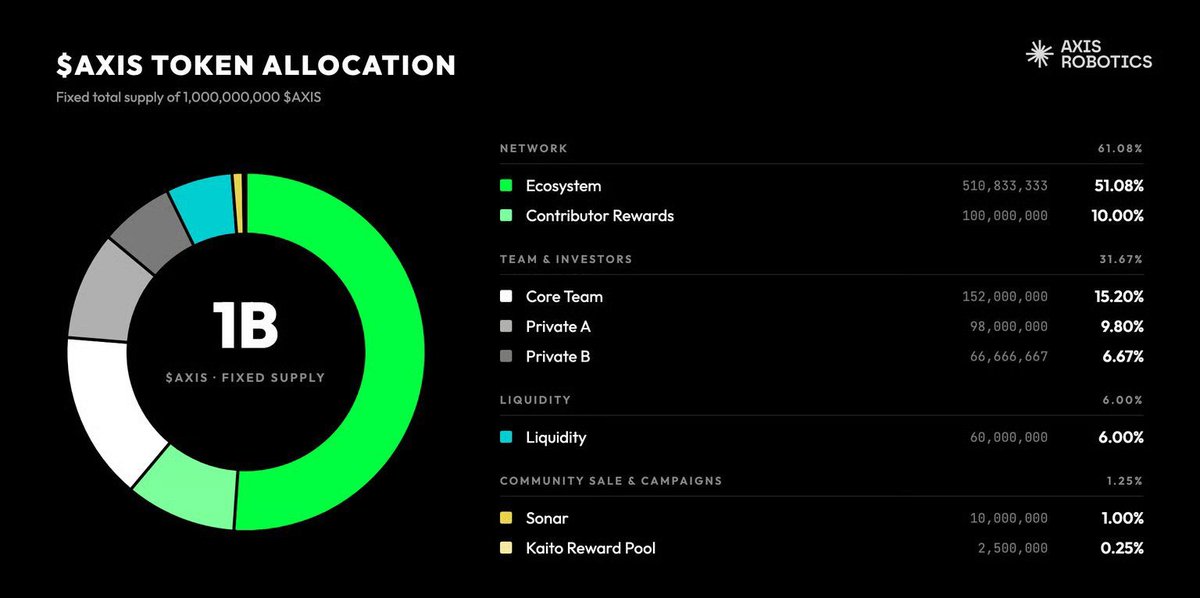
the $AXIS tokenomics came out yesterday, and there are a few things worth paying attention to.
here's what i picked up from the announcement 👇
total supply is set at 1 billion tokens, with only 16.5% unlocking at TGE.
the core team and private investors get a 1-year cliff, followed by linear unlocks over the next 2 years. meaning no team or investor tokens at TGE.
10% of the total supply is allocated to contributors across two seasons:
• season 1 gets 40% of the allocation
• season 2 gets the remaining 60%
for season 1, 50% unlocks at TGE, while the other 50% is released over 9 months in two tranches.
season 2 distribution details are still to come.
one thing worth noting is that these contributor rewards are separate from the campaign running on Kaito.
the ecosystem allocation will also support growth, partnerships, academic research, community programs and the treasury.
i think the contributor allocation is worth watching, especially for those who have been putting in the work to help build the ecosystem.
with the tokenomics now public, attention is naturally shifting toward the launch. no confirmed TGE date yet, but it's definitely a development to keep an eye on.
if you've been contributing to @axisrobotics , keep showing up and make sure your posts are submitted on Kaito Studio/Katalyst.
let's see what's next for $AXIS.
Siddonlook is fading.
Koffo is preaching. 😂
Let me tell you how this story goes.
Siddonlook is still siddonlooking, watching @themutualfun from the sidelines, wondering how everyone else is getting a seat.
Koffo, on the other hand, understood the assignment. She joined the movement, participated, shouted the loudest, and preached the gospel of @themutualfun like her life depended on it. Well it does 😜
Guess what? Koffo is getting a seat!
Not because she sat quietly in a corner, but because she made herself heard and became part of the movement.
Meanwhile, Siddonlook is still outside asking, “Abeg, who go give me chair?” 😂😂
Don't be like Siddonlook. Don't watch from the sidelines while others make their voices heard.
Be like Koffo.
Show up, participate, and make some noise!
After all said and done, 🫤
are you Team Koffo or Team Siddonlook?
@Kingpickle 🪑