Heads up, Trenchers we're tuning the phone experience right now.
Shoutout @appdeployai API support.
Smoother touch controls, cleaner auto-landscape, better performance on the go.
The whole realm, in your pocket. We keep upgrading.
We asked Codex to build an open-world combat flight sim in Three.js where you pilot an AH-64D Apache and blow stuff up with machine guns and lock-on missiles.
Codex: Done. What's next?
Thanks to @threejs for huge 3D model protocols.
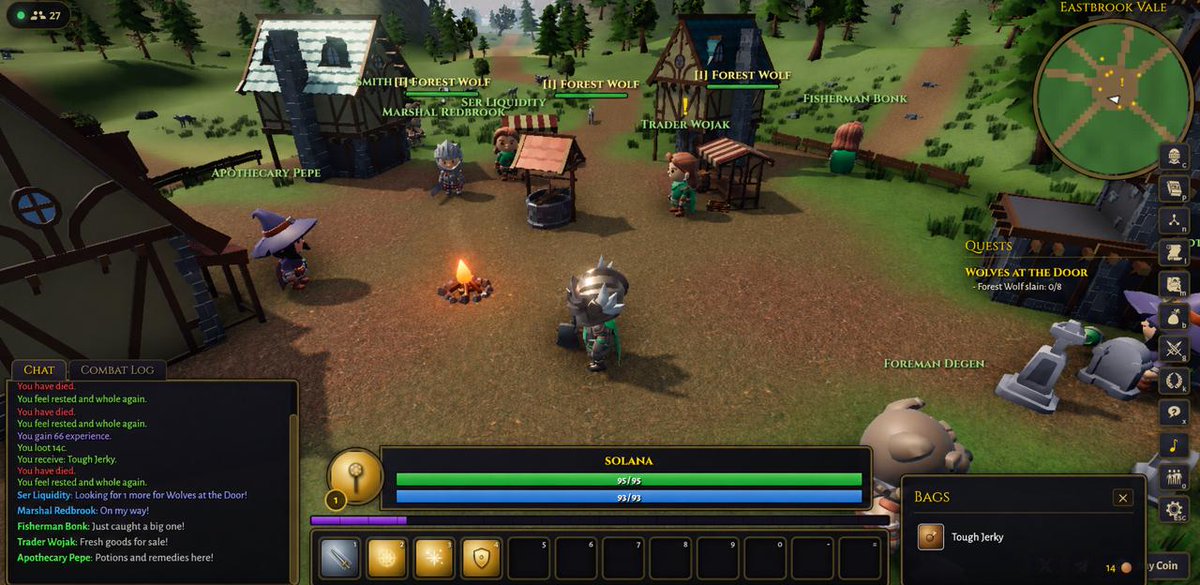
The Trencher II is a browser native dark fantasy MMO where the realm is not saved by kings, but rebuilt by players in real time.
Game overview:
Enter the Vale, walk through the village, meet NPCs, take quests, mine ore, chop wood, fight wolves, and trade your haul with other trenchers.
The core fantasy is simple: a broken frontier economy where every player action matters. Ore feeds crafting. Timber fuels expansion. Combat keeps the roads open. Trade turns survival into value.
A classic MMO loop, rebuilt for web3.
.@threejs
The Trencher 2 is a full MMO built on Three.js (r165), running in a single browser tab. The 3D world is overwhelmingly procedural geometry, textures, and particle VFX generated at runtime and layered over instanced/merged CC0 models, then finished with SSAO and bloom post-processing. Twelve rigged creature families animate through walk/attack/cast/death states, and terrain, water, sky, and foliage are all sampled from the same height functions the simulation uses, so what you see lines up exactly with where you can actually walk. There's no UI framework: the entire classic-style HUD is hand-built on raw DOM and canvas, every spell and item icon is drawn procedurally, and even the music and sound effects are synthesized live with the Web Audio API zero image or audio asset files for the interface.
https://t.co/acn3E1PkSb
The technical spine is a single deterministic simulation core ticking at a fixed 20 Hz. The exact same TypeScript sim runs three ways offline in your browser, on the authoritative Node WebSocket server, and headless as a reinforcement-learning environment and a seeded RNG makes the world byte-identical across all three. Online, clients stream movement and commands at 20 Hz and receive interest-scoped delta snapshots; the server resolves all combat, loot, and economy and persists characters as JSONB in Postgres. Strict TypeScript throughout, ~1,200 automated tests guarding determinism and balance, Vite + esbuild builds and the whole stack (renderer, server, sim) was coded end-to-end with Fable 5.
Items & Leveling :
The Trencher II is built around a labor economy: players grind, gather, level up, and push resources into the market.
Virtual world research has shown that MMO economies can behave like real economies when player labor, scarce goods, currency, and trade create value inside the world. Castronova’s study of Norrath framed online worlds as economic systems with production, wages, and exchange.
That is the thesis here: items are not just loot. They are economic signals. Ore, wood, food, gear, drops, and XP become the foundation for progression, crafting, trading, and guild coordination.
Wallet balances + Solana reads in The Trencher 2 are powered by @helius.
Super-fast RPC = instant SOL balance the moment you connect. No lag, no spinners.
gm @heliuslabs @mert 🙏
https://t.co/xG27p8VAei