Have a look at this 👀
friends of play and playwork . . .
Introducing
Kindred: Fictions and Unfictions
a playworker’s one hundred fictions and unfictions . . . of children, their rights, play
https://t.co/PtlzlY3mxh
‘If play is a preparation for maturity . . . then what are the mature doing when they play? Are they preparing for death? Perhaps they are not preparing for anything.’
— Brian Sutton-Smith, The Ambiguity of Play (2001)
Playworkers:
‘Create a good atmosphere for play . . .
How much of what you do relates to [this aspect] of your role?’
Jacky Kilvington and Ali Wood, Reflective Playwork: for All who Work with Children (2010)
Let’s start over . . .
‘When we are playworking we have to be alert to what is happening, watching, listening and feeling the playing, being there when we are needed, being respectful and careful not to take over something that is not ours.’
— Penny Wilson, Play Works (2024)
A brief taster:
‘blessèd by the love, the play that in its exaltation, fascination, lifts, the children with all they have to give, their curios of ways of being, seeing, comprehending, there go I in fullness . . .’
Have a look at this 👀
friends of play and playwork . . .
Introducing
Kindred: Fictions and Unfictions
a playworker’s one hundred fictions and unfictions . . . of children, their rights, play
https://t.co/PtlzlY3mxh
Imagine other sections of society being treated the way children are reported as being treated here (because of distress or because of age).
https://t.co/RkJaEGDPLs
Children are called KIDS because young goats are called kids. The word—which dates back to the 1100s—originally only referred to goats, before it began to be jokingly applied to children in 16th century slang. It’s been in widespread use in that sense since the mid 1800s.
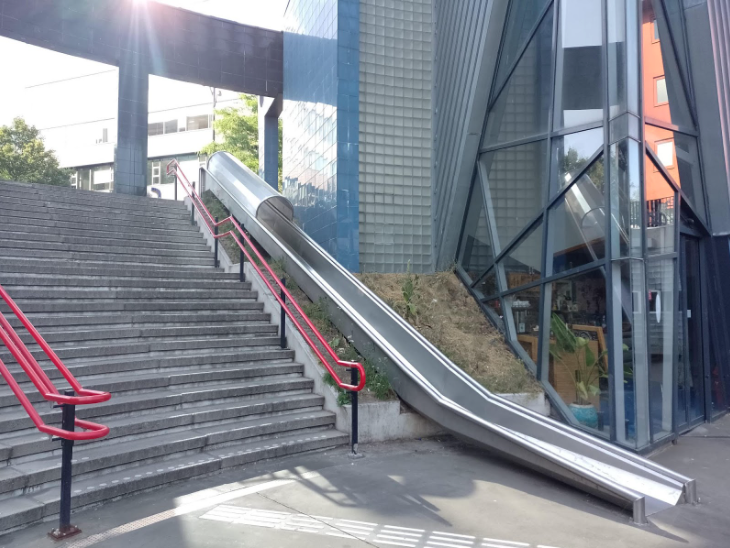
The Overvecht train station in Utrecht has a ‘transfer accelerator’ to speed passage through the station - also known as an adult-sized slide. ( 📷:@theorangeone)
1558: ‘Now for yow childer, both boys and wenches . . . it is for yow most necessary to kepe the innocency of your childhod, and other vertues proper unto that tendre age, and not to learn the vices and evill qualities of your elders.’
‘If Tudor children seem familiar it’s partly because of the way we have continued to treat them in the thirty generations since.’
@tomlukejohnson on the history of childhood, which might be read as a ‘record of spirited resistance’:
https://t.co/QSn0gJZAOE
As well as being irregular, etymologically the word CHILDREN is a double plural. In early Old English, the plural of CHILD was identical with the singular, ‘cild’, but an alternative form ‘cildru’ emerged later, that in Middle English was itself repluralized to make CHILDREN.
‘The universe doesn't have some destination that it ought to arrive at. You play the piano, you don't work the piano. One doesn't make the end of a composition the point of the composition. The whole point of dancing is the dance.’
- Alan Watts
The point of play is playing.
Inspired by David Suzuki:
The way we see children shapes the way we treat them. If a child is as deity (not as if a pile of ore), is sacred (not as if timber), is biological kin (not resources), is as an elder (not an opportunity), then we will treat them with greater respect.
Some disturbing piano-related scenes in Kakogawa, Japan where, reportedly, ‘officials were disappointed by apparent rule-breaking, such as people playing for too long or singing.’
😱
https://t.co/FBh3JJhllw