Vosotros sois muy jóvenes, pero el sudapollismo lo invento un señor que tenía un programa de cine que se emitía de madrugada y que según él sólo podía ser visto por un puñado de politoxicómanos insomnes.
Una leyenda.
Què coneixem, de l'univers?
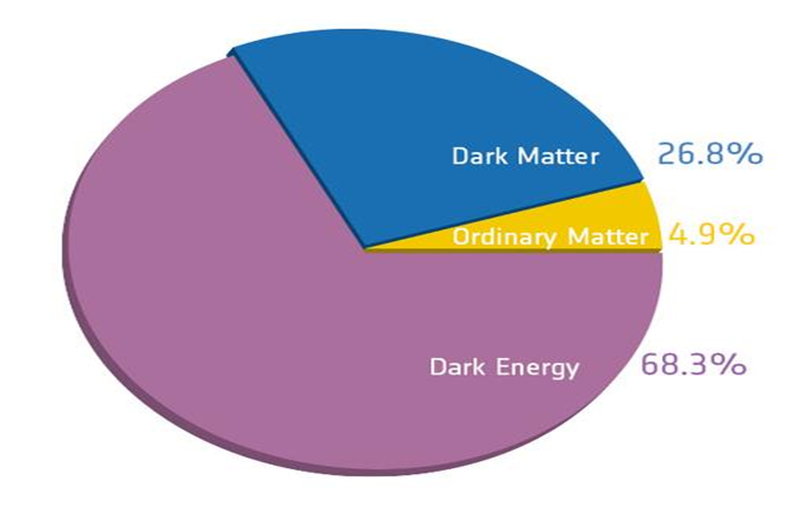
De moment, tan sols podem aspirar a contemplar i entendre menys del 5% del seu contingut: la matèria ordinària, tot allò fet per àtoms (estels, galàxies, planetes, arbres o persones).
Prop del 27% és matèria fosca, una enigmàtica substància que encara no sabem de què està feta.
I un 68% és l'energia que fa que el cosmos s'expandeixi acceleradament i que tampoc no sabem què és.
The human eye contains no mechanism for detecting color. Photoreceptor cells detect electromagnetic wavelengths and
convert them into electrical signals. The visual cortex then constructs the experience of color from those colorless frequency inputs. Every color perceived
by any human being in history was built inside the brain. The external world contains no color. Only wavelength.
Hubel, D.H. & Wiesel, T.N. Nobel
Prize in Physiology or Medicine. 1981.
😮Quina paradoxa!
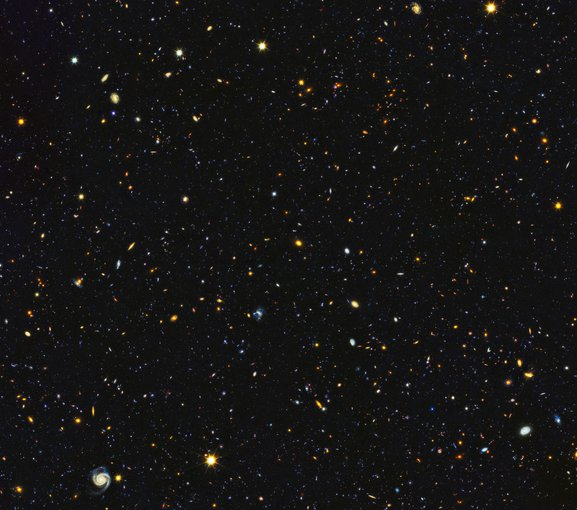
🔭En aquesta imatge del telescopi Hubble apareixen més de 15.000 galàxies, cadascuna amb centenars de milers de milions d'estels i de planetes. Però tot i això, aquestes fotografies retraten l'extrema BUIDOR de l'univers.
Fem l'exercici següent: fixem-nos en un dels petits punts que hi apareixen. Com dèiem, és una galàxia, potser amb un bilió de planetes.
* Primera reflexió: com de lluny ha d'estar perquè, sent tan grossa, aparegui tan petita a la foto?
* I segona reflexió: què hi ha entre nosaltres i aquesta galàxia? Res, perquè si hi hagués quelcom ens la taparia.
Per tant, no són els punts de llum, les galàxies, els protagonistes del retrat, sinó els immensos espais buits.
😵Vaig calcular-ho: per simular la densitat de matèria que hi ha a l'univers (incloent matèria ordinària i l'enigmàtica matèria fosca) hauríem d'agafar la novena part d'un granet d'arròs, esmicolar-la i distribuir el polsim dins d'una esfera buida de la mida de la Terra!
En altres paraules, si poguéssim contemplar tot l'univers en la nostra mà i ens preguntessin què hi ha, respondríem que RES, i seria la resposta científicament més precisa de la història.
🙋I aquí som, en un racó d'un cosmos buit i omplint de vida un petit planeta.
«En efecto. Aunque tecnológicamente nuestras sociedades modernas son completamente diferentes de los reinos medievales, no hemos avanzado mucho en la organización política. A pesar de ser ostensiblemente una sociedad democrática, la UE está gobernada por una pequeña élite no muy diferente de la que gobernaba el Sacro Imperio Romano. Recordemos que el Emperador era un cargo electivo. Pero, al igual que los señores medievales, que se preocupaban poco por los campesinos, las élites políticas europeas muestran un desprecio similar hacia la gente común. El rango se traduce en privilegio, hoy igual que en el siglo XIII.»
-Peter Turchin
En este post Peter Turchin, que estudia dinámicas históricas de élites y sociedades (cliodinámica), critica la hipocresía y el feudalismo moderno de las élites europeas con el ejemplo del aire acondicionado en la sede de la Comisión Europea. Mientras predican austeridad climática y sacrificios para la población, ellos mismos se dan privilegios.
https://t.co/VDJw3KstBB
Pouca gente sabe, mas os cavalos de tração que competem na Eslováquia são verdadeiros monstros de força. Um único animal pode passar dos 1.100 kg de puro músculo e, na força bruta, arrastar mais de 4 toneladas de toras na lama. Uma demonstração surreal de potência da natureza.
“We've arranged a society based on science and technology, in which nobody understands anything about science and technology. And this combustible mixture of ignorance and power, sooner or later, is going to blow up in our faces.”
— Carl Sagan
El meteorólogo estadounidense Chris Martz (@ChrisMartzWX) explica por qué hace tanto calor esta semana en Europa y no, no se debe al cambio climático (aunque el cambio climático sea un hecho –pero no una crisis).
Europa es el continente que más ha reducido sus emisiones de CO2 (junto con otros países ricos de la OCDE), con un coste enorme para sus contribuyentes, inmolándose económica e industrialmente frente a la mitad del mundo (especialmente frente a China), sin obtener ningún resultado ni sobre el clima ni sobre el tiempo ni sobre las olas de calor.
De acuerdo con Martz, el bloqueo omega Ω es la verdadera explicación meteorológica detrás de las temperaturas extremas que actualmente se miden en gran parte del continente europeo. Mientras que los grandes medios vinculan el calor al cambio climático y los gases de efecto invernadero, los científicos críticos señalan una explicación mucho más sobria y mejor fundamentada: un patrón meteorológico persistente en la alta atmósfera que ya ha ocurrido en Europa en varias ocasiones.
Un bloqueo omega es un patrón de la corriente en chorro — el potente flujo de viento a gran altura que en gran medida condiciona el tiempo en nuestras latitudes. El nombre proviene de la similitud de la forma que adopta la corriente en chorro con la letra griega omega (Ω): una gran cresta de alta presión en el centro, flanqueada por dos áreas de baja presión a ambos lados. Este patrón hace que las masas de aire cálido apenas puedan fluir y que la situación meteorológica pueda mantenerse durante días e incluso semanas.
En el caso de la actual ola de calor, el aire caliente del Sáhara es transportado hacia el norte en dirección a Europa por el aire anticiclónico (que gira en el sentido de las agujas del reloj). Mientras esa masa de aire sube y baja, se comprime adiabáticamente (sin intercambio de calor) — un proceso puramente físico que hace que la temperatura aumente aún más. Sin ninguna influencia del CO2.
Chris Martz ha compartido su análisis de manera extensa a través de las redes sociales. Su conclusión es clara: este bloqueo omega no tiene nada que ver con el cambio climático o las emisiones de gases de efecto invernadero. Es una dinámica meteorológica conocida, bien documentada, que siempre ha ocurrido y que muy probablemente también habría llevado a alcanzar récords de calor en otras épocas preindustriales.
Martz además señala una paradoja científica notable. Existen diversos estudios que sugieren que el calentamiento del Ártico en realidad conlleva bloqueos omega menos frecuentes, porque la diferencia de temperatura entre el ecuador y las regiones polares se reduce. Eso contradice directamente la afirmación de que el cambio climático causa o intensifica este tipo de olas de calor. Martz reconoce que hay debate sobre este tema, pero el mensaje que los medios transmiten es demasiado simplista.
Luego está el aumento de la radiación solar debido a que hay menos nubosidad en las capas de nubes bajas y medias. Esa disminución de la nubosidad está parcialmente relacionada con las estrictas regulaciones europeas contra la polución del aire, que han llevado a que haya menos partículas y aerosoles en la atmósfera. Menos partículas en el aire, menos polvo y contaminación, significa menos formación de nubes, más luz solar directa y, por lo tanto, temperaturas superficiales más altas. En otras palabras: la propia regulación ambiental europea de cielos más límpidos contribuye en parte al aumento del calor. Esa es una conclusión incómoda que rara vez encontraremos en los medios.
Los medios de comunicación eligen siempre el sensacionalismo por encima de la sutileza científica.
En cuanto hace calor, los medios buscan el clickbait y establecen el vínculo con el cambio climático, casi sin matices, raramente con fundamentos meteorológicos y sin la más mínima referencia a posibles explicaciones alternativas. Eso no es periodismo — eso es activismo político disfrazado de ciencia.
CLINTEL (Climate Intelligence), con más de 2.000 científicos climáticos asociados, representada en Europa por el periodista científico Marcel Crok (@marcelcrok), respalda el análisis de Martz.
Scientists have created one of the most detailed 3D reconstructions of a human cell (eukaryotic cell) ever produced.
This groundbreaking model, often termed a "Cellular Landscape Cross-Section Through a Eukaryotic Cell," combines data from X-ray tomography, nuclear magnetic resonance (NMR), and cryo-electron microscopy to map molecular structures in extreme detail.
"En España (...) Amazon Web Services ha instalado tres centros de datos en la provincia de Huesca. Estas instalaciones demandan tanta electricidad como una ciudad de 50.000 habitantes y consumen millones de litros de agua para refrigeración, en una de las regiones más castigadas por la sequía". (...) los agricultores ven cómo se restringe el riego para garantizar el suministro eléctrico a los servidores". Para meditar. https://t.co/gIM0DvWSwP
Mirror to Heaven.
Rome’s Hidden Miracle
The ceiling of Sant’Ignazio di Loyola isn’t curved…
It’s completely flat. Andrea Pozzo’s 17th-century trompe-l’œil masterpiece tricks your eyes into seeing infinity.
Pure magic.
A Stanford neuroscientist published a paper a few years ago that quietly answered one of the oldest questions in human history, and almost nobody outside his field has heard of it.
The question is why we dream. Not what dreams mean. Why they exist at all. Why your brain spends a third of its sleep hallucinating images instead of just resting like every other organ in your body.
His name is David Eagleman.
He runs a lab at Stanford. The paper is called "The Defensive Activation Theory", and the moment you read it the explanation collapses every other theory you have ever been taught about dreams.
Freud said dreams were repressed desires. He was guessing. He had no brain scans. He had no electrodes. He had a couch and a notebook and a century of credibility that nobody has been able to fully scrub off the subject since.
Modern neuroscience replaced him with the memory "consolidation theory". The idea that dreams are your brain sorting through the day, filing things away, deciding what to keep. That story is partially true. Sleep does consolidate memory. But it does not explain the single strangest thing about dreams, which is that they are almost entirely visual.
You do not dream in pure sound. You do not dream in taste. You do not dream in smell. You dream in pictures. Vivid, detailed, often impossible pictures that activate the back of your brain so hard a scientist scanning you would think your eyes were wide open.
Eagleman started from one fact almost nobody outside neuroscience knows. The brain is territorial. Every region holds its turf through constant electrical activity. The moment a region goes quiet, its neighbors start invading. They take the silent territory and reassign it to themselves.
This is called "cortical takeover", and it is not slow. It is not a long process measured in years. In experiments where adults are blindfolded, the visual cortex starts processing touch and sound within an hour. One hour of darkness, and the territory is already being annexed.
In congenitally blind people, the visual cortex is fully repurposed. It runs language. It runs hearing. It runs touch. The hardware never went unused. It was just reassigned to whoever showed up first.
Now sit with the implication of that for a second.
Every night, when you close your eyes and fall asleep, the sun has set. The planet has rotated. The visual cortex, which takes up roughly a third of your entire cortex, is suddenly receiving zero input. For eight hours. Every single night. For your entire life. And evolution has shaped your brain inside a planet that has been spinning into darkness for billions of years.
If cortical takeover happens in an hour, the visual cortex should have been lost a long time ago. Stolen by hearing. Stolen by touch. Reassigned by morning. Humans should have evolved into a species whose vision works fine during the day and then degrades every time the sun goes down because the territory keeps getting renegotiated overnight.
But that did not happen. Vision works the moment you open your eyes. Which means something is defending the territory while you sleep.
Eagleman's claim is that dreams are that defense.
Every 90 minutes through the night, a precise burst of activity fires from the brainstem into the visual cortex. Pontine-geniculate-occipital waves. PGO for short. They are anatomically aimed. They are not general arousal.
They are a targeted volley of signal launched directly at the back of the brain where vision lives. The cortex lights up as if it is receiving real images, and you experience that artificial activation as a dream. The bizarre narrative your conscious mind invents around it later is just your brain trying to make sense of the noise.
The dream is not the point. The dream is the side effect. The point is keeping the territory occupied.
The evidence for this is the part that should haunt you.
Newborns spend roughly 50% of their sleep in REM. Adults spend twenty. Old adults spend fifteen. The amount of dreaming you do tracks almost perfectly with how plastic your brain is. Newborns have the most plastic brains on earth. Their visual cortex is in the highest danger of being overrun by neighboring senses while it develops.
So evolution gave them an enormous defense budget. As you age, your brain becomes less plastic, the takeover risk drops, and the defense system scales down accordingly.
Eagleman and his co-author ran the same correlation across twenty-five primate species. The more plastic a species' brain, the higher the proportion of REM sleep. The relationship held across the entire primate family tree. Plasticity and dreaming move together. They are two halves of the same evolutionary equation.
A species that ranks higher on flexibility and learning also dreams more. A species that is born ready to walk and survive dreams less. Plasticity is the asset. Dreaming is the insurance premium.
And the prediction the theory makes is the one that quietly closes the case.
Of all your senses, only one is disadvantaged by darkness. You can still hear in the dark. You can still feel in the dark. You can still smelll and taste in the dark. The only sense that depends on light is vision. Which is exactly the sense your dreams are made of. The defense system is targeted at the only territory that is actually vulnerable while you sleep.
Memory consolidation is real. Emotional processing is real. Your brain does do those things at night. But Eagleman's argument is that those functions piggyback on a much older system whose original job was simpler and more brutal. Keep the lights on inside the visual cortex while the planet is dark, or lose it.
For thousands of years, people have asked what dreams mean. Prophets wrote about them. Poets wrote about them. Freud built a discipline on them. None of them had access to the actual answer, which is that dreams may not mean anything in the symbolic sense at all.
They may be the visible flicker of a defense system running in the background, the way a screen saver protects a monitor by keeping the pixels moving even when nobody is looking.
The strangest thing about the theory is how cleanly it explains why dreams feel so real. Your visual cortex cannot tell the difference between a PGO wave and an actual photon. It is the same hardware lighting up the same way. The cortex does its job. It builds an image. Your conscious mind, half-awake, wraps a story around it and calls it a dream.
You are not seeing your subconscious tonight. You are watching your brain defend a piece of itself from being stolen.
Every animal that has ever closed its eyes on this planet has done the same thing.
En català no podem riure jajaja perquè la jota catalana no té so de riure.
jaqueta
jersei
jurídic
joguina
En canvi, la lletra hac catalana sí que té so de riure en interjeccions, com ahà o ehem. Per aquest motiu, en català riem hahaha, hehehe, hihihi.
I com riuen en altres llengües??
🔹En portuguès expressen el riure amb la lletra k, la qual es pronuncia kja, i l'escriuen kkkkkk. També fan servir rsrsrs, abreviatura de 'risos' (riures), i la lletra h en la forma huehuehue.
🔹En coreà també fan servir la k pel seu so similar al riure, tot i que més discret que en portuguès.
🔹En francès utilitzen la lletra h, per tant, escriuen hahaha. També ens hi podem trobar mdr, acrònim de 'mort de rire' (mort de riure).
🔹En italià, en canvi, se escriu ahahaha.
🔹En tailandès s'estimen més el número 5 perquè el seu so és el més similar al riure. Amb això podem dir que 555555555555555555 és un tip de riure.
🔹En àrab fan servir la lletra h, però sola: hhhhh. El motiu d'això també té a veure amb el seu so rialler.
🔹En grec la lletra que té so de riure és la x. Les seves rialles escrites són xaxaxa.
🔹En hebreu també fan servir la x.
🔹En danès, finès, suec i romanès es riuen hahaha.
🔹En anglès també hahaha, a més de LOL, acrònim de 'laughing out loud' (petar-se de riure).
🔹En la llengua urdú els homes riuen hahaha i les dones hehehe.
🔹En japonès usen la lletra w, perquè riure és diu 'warai'.
Font:
https://t.co/QpVk7yN8kx