Not bad for a simple model. Hope to expand on this, including comparing with predictions based on last-available *polling* (as opposed to *actual* results), later in the week.
How effective is a regionally-weighted swing model (of the kind used in our app at https://t.co/v73q626wJG) at predicting election results? Here are the preliminary findings based on this week’s election.
On a regional basis, the model correctly predicted ridings as follows:
Atlantic 25/32 (78%)
Quebec 66/78 (85%)
Ontario 111/121 (92%)
Prairies 25/28 (89%)
Alberta 34/34 (100%)
British C. 38/42 (90%)
Territories 2/3 (67%)
How blue is Alberta? Very! This election result is in no way historically special. Interactively explore regional party support in elections since 1968 with our new visualization: https://t.co/PprM0PLa9u #cdnpoli#elxn43
For anyone who wants to work with the preliminary results from last night’s election released by @ElectionsCan_E, the long format can be a little annoying. I put them into wide CSV format: https://t.co/urep0qNVD0 May have errors: caveat downloader. #cdnpoli#elxn43
(The reason for this is that the regionally-weighted swing model distributes that shift most heavily in areas the Conservatives were already strong in, i.e. AB / SK.)
One interesting finding: a swing model (using regional weights from last night) suggests that the Liberal vote was so efficient that even had the Conservatives won 36.5% of the vote *exclusively at the expense of the Liberals*…
…(i.e. Liberals at 31.0%), they would only have had ~50% chance of winning a minority. Again, this is assuming a regionally-weighted swing, usual disclaimers apply, etc, etc. But still.
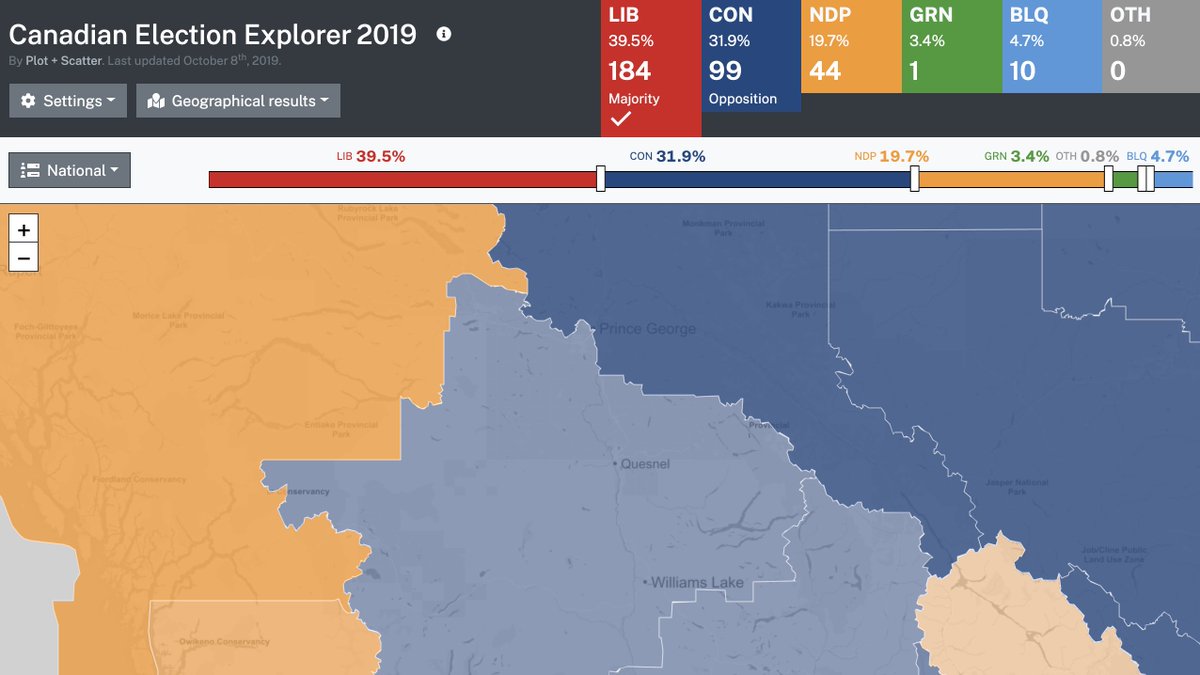
New version of the Canadian Election Explorer deployed, now with preliminary Elections Canada results from last night: https://t.co/BovVnEYtkG #cdnpoli#elxn43
For posterity: our simple regionally-weighted election app (https://t.co/BovVnFg4Jg), using CBC Poll Tracker regional values, gives L144 • C119 • N42 • BLQ 31 • G2. Only a few hours till we know for sure…
A three-party coalition would seem even more unstable than a two-party one. If (and it’s a big “if”!) the actual results on Monday follow the polls as they are now, a return trip to the ballot box in the near future seems likely. #cdnpoli#elxn43
Lots of talk of minority governments lately! The Insights view, newly added to our tool (https://t.co/BovVnEYtkG), simulates elections and shows statistically likely outcomes. A large variety of possible minority coalitions, given current polling numbers. #cdnpoli#elxn43
At least with these figures, the number of available two-party coalitions is relatively low, reflecting just how fractured public opinion appears to be. CON + NDP seems statistically likely, but is perhaps politically less so. LIB + NDP only works ~56% of the time.