I’ve been looking deeper into @Zcash lately.
$ZEC right now feels less like a random price move and more like years of infrastructure work finally getting recognized.
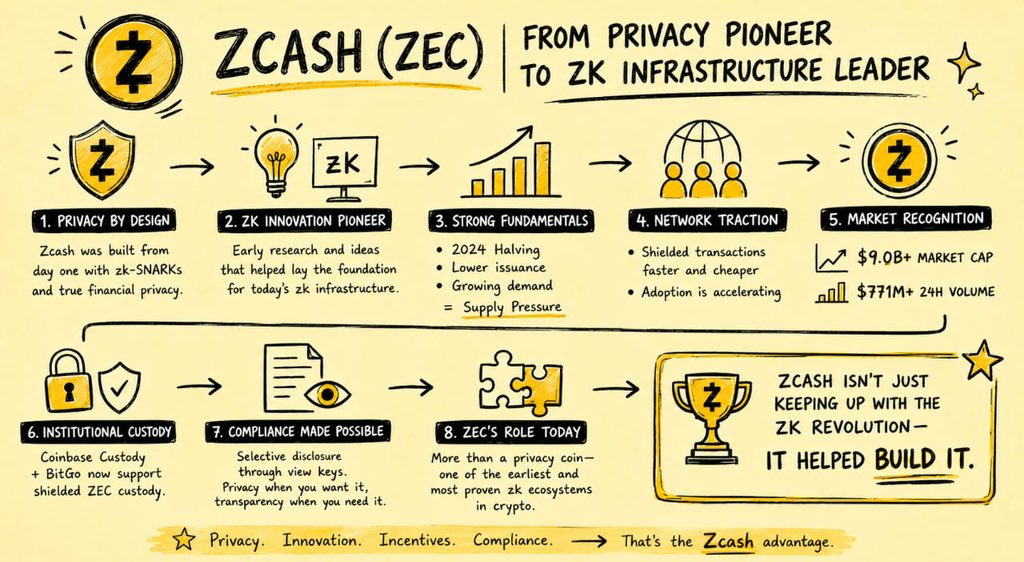
The part I find most interesting is how Zcash went from being labeled “just a privacy coin” to becoming part of the broader zk conversation.
A lot of the zk infrastructure dominating today’s market was built on ideas and research Zcash helped push early.
Now you’re seeing that shift reflect everywhere:
• ZEC crossed a $9.0B market cap
• $771M+ traded in 24h
• Shielded transactions became significantly faster and cheaper
• @coinbase Custody + @BitGo now support shielded ZEC custody
• Some exchanges are becoming more open to ZEC again because of its selective disclosure model through view keys
That compliance angle is probably the most misunderstood part of Zcash.
Zcash took a different route by allowing optional disclosure when needed.
In this environment, that design decision is starting to make more sense.
Another thing I noticed is that institutions seem to be looking at Zcash differently now.
Not just as a privacy asset, but as one of the earliest projects that helped bring zk cryptography into real-world crypto infrastructure.
When you see @ethereum L2s scaling with zk tech everywhere, it kind of changes how you look at Zcash’s role in the space.
And after the 2024 halving, supply pressure also changed a lot.
At current levels, daily issuance looks relatively small compared to the amount of volume flowing through ZEC now.
Zcash is migrating from speculation → infrastructure relevance.
That’s the part I’m paying attention to.