Digital health infrastructure for hospitals, diagnostics, governments & public health systems. MediXcel • BHAIRAV AI • 110M+ patient lives • 26 nations
ChatGPT Prompt for Hospital Admins: "I run a 200-bed hospital. Create a 90-day roadmap for implementing AI triage in my ER. Include budget estimates, staff training phases, and success metrics." @amey6991@nrip#HealthAI#AIAcademyAtPlus91#ChatGPT
The achievements and progress of Tripura’s Digital Health Initiative were highlighted by our respected Secretary, Health & Family Welfare, and SMD, ABDM Tripura, at the National Review Meeting of AB-PMJAY & ABDM (5–6 November 2026), Kolkata, West Bengal.
read this by @sharran
this morning "You are not allowed to say something's difficult until you've done it a 100 times. It's . . not hard. You are just a beginner."
love it... Go do it a 100 times...get MORE reps
.
Excellent update from @LucidDiag - peer-reviewed publication of the largest real-world study of nonendoscopic esophageal precancer testing to date, published in the journal Diagnostics MDPI @diagnostic_mdpi
https://t.co/Xzu5E9ubam
Follow Plus91's channel on Youtube. On this channel, we share product demos, digital health insights, clinical AI use cases, healthcare interoperability, public health transformation, customer stories, webinars, and practical AI education. #hcsm
https://t.co/6BDgQj1DBx
are you following @plus91 on youtube ? access a ton of webinars, trainings, adoption tactics and how to's ...all.about HealthTech from the most trusted brand in digital health https://t.co/sPa2sNbD1C
🏥 The Secretary, Health & Family Welfare, Govt. of Tripura, urges citizens to embrace digital healthcare by using digital health services for registration, admission, discharge & diagnostic tests.
🎯 Towards better, faster & citizen-centric healthcare!
Tripura Accelerates Digital Healthcare!
Secretary, Health & FW, GoT, chaired an IHMIS review meeting with all DMs & CMOs, focusing on ABHA-linked health records.
From 10 Nov 2026, all health facilities must adopt online registration, ePrescription, ADT, LIS, RIS & billing.
“Why Should You Link Your Health Records with ABHA? 📱🏥”
Key message: ABHA-linked health records can make medical information easier to access and share with consent, helping support more connected healthcare.
BREAKING NEWS!
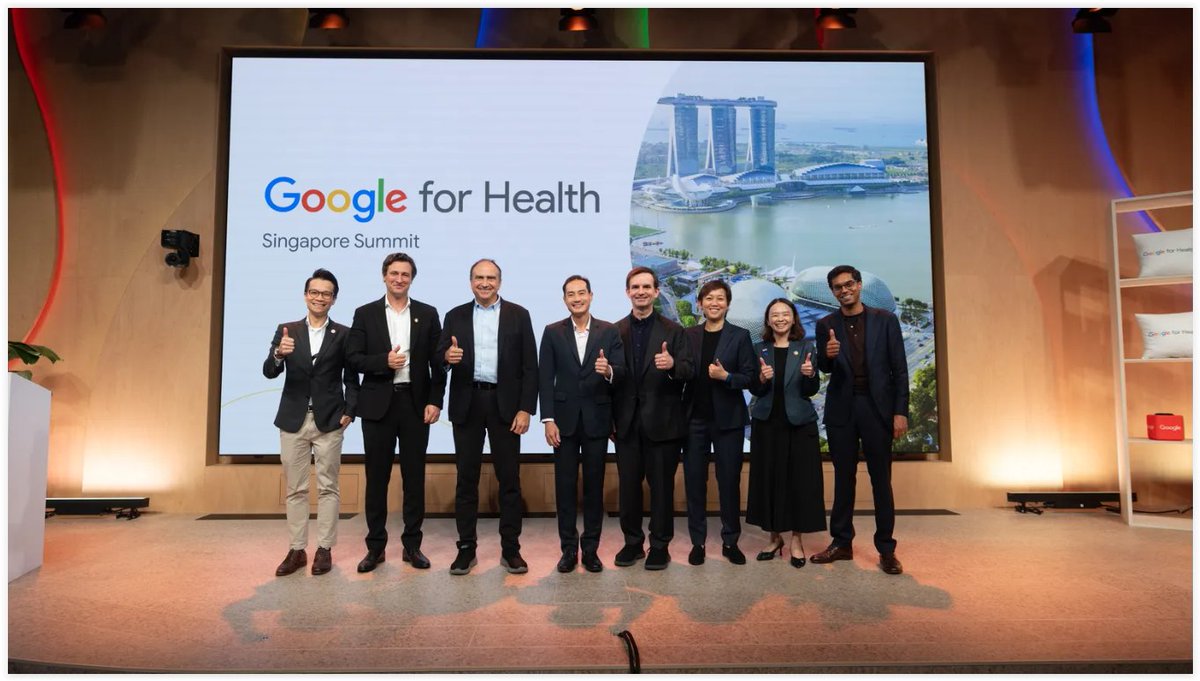
Google just announced to deepen its partnership with Singapore to deploy frontier AI across the nation’s healthcare system!
Given a tech company with a lot of tools and research in healthcare AI, and a developed nation that realized that it simply cannot keep on providing care at a given level of quality without the massive use of AI.
Here is Google's announcement:
"We’re establishing a Google Research hub in Singapore composed of local research scientists and software engineers. The group will focus on driving advancements in foundational AI models to accelerate scientific breakthroughs. It will also partner with academic institutions, such as the National University of Singapore and Nanyang Technological University, to help nurture future scientific leaders and provide targeted research support.
Google Research will also scale its existing health research initiatives in Singapore. This includes bringing open models like MedGemma to frontline care settings to enable the development of secure, customized solutions while maintaining full data sovereignty."
Kudos to the leaders of Singapore for this bold step!
Source: https://t.co/45Wcejr3PE
Friendly reminder: Win bigger so you can give bigger. You can’t give to someone else if you have nothing to give. Success is one of the highest forms of generosity.
Health secretary calls for visible improvements in cleanliness at public healthcare facilities.
Read more at:
https://t.co/UpFN8kfTK4
about time, dont you think
What about humans-in-the loop with medical AI?
Our @AnnalsofIM paper just published
@pranavrajpurkar, Christine Zhou, Alexandra Willauer
https://t.co/n1gOaQld1R
There’s a really pronounced divide between people who are on the AI side of things and people who are on the biology side of things. Even among people working in AI, the divide persists based on where they’re focused.
The AI side, adherents of scaling laws and the bitter lesson, believe that AI getting better means AI being more capable of novel discoveries in medicine (that go beyond discovering new drugs in well understood targets or speeding up dry lab work etc).
The biology people think the idea of a bitter lesson in biology is kind of ridiculous and that regardless of AI’s capabilities it’s going to be at least 5-10 years until you could hope to reliably simulate human toxicology in silico (right now AI/ML can’t even reliably simulate in vivo studies like binding affinities or functional assays).
Even the most AI pilled of them, who will list all the areas that AI can reduce the time spent on various areas, don’t think the concept of AI discovering novel targets or generating new understanding of causal biology is realistic in the near term. Most, in fact, will readily characterize the assumption that even an “ASI” level model could find cures hidden in our current understanding (without expanding that understanding with significantly more biological data) as patently false.
This was a big part of why we wanted to experience it ourselves by using AI for a (very) small portion of what it can do in biology. It was both mind blowing and revealed some poignant insights into how different the problem of making AI better at something like coding is to the problems of biology.
Even if it unlocked the ability to generate new molecules at a stunning pace, its simulation (in silico) of binding only had 49% accuracy. And if we wanted to improve that, we’d need to feed it back the data from the lab - data that took about 30x as long to get as it took to generate the molecules. And these were tests in a test tube (turn of phrase), imagine how long it would take if we wanted to improve the model with data that required recruiting humans and monitoring their reactions.
Human biology is very complex, and adding a drug - especially a novel drug and doubly so for a novel drug acting on a novel mechanism - means mapping interactions that have nth-order-effects that we don’t have the data to predict. Virtual cells have made advancements enabled by AI, but the perturbations equate to a small fraction of the possible.
This is before you even get into curing disease, especially uniquely human diseases. Brain function involves cellular identities that are unique to humans, meaning animal studies are of little use.
How long does it take to understand what the side effects of chronic administration of a drug in humans are? AI can speed up analyzing the data, or designing the trial or even getting it approved…but it can’t make a 6 month trial complete in 3 months.
I think its important to point out that significant advancements can be made in AI that contribute to biology, while also being realistic about how much it speeds up something as complex as curing a specific cancer or diseases of the brain.