📈 Clocking in daily while building a way out
💰 Sharing trades ideas & lessons and my own journey
🎯 9-5 → Financial freedom, one trade at a time
| NFA | DYOR
I’m writing a full piece about my insights from Nebius Inflection, but one topic I found particularly interesting was disaggregated inference.
$NBIS is already planning for it as a way to extend the useful life of GPUs.
Let me put it simply...
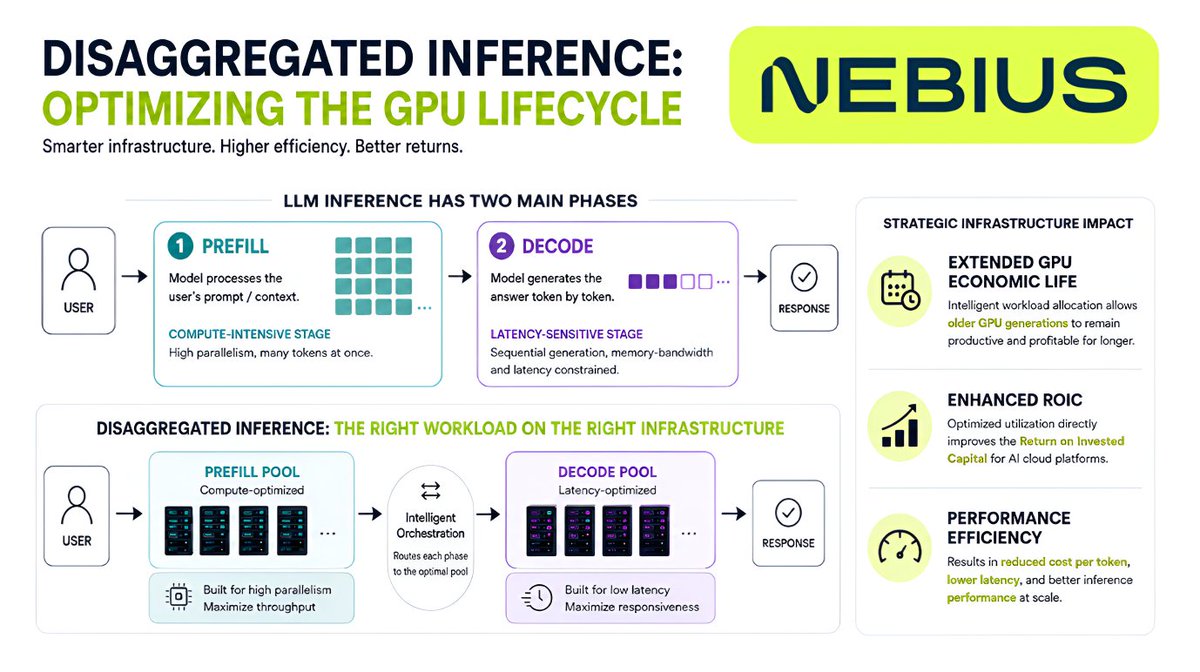
LLM inference has two main phases:
Prefill, when the model processes the user’s prompt/context.
Decode, when the model generates the answer token by token.
The important point is that these two phases stress infrastructure differently.
Prefill is more compute-intensive and benefits from processing many tokens in parallel, while decode is more latency-sensitive and often more memory-bandwidth constrained.
Disaggregated inference separates these workloads, allowing different infrastructure pools to be optimized for each stage.
Why does this matter?
Because it can improve GPU utilization, reduce cost per token, lower latency, and make inference more efficient at scale.
All of this can also help extend each GPU’s economic useful life.
Same old story...
As new GPU generations come out, older GPUs may become less attractive for cutting-edge training. But that doesn’t mean they become useless.
If $NBIS can intelligently allocate different parts of inference workloads across different types of hardware, older GPUs can remain productive for longer.
That has direct implications for ROIC.
In my view, this is exactly the kind of infrastructure-level optimization that separates a serious AI cloud platform from a simple GPU capacity reseller.
As I’ve been saying since the beginning, building a sustainable AI cloud isn’t just about plugging GPUs into electricity, and this is a good example of that.
$NBIS' engineering advantage is what can make this type of optimization possible.
Mark my words, Nebius will be the first Trillion dollar Neo-cloud company and here is why (Save this).
Roman Chernin, CEO of Nebius just said on 20VC that Nebius raised prices and demand didn't move.
When a company can raise prices and still have more demand than supply, that's the opportunity.
Chernin also explained why he is deliberately not charging the maximum.
As AI shifts from training, a one time cost to inference, which is the ongoing cost of serving every user and every query, compute pricing becomes the cost structure of the entire AI economy.
If Nebius prices customers out, those customers cannot grow, and Nebius cannot grow with them.
That is the compounding flywheel built directly into the revenue model.
The numbers are already confirming it.
Q1 2026 revenue came in at $399 million, up 684% year over year.
The AI cloud segment grew 840% and represented 98% of total revenue. Adjusted EBITDA flipped positive to $129.5 million.
And Nebius signed a long-term agreement with Meta worth up to $27 billion over five years, a hyperscaler outsourcing its own AI compute stack to a neocloud, which tells you that even companies with $50 billion capex budgets cannot build fast enough.
Goldman Sachs says the consensus is underestimating 2027 hyperscaler capex by $500 billion.
Every dollar hyperscalers cannot provision themselves flows to neoclouds like Nebius.
As that gap widens, Nebius captures the overflow with 3 gigawatts of contracted power already secured and a CEO who just told you raising prices did not dent demand.
Our subscribers are already up massively on Nebius and come join Milk Road Pro for our full breakdown, how to size Nebius against the broader neocloud opportunity, and our full AI thesis.
Link below!
Markets are volatile again. I've seen this before. No change to strategy. I invest only what I can afford to leave alone, I'm comfortable with my risk, and I know exactly what I own.
No panic. I'll be adding to positions at attractive entries. My stocks list to top-up:
1. NVDIA $NVDA
2. Micron $MU
3. Nebius $NBIS
4. TSMC $TSM
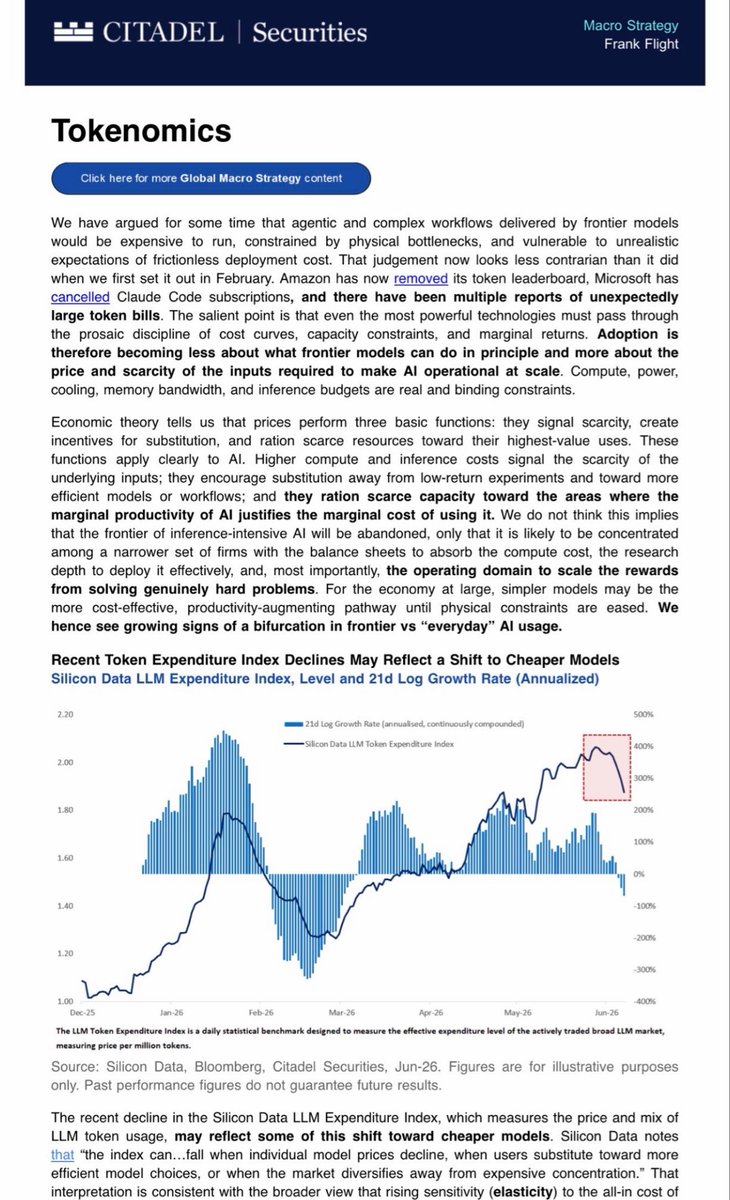
Citadel just released its Tokenomics research. Worth a read for all semis and software investors on X.
According to Citadel, the best returns will come from companies that lower Ai costs and improve efficiency, not those building the best models.
- AI is hitting economic limits. Citadel's message is that the constraint is no longer model capability—it's token costs, compute, power, and inference budgets.
- Customers are already optimizing for cost. Rising token bills are pushing users toward cheaper models and more efficient workflows, suggesting AI demand may be more price-sensitive than investors assume.
Jim Cramer says he is pulling back on $NBIS after the market turned ugly saying Nebius no longer has the right setup for speculation.
He was even more blunt on $ONDS calling it a “meme stock” and saying he cannot get behind it.
What just happened?
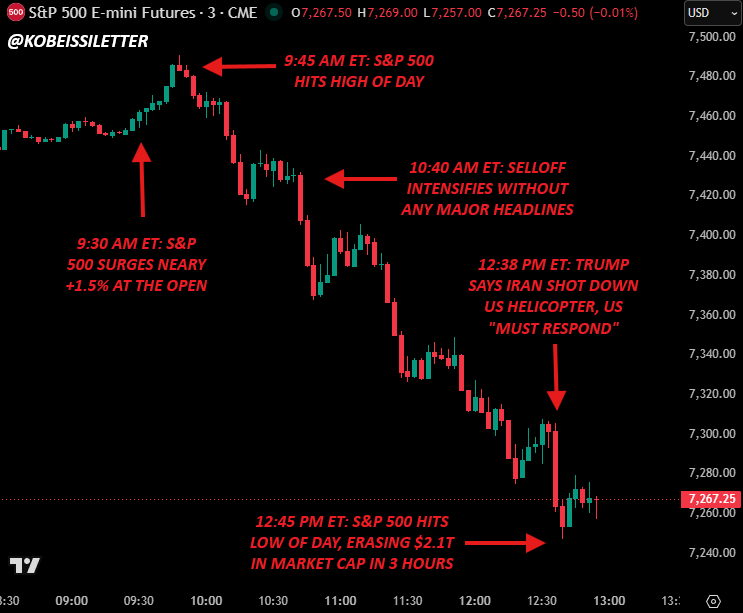
At 9:45 AM ET, the S&P 500 was trading nearly +1.5% higher and tech stocks were sharply higher.
At 10:40 AM ET, selling pressure began to intensify without any major headlines in one of the biggest reversals of the year.
Just 2 hours later, President Trump said Iran shot down a US helicopter "last night" and that the US must "respond to this attack."
This sent the S&P 500 to a new low of the day, down 240 points since 9:45 AM ET.
In just 3 hours, the S&P 500 has erased -$2.1 trillion in market cap.
Volatility is back.
Steve Schwarzman started Blackstone with $400,000 - mailed 488 fundraising documents - the first 17 said no
person number 18 said yes - he raised $850 million
his first deal made 16x - his second made 24x - Hilton made $12 billion, the most profitable buyout in history
Mike Bloomberg offered him 20% of his company for $100 million - Schwarzman wanted in but his fund structure wouldn't allow it - that stake today would be worth $8 billion
today Blackstone manages $333 billion
bookmark and watch the full interview ↓
Stocks holdings I bought these past days:
$MU top-up at $888 (lucky number!)
$PL at $32.59 (new position)
$CRDO at $209.50 (new position)
$AAOI at $182.50 (new position)
$OUST at $41 (new position)
$NVD3 at £45.42 (new position)
Nebius has announced an investment of £1.7 billion to build out capacity in the UK with three new deployments of NVIDIA infrastructure.
The three new sites will deploy the latest generations of NVIDIA’s full-stack, end-to-end AI factory platform technology and combined will reach 65 MW when fully ramped up in 2027.
In addition to the capacity investment, Nebius is expanding its commercial and AI R&D hub in London and establishing local partnerships with universities and research institutions through Nebius Academy.
Arkady Volozh, founder and CEO of Nebius, said:
"The UK is one of the places where AI is being built, deployed, and adopted at the same time — by startups, by enterprises, and by the public sector. The work is happening here and the demand is here. And we are also here for the long run."
Read the full press release: https://t.co/sihQhjU8Ow